A sufficient theorem is dominated differentiation under the integral sign. Let be interior to a parameter interval, suppose is measurable for each , and suppose is integrable. Assume is differentiable near for outside one fixed null set, and that throughout this neighborhoodfor one nonnegative Lebesgue integrable function . Then is defined near , is differentiable at , andIndeed the mean value theorem bounds both by and the difference quotient by . The first bound proves local integrability; the second lets the dominated convergence theorem pass the limit of difference quotients through the integral.
Fix . The mean value theorem for the exponential givesConsequentlyThe function is continuous on and hence measurable, so is Lebesgue integrable for every real . In particular, the numerator cancels the apparent singularity at zero: as . Only the integrable square-root singularity at one remains. At the function is identically zero.
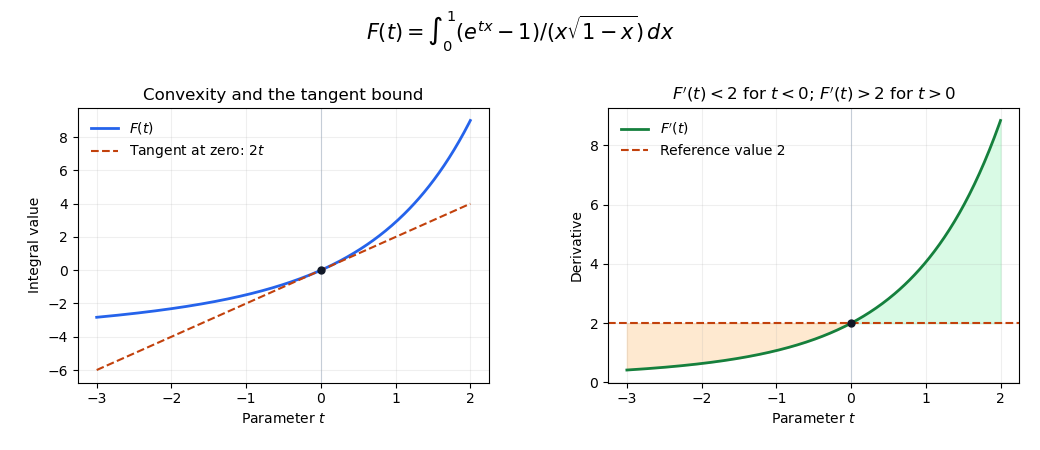
Fix any real and restrict to . The parameter derivative isThis bound is integrable on and is uniform throughout the parameter neighborhood. Part (ii) supplied integrability at , so dominated differentiation under the integral sign proves differentiability there. As was arbitrary,For , ; for , . Since , these comparisons giveThe first two inequalities are actually strict, because the exponential differs strictly from one throughout . Differentiating once more under the same type of bound gives . Hence is strictly convex and lies above its tangent at zero. These properties are collected in exponential integral with a square-root endpoint singularity.

Articles by others on the same topic
There are currently no matching articles.