A sufficient theorem is dominated differentiation under the integral sign. Let be interior to a parameter interval, suppose is measurable for each , and suppose is integrable. Assume is differentiable near for outside one fixed null set, and that throughout this neighborhoodfor one nonnegative Lebesgue integrable function . Then is defined near , is differentiable at , andIndeed the mean value theorem bounds both by and the difference quotient by . The first bound proves local integrability; the second lets the dominated convergence theorem pass the limit of difference quotients through the integral.
Fix . The mean value theorem for the exponential givesConsequentlyThe function is continuous on and hence measurable, so is Lebesgue integrable for every real . In particular, the numerator cancels the apparent singularity at zero: as . Only the integrable square-root singularity at one remains. At the function is identically zero.
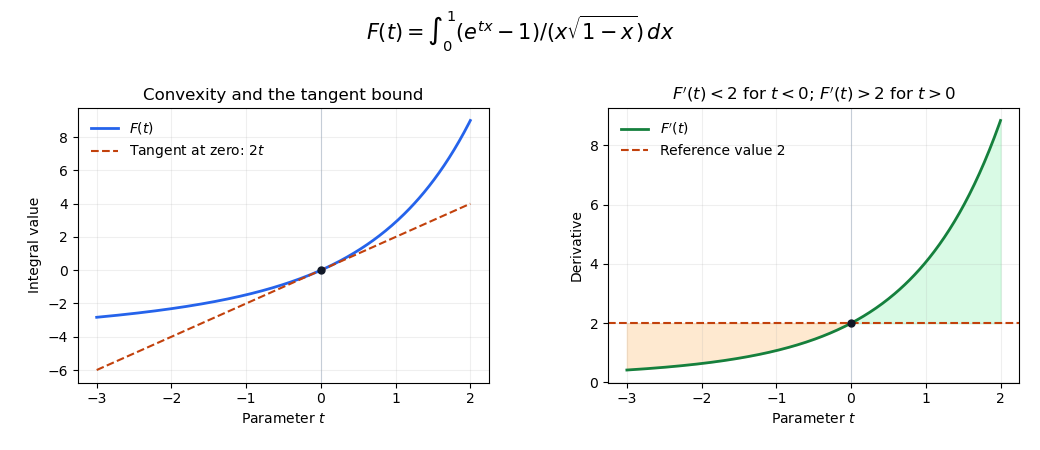
Fix any real and restrict to . The parameter derivative isThis bound is integrable on and is uniform throughout the parameter neighborhood. Part (ii) supplied integrability at , so dominated differentiation under the integral sign proves differentiability there. As was arbitrary,For , ; for , . Since , these comparisons giveThe first two inequalities are actually strict, because the exponential differs strictly from one throughout . Differentiating once more under the same type of bound gives . Hence is strictly convex and lies above its tangent at zero. These properties are collected in exponential integral with a square-root endpoint singularity.

On sigma-finite measure spaces, including the real line with Lebesgue measure, Tonelli's theorem says that a nonnegative measurable function has equal product and iterated integrals:with infinity allowed. Finiteness is not a prerequisite.
Fubini's theorem says that if a measurable signed or complex is absolutely integrable on the product, then its sections are integrable for almost every value of the other variable, the iterated integral functions are integrable, and the same equalities hold with finite values. For completed Lebesgue measure, exceptional sections need not themselves be measurable; the integrals use the almost-everywhere defined sections. Thus Tonelli can first establish absolute integrability using , after which Fubini permits changing the order for .
Because is continuous, is continuous on , so is a nonnegative measurable function. Apply Tonelli's theorem before assuming integrability. For each fixed , set , so . Lebesgue substitution on an interval givesTherefore the Gaussian integral yieldsThis proves that is Lebesgue integrable on . Fubini's theorem now permits changing the order for itself. The same substitution without absolute values gives the stronger exact identityTaking absolute values and using the triangle inequality for an integral provesThe constant is sharp: any nonzero nonnegative continuous integrable gives equality. This is a weighted dilation kernel with and . The inner integral in the requested order is guaranteed to be integrable for almost every , which is all the iterated integral requires.
Articles by others on the same topic
There are currently no matching articles.