Write and , with the top wire carrying , the middle wire , and the bottom wire the ancilla bit . The binary inner product is , where is exclusive or. Let denote a CNOT gate controlled by wire and targeting . The four linear Boolean functions and their Boolean quantum oracles are:
| Reversible circuit for | : three unchanged wires |
|---|
The CNOT gates in the last row commute: their common target acquires the exclusive or of the two controls. Each input wire is preserved, and applying any of these reversible circuits twice restores .
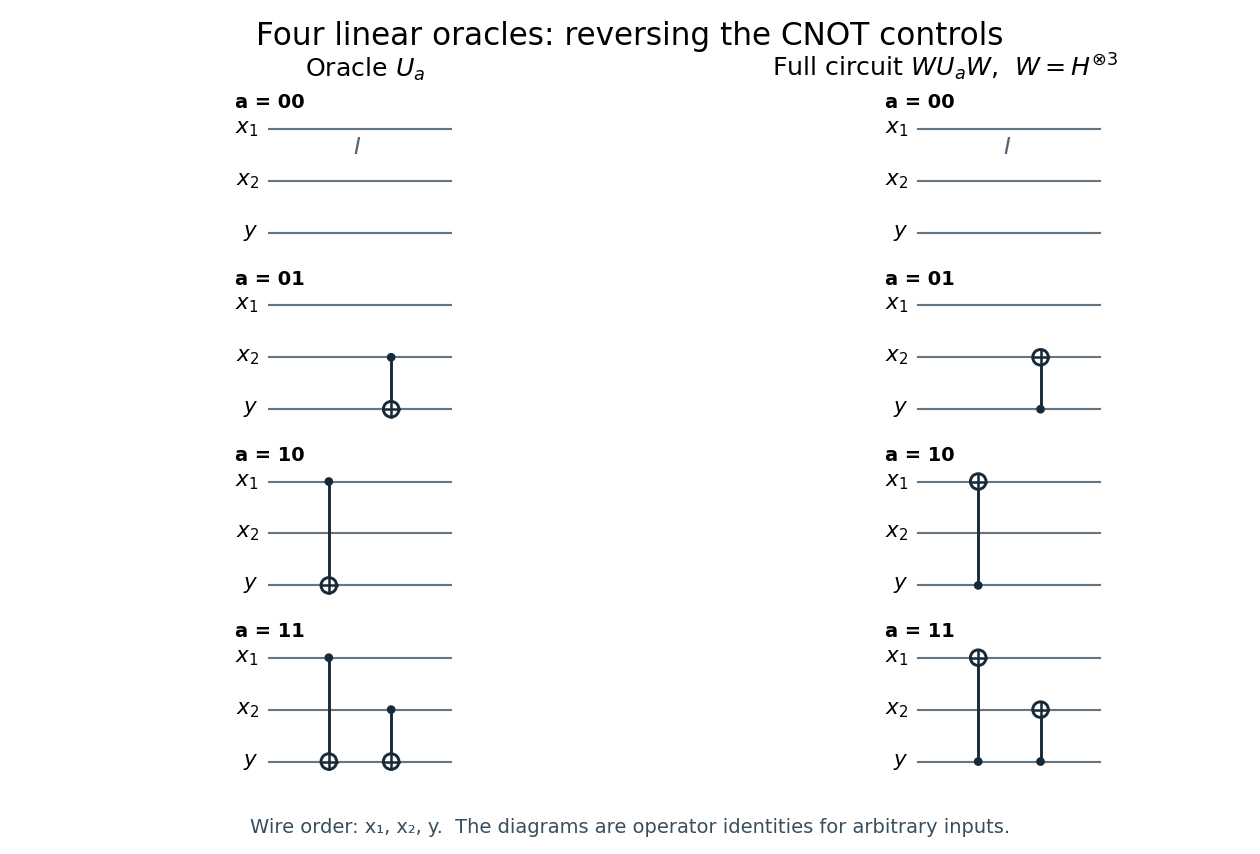
The four two-bit linear oracles and their exact simplifications after Hadamard gates on all three wires; a filled dot is a control and a circled plus is a target
. Details. 
For classical reversible computation, call the unknown function oracle on and . The resulting ancilla bits are respectively and :Use a fresh zero ancilla bit for each call, or preserve the first result in workspace before restoring the target to zero. Thus two classical calls determine the two-bit string.
For input bits, query the standard basis strings , since . This gives an upper bound of calls. It is also optimal for exact identification: every classical query reveals at most one new bit, since is unchanged and reveals just when is known. A depth- decision tree has at most answer histories, but must distinguish possible hidden strings. Hence , including adaptive strategies. The classical query complexity of linear Boolean function identification is therefore
Articles by others on the same topic
There are currently no matching articles.