The held files are question extracts attributed to 2010 by Oxford's C2 support-page records. They do not establish a full examination paper or its historical stage.
Source extract: users.physics.ox.ac.uk/~Foot/C2/pdf/C22010Q6.pdf
The Oxford C2 support-page record attributes this extract to 2010. The held page prints the question number and identifiers above, but no year, examination stage or sitting date.
Write and , with the top wire carrying , the middle wire , and the bottom wire the ancilla bit . The binary inner product is , where is exclusive or. Let denote a CNOT gate controlled by wire and targeting . The four linear Boolean functions and their Boolean quantum oracles are:
| Reversible circuit for | : three unchanged wires |
|---|
The CNOT gates in the last row commute: their common target acquires the exclusive or of the two controls. Each input wire is preserved, and applying any of these reversible circuits twice restores .
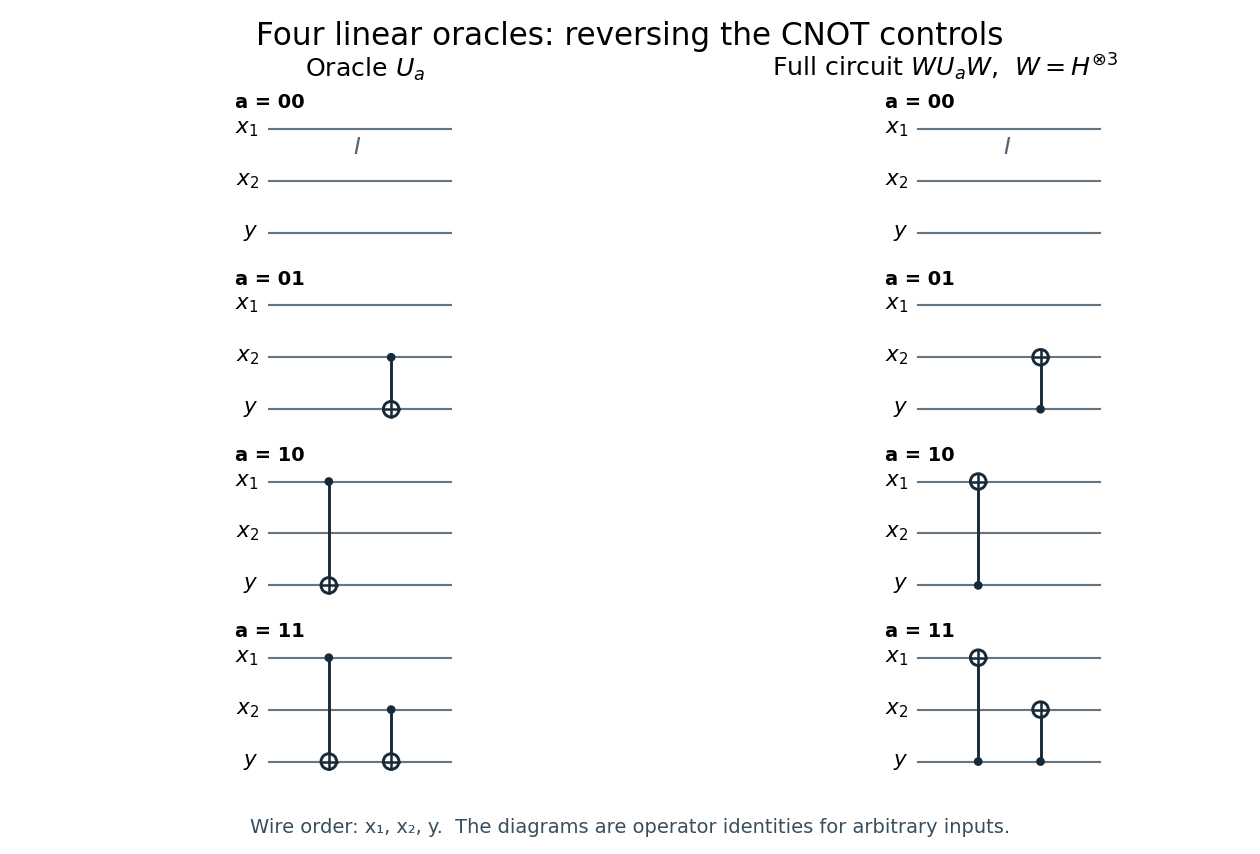
The four two-bit linear oracles and their exact simplifications after Hadamard gates on all three wires; a filled dot is a control and a circled plus is a target
. Details. 
For classical reversible computation, call the unknown function oracle on and . The resulting ancilla bits are respectively and :Use a fresh zero ancilla bit for each call, or preserve the first result in workspace before restoring the target to zero. Thus two classical calls determine the two-bit string.
For input bits, query the standard basis strings , since . This gives an upper bound of calls. It is also optimal for exact identification: every classical query reveals at most one new bit, since is unchanged and reveals just when is known. A depth- decision tree has at most answer histories, but must distinguish possible hidden strings. Hence , including adaptive strategies. The classical query complexity of linear Boolean function identification is therefore
Use the Hadamard basis states . The Hadamard gate satisfies , , and . After the first three Hadamard gates, the full quantum state isThe Pauli X gate obeys . Consequently the Boolean quantum oracle produces phase kickback:Factoring out the ancilla qubit, the four states immediately after the function oracle areThe final Hadamard gates send to and to . In particular, the printed quantum circuit includes a final Hadamard gate on the ancilla qubit too. Its full outputs, ordered as , areThus one oracle call identifies with certainty: a computational-basis measurement of the first two qubits returns . The ancilla qubit returns to and carries no additional information about . The Bernstein-Vazirani algorithm turns the pattern of relative quantum phases into a definite computational-basis state.
The required identity is CNOT control reversal in the Hadamard basis. To derive it using standard quantum circuit identities, let be the Controlled-Z gate, which multiplies by and fixes the other computational-basis states. Since ,The Controlled-Z gate is symmetric in its two wires. Combining this symmetry with givesThis is an exact operator identity, including its global phase, and applies to arbitrary inputs. One can also check it directly from the orthogonal projectors : conjugating by gives
For the three-wire quantum circuit, put . Conjugation distributes over products because : . Each CNOT gate in therefore reverses direction, while the Hadamard gates on untouched wires cancel. The Hadamard-conjugated linear oracle isThese are the simplified quantum circuits in the figure: for there are no gates; for there is ; for there is ; and for there are both. The ancilla qubit becomes their common control. On every computational-basis state, the entire simplified circuit acts asStarting the data qubits at , the prescribed computational basis preparation of the ancilla qubit must therefore be : it activates the required flips and gives . Starting it at instead gives for every , so no information is obtained.
More generally, an initial ancilla qubit state in this same fixed quantum circuit givesFor nonzero , the desired data output has probability , and exact identification for every requires . This condition refers to the displayed ancilla preparation for the Bernstein-Vazirani algorithm: the state entering the function oracle must be , up to global phase. Other quantum state preparation procedures that deliver this same state are equivalent; is the prescribed input before the first Hadamard gate.
For arbitrary , linearity of the linear Boolean function suppliesThis decomposition is for analysis: the Bernstein-Vazirani algorithm calls the unknown function oracle as one supplied operation. The common control starts at , so the simplified quantum circuit takes to . Equivalently, phase kickback gives a product statewhich the final Hadamard transform decodes to . Thus one quantum oracle call suffices for every , compared with classical calls. This counts function oracle uses; the surrounding Hadamard gates and final computational-basis measurement still act on and qubits, respectively.
Source extract: users.physics.ox.ac.uk/~Foot/C2/pdf/C22010Q8.pdf
The Oxford C2 support-page record attributes this extract to 2010. The held page prints the question number and identifiers above, but no year, examination stage or sitting date.
The beta barium borate crystal supplies spontaneous parametric down-conversion: a weak ultraviolet pump can produce a pair of lower-frequency photons, with their frequencies and wavevectors selected by conservation of energy and phase matching. A suitably aligned and compensated source makes the two polarization alternatives coherent, giving the stated Bell state. The crystal alone does not guarantee that every collected pair has that state.
The two polarizing beam splitters route horizontal polarization and vertical polarization to different ports. Take from arm to the trigger and to arm . The ordinary beam splitter in arm is a lossless, polarization-independent 50:50 splitter, with the unused input in the vacuum state. It splits probability amplitudes, rather than measuring which output a photon takes. The half-wave plate changes the relative phase of its principal polarizations by ; orient it so that a photon in becomes in , up to a common phase. Finally, photodetectors absorb arriving photons and supply electrical clicks. They need not resolve photon number for the ideal four-photon, fourfold-coincidence calculation: a click at every detector already requires one photon at each.
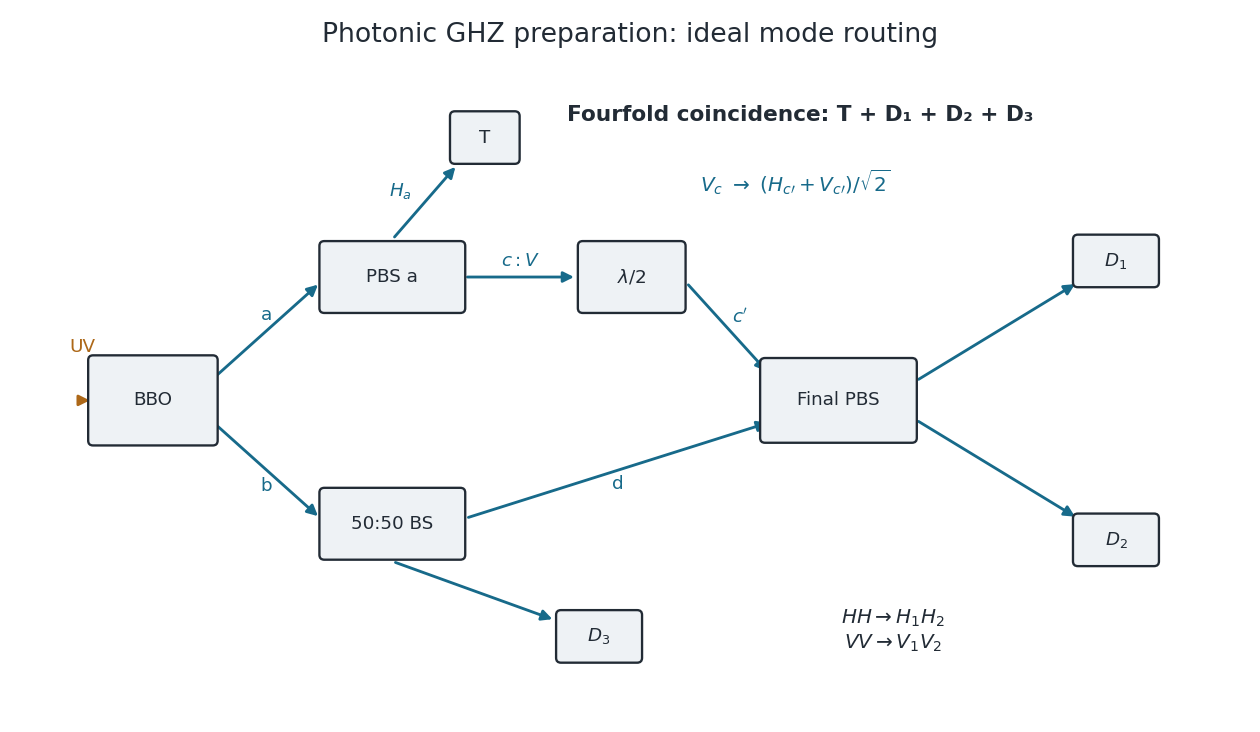
Original mode diagram for photonic GHZ preparation by fourfold coincidence
. The paths and polarization conventions used in the calculation. PBS denotes a polarizing beam splitter; BS is a polarization-independent 50:50 beam splitter. A trigger click alone does not guarantee the required one-photon occupation of all three other outputs. Details.
Choose the relative wave phases so that the final polarizing beam splitter sends to , to , to and to . Such phase conventions must be used consistently: an uncompensated relative phase would give a phase-shifted GHZ state.
Use the two-pair component of polarization-entangled down-conversion to account for identical bosons in the same collected modes. Write for a creation operator in mode with horizontal polarization, and similarly for the other modes. For the plus Bell state, the pair-creation operator is . The normalized four-photon state isThese are normalized Fock states. In particular, ; omitting this factor would misnormalize the four-photon input.
The first polarizing beam splitter sends to and to . Only the middle term can give exactly one trigger photon and leave another photon in . In the first term both photons reach and none reaches ; in the last there is no trigger. Thus the relevant, still unnormalized component is
For the selected paths of the half-wave plate and beam splitter, takeHere labels the output towards . An immaterial common reflection phase has been absorbed in the mode definitions. Keeping one photon at leavesAt the final polarizing beam splitter, the alternative yields one at each of , while yields one at each. The two opposite-polarization alternatives send both photons to the same detector and fail fourfold coincidence counting. The accepted component is thereforeAfter conditioning and normalization, the three detected output modes haveThe optical mode matching must erase any timing, frequency or other record that distinguishes the two alternatives. Otherwise the same polarization populations could describe an incoherent mixed quantum state, rather than this quantum superposition. The Bouwmeester three-photon GHZ experiment uses this principle. The photonic GHZ preparation by fourfold coincidence is a measurement in the coincidence basis: detecting all four photons projects and consumes them. A click at by itself does not herald a guaranteed freely available three-photon state.
The optical success probability of a fourfold GHZ source depends on the photon-number statistics of the assumed two-pair input. Let be the probability that arm contains one and one , given two pairs. The beam splitter then puts one of the two photons into each output with probability , and the final polarization-parity selection succeeds with probability . With ideal photodetectors,For the normalized, fully overlapping two-pair component of polarization-entangled down-conversion used above, , so the squared norm of the accepted component gives . Treating the two emissions instead as independently labelled Bell pairs gives the commonly used bookkeeping estimate and . This is a different pair-statistics approximation; it must not be obtained by dropping labels from an input state without renormalizing it. Genuine GHZ state coherence additionally requires erasing information about the pair of origin.
Let be the two-pair probability per pulse and the pulse repetition rate. The coincidence rate is . With the usual order-of-magnitude estimate , the supplied and give . The fully overlapping model gives , about one event per twelve seconds; independent-pair bookkeeping gives , about one per eight seconds. Thus the estimate is of order under these idealizations.
An exact prefactor cannot follow from the single-pair probability alone. For example, the pair-number statistics of polarization-entangled down-conversion in a single collected mode pair give at weak gain, and hence with . Multiple temporal or spectral modes change those statistics. Real collection losses and detector efficiencies further reduce the rate; they are excluded by the ideal calculation.
Articles by others on the same topic
There are currently no matching articles.