Source extract: users.physics.ox.ac.uk/~Foot/C2/pdf/C22010Q6.pdf
The Oxford C2 support-page record attributes this extract to 2010. The held page prints the question number and identifiers above, but no year, examination stage or sitting date.
Write and , with the top wire carrying , the middle wire , and the bottom wire the ancilla bit . The binary inner product is , where is exclusive or. Let denote a CNOT gate controlled by wire and targeting . The four linear Boolean functions and their Boolean quantum oracles are:
| Reversible circuit for | : three unchanged wires |
|---|
The CNOT gates in the last row commute: their common target acquires the exclusive or of the two controls. Each input wire is preserved, and applying any of these reversible circuits twice restores .
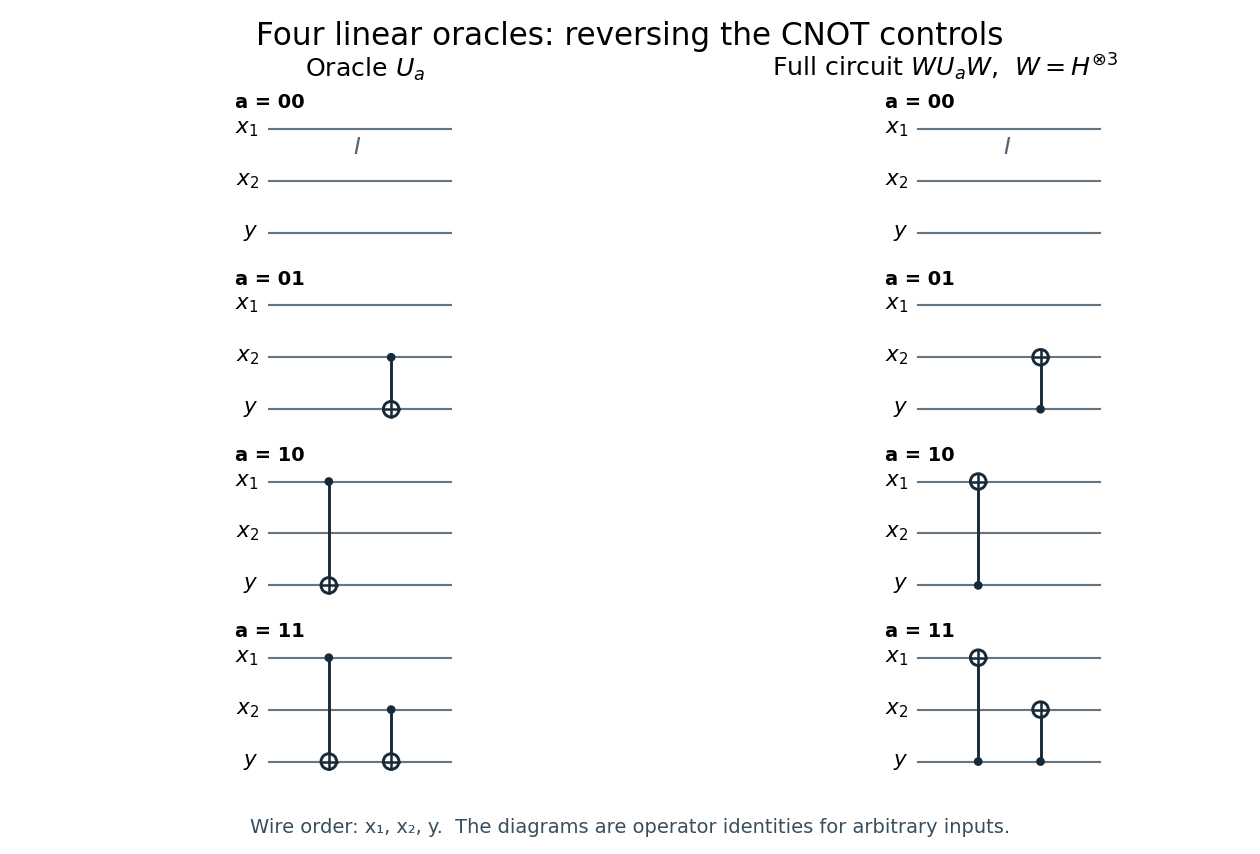
The four two-bit linear oracles and their exact simplifications after Hadamard gates on all three wires; a filled dot is a control and a circled plus is a target
. Details. 
For classical reversible computation, call the unknown function oracle on and . The resulting ancilla bits are respectively and :Use a fresh zero ancilla bit for each call, or preserve the first result in workspace before restoring the target to zero. Thus two classical calls determine the two-bit string.
For input bits, query the standard basis strings , since . This gives an upper bound of calls. It is also optimal for exact identification: every classical query reveals at most one new bit, since is unchanged and reveals just when is known. A depth- decision tree has at most answer histories, but must distinguish possible hidden strings. Hence , including adaptive strategies. The classical query complexity of linear Boolean function identification is therefore
Use the Hadamard basis states . The Hadamard gate satisfies , , and . After the first three Hadamard gates, the full quantum state isThe Pauli X gate obeys . Consequently the Boolean quantum oracle produces phase kickback:Factoring out the ancilla qubit, the four states immediately after the function oracle areThe final Hadamard gates send to and to . In particular, the printed quantum circuit includes a final Hadamard gate on the ancilla qubit too. Its full outputs, ordered as , areThus one oracle call identifies with certainty: a computational-basis measurement of the first two qubits returns . The ancilla qubit returns to and carries no additional information about . The Bernstein-Vazirani algorithm turns the pattern of relative quantum phases into a definite computational-basis state.
The required identity is CNOT control reversal in the Hadamard basis. To derive it using standard quantum circuit identities, let be the Controlled-Z gate, which multiplies by and fixes the other computational-basis states. Since ,The Controlled-Z gate is symmetric in its two wires. Combining this symmetry with givesThis is an exact operator identity, including its global phase, and applies to arbitrary inputs. One can also check it directly from the orthogonal projectors : conjugating by gives
For the three-wire quantum circuit, put . Conjugation distributes over products because : . Each CNOT gate in therefore reverses direction, while the Hadamard gates on untouched wires cancel. The Hadamard-conjugated linear oracle isThese are the simplified quantum circuits in the figure: for there are no gates; for there is ; for there is ; and for there are both. The ancilla qubit becomes their common control. On every computational-basis state, the entire simplified circuit acts asStarting the data qubits at , the prescribed computational basis preparation of the ancilla qubit must therefore be : it activates the required flips and gives . Starting it at instead gives for every , so no information is obtained.
More generally, an initial ancilla qubit state in this same fixed quantum circuit givesFor nonzero , the desired data output has probability , and exact identification for every requires . This condition refers to the displayed ancilla preparation for the Bernstein-Vazirani algorithm: the state entering the function oracle must be , up to global phase. Other quantum state preparation procedures that deliver this same state are equivalent; is the prescribed input before the first Hadamard gate.
For arbitrary , linearity of the linear Boolean function suppliesThis decomposition is for analysis: the Bernstein-Vazirani algorithm calls the unknown function oracle as one supplied operation. The common control starts at , so the simplified quantum circuit takes to . Equivalently, phase kickback gives a product statewhich the final Hadamard transform decodes to . Thus one quantum oracle call suffices for every , compared with classical calls. This counts function oracle uses; the surrounding Hadamard gates and final computational-basis measurement still act on and qubits, respectively.
Articles by others on the same topic
There are currently no matching articles.