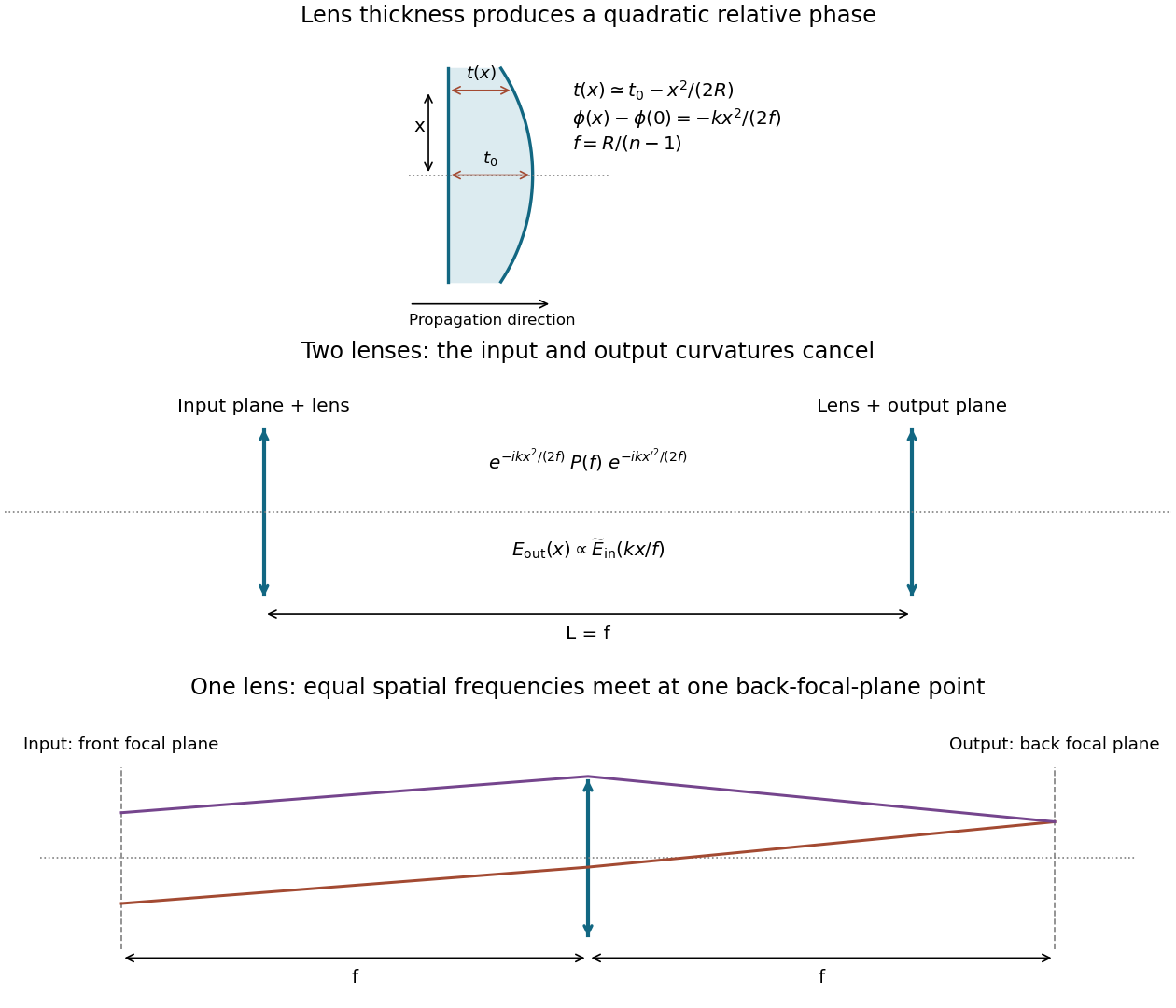
Measure the phase relative to propagation through the same geometrical thickness of air. If the lens's central thickness is , its spherical surface givesThe optical-path excess is , so the phase imparted by the lens isThe constant part is a spatially uniform phase. The physically important lens transmission is therefore withOne way to identify the focus is to append propagation to the on-axis point a distance away. Its path phase has the paraxial contribution , which cancels the lens phase. Thus all incident portions of a plane wave add with the same phase at that point. The diagram below shows the thickness change and both Fourier-transform arrangements.

Articles by others on the same topic
There are currently no matching articles.