Let . At the port that is bright for zero delay, the ideal 50:50 Michelson interferometer givesEach arm has field amplitude one half after two beam-splitter interactions. For , approximate both real Gaussian envelopes by while retaining their rapidly varying phases. Put and . The identity giveswhereA delay-dependent constant overall phase can be shifted by a port convention, but the expression above follows directly from the specified bright-port sum.
The output intensity is a Gaussian envelope modulated by a squared cosine:The modulation maxima are separated byThis is the spacing of resolved adjacent pulse peaks when the envelope changes little over a modulation period, requiring . The source's assumption alone does not ensure several visible peaks: a weakly chirped pulse may show only one broad maximum. At the output is the original pulse and the modulation-spacing formula has no finite-peak interpretation. The figure compares the exact bright-port field sum with the small-delay approximation.
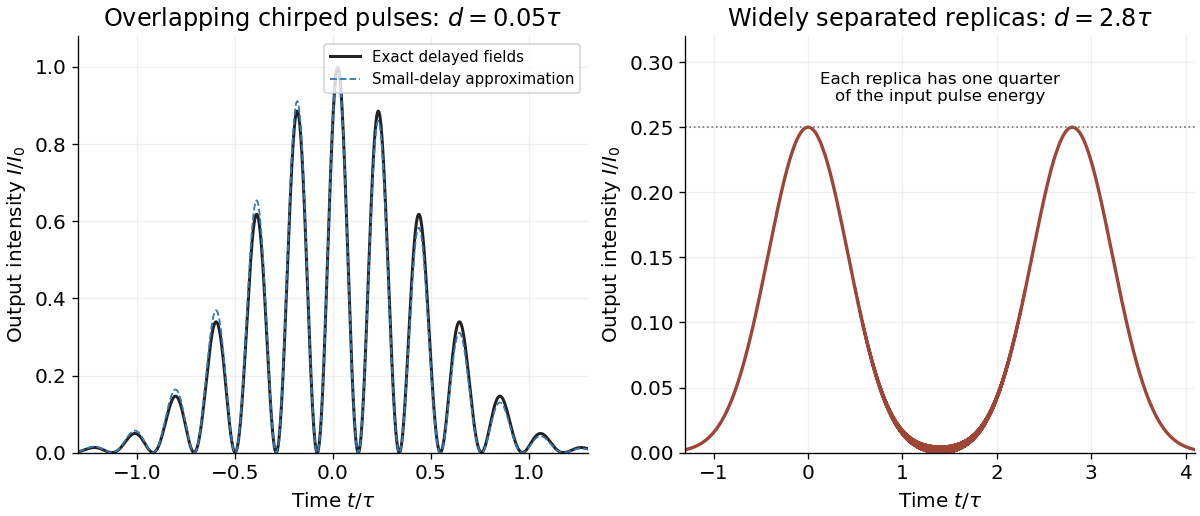
Temporal interference of chirped pulses at small and large Michelson delays
. Details. 
Articles by others on the same topic
There are currently no matching articles.