Source paper: www.whatdotheyknow.com/request/oxford_physics_past_papers_2/response/2340696/attach/6/Physics%20Papers%202017.pdf?cookie_passthrough=1. The cover identifies C2 on 11 June 2018; the annual bundle's 2017 filename does not determine the examination year. All six questions are solved. Optical fields use time dependence ; quantum pulse sequences are applied from left to right as specified in the source.
Write the optical system's spectral response as . Expanding its spectral phase around the pulse's central angular frequency givesThe group delay is , with units of time. The linear spectral phase term delays the pulse envelope by this amount. The group delay dispersion is , with units of time squared. It makes the group delay frequency dependent: . Positive group delay dispersion delays higher frequencies more and gives positive chirp. A nonzero quadratic spectral phase broadens an initially transform-limited pulse; applied to an already chirped pulse, a suitable opposite sign can compress it.
In chirped pulse amplification, an ultrashort seed pulse first passes through a dispersive stretcher, often a grating-based system. This correlates frequency with arrival time and increases pulse duration while approximately preserving pulse energy, thereby lowering peak intensity. An optical amplifier can then increase pulse energy without exposing the gain medium to the original short pulse's enormous peak intensity, reducing optical damage and unwanted nonlinear phase accumulation. A final dispersive compressor, typically using gratings, cancels the accumulated spectral phase to recover a short, high-energy pulse. The essential components are therefore a short-pulse source, stretcher, amplifier and matched compressor; spectral gain bandwidth and higher-order dispersion limit the achievable compression.
The temporal intensity is proportional to the squared field modulus:Its half-maximum points satisfy , so the intensity full width at half maximum isWith the chosen convention, the instantaneous angular frequency is minus the time derivative of the field's argument. HenceA localized Gaussian requires . It is positively chirped precisely when , or ; gives no chirp and gives negative chirp.
Let . At the port that is bright for zero delay, the ideal 50:50 Michelson interferometer givesEach arm has field amplitude one half after two beam-splitter interactions. For , approximate both real Gaussian envelopes by while retaining their rapidly varying phases. Put and . The identity giveswhereA delay-dependent constant overall phase can be shifted by a port convention, but the expression above follows directly from the specified bright-port sum.
The output intensity is a Gaussian envelope modulated by a squared cosine:The modulation maxima are separated byThis is the spacing of resolved adjacent pulse peaks when the envelope changes little over a modulation period, requiring . The source's assumption alone does not ensure several visible peaks: a weakly chirped pulse may show only one broad maximum. At the output is the original pulse and the modulation-spacing formula has no finite-peak interpretation. The figure compares the exact bright-port field sum with the small-delay approximation.
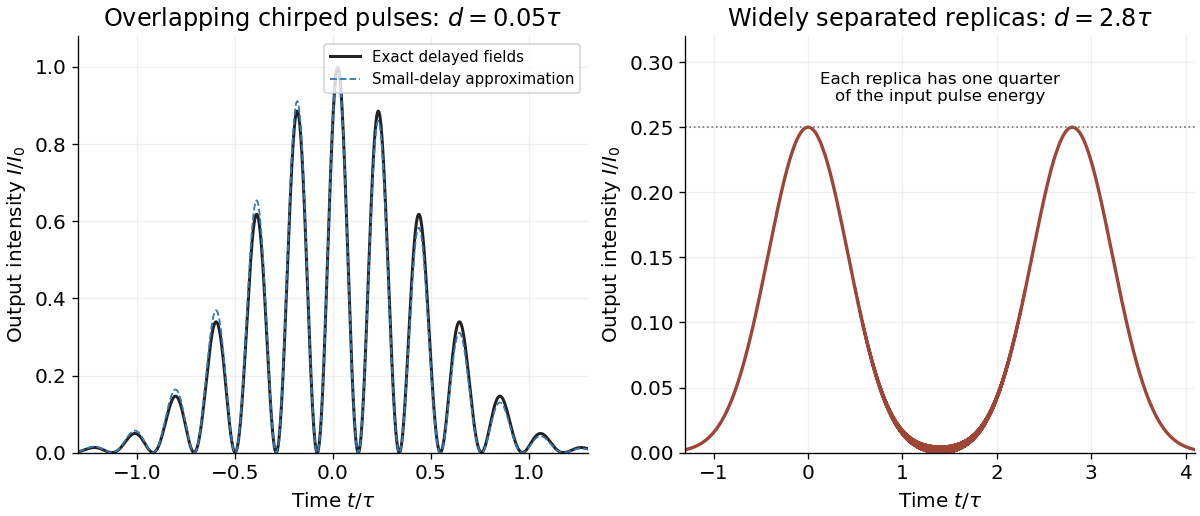
Temporal interference of chirped pulses at small and large Michelson delays
. Details. A time delay multiplies the spectral field by . The bright-port transfer function is thereforeThe spectral transmission maxima have angular frequency spacing . For a strongly chirped pulse the local frequency-time mapping is . Thus the filter's adjacent transmitted frequency bands emerge at times separated byas obtained directly from the temporal fields. The spectral transfer function itself is exact; mapping its features directly onto time requires a sufficiently strong chirp and overlapping envelopes.
As approaches the pulse duration, the two envelopes overlap only partly and the small-delay formula fails. For , the selected port contains two separate replicas of field amplitude , each with one quarter of the input pulse energy. Their combined energy is half the input; the other output port carries the remainder. There is no temporal overlap or corresponding time-resolved interference. A sufficiently resolving spectrometer can still reveal fine spectral fringes, whose spacing decreases as .
Represent a paraxial ray by its height and forward slope , with . Free-space propagation leaves the slope unchanged and increases height by , givingA thin lens leaves the ray height unchanged. A parallel incident ray at height must emerge toward the focal point, so its slope changes by . By linearity, the same increment applies to any paraxial incident slope:These ray transfer matrices have determinant one in air and compose in reverse matrix order to the physical order of traversal.
Use the forward-slope convention established in part a, with and , where . Assume . Solve for the endpoint slopes:Fermat's principle makes the optical path stationary against variations at internal interfaces. Consequently only endpoint terms survive when its endpoints change. For optical path , these areIntegrate the first equation with respect to , then match the second and impose . The resulting ABCD optical path generating function isThus the geometrical kernel defined in the source would have the formThe printed minus sign is inconsistent with forward propagation under these conventions. A concrete counterexample is free space: , , . Its true geometrical path iswhereas the printed expression predicts a path shorter than for nonzero transverse separation. For example, , , gives , rather than the printed . Reversing the slope convention would also reverse the free-space entry and must be done consistently; it cannot justify the minus sign with from part a.
The printed form can be recovered by explicitly using the opposite slope coordinate . Then , free space has , and the same physical path is . Thus the sign can be a convention choice, but the printed minus sign must not be combined with the positive- free-space ray transfer matrix used here.
For physical field propagation, the paraxial diffraction kernel retains this quadratic optical-path phase while using the leading spreading amplitude. In one transverse dimension the normalized linear canonical transform iswith a consistent square-root branch and . The source's prefactor and kernel are a schematic one-dimensional version of the Fresnel-Kirchhoff diffraction integral, not this normalized general-system propagator. The quadratic denominator is normally replaced by its leading value when making the Fresnel approximation. When , propagation is an imaging limit rather than an ordinary integral with division by .
For the shown sequence of free space, thin lens, and free space, multiply the ray transfer matrices in traversal order:To obtain an ordinary Fourier transform of an arbitrary input field, neither an input quadratic phase nor an output quadratic phase may remain. Thus , requiringUsing the physically consistent kernel derived in part b givesThe spatial Fourier coordinate is . If the source's schematic integral normalization is retained instead, set its slowly varying denominator to to obtain the same Fourier transform with overall prefactor . Keeping the source's incorrect quadratic sign would reverse the Fourier coordinate. These overall-normalization conventions do not alter the focal-plane placement, but an unapproximated transverse-dependent denominator would not give an exact Fourier transform.
Take and . In the resonant Jaynes-Cummings model, the interaction connects only and . Both have free energy , and their interaction matrix is . ThereforeExponentiating this two-state block and applying it to yieldsThe populations undergo Rabi oscillations at angular frequency . The common phase in this fixed- block does not affect its probabilities, but it must be retained when blocks with different photon numbers are superposed.
Let the initial field be the normalized coherent state , where . The atom is again initially excited. Linearity of the Schrödinger equation givesThe different photon numbers have different Rabi frequencies, so the state generally becomes entangled between atom and field. It cannot in general be replaced by one Rabi-oscillating atomic state multiplied by an unchanged coherent state.
Project the field onto the five-photon number state. The excited-atom contribution comes from the initial block, while the ground-atom contribution comes from the initial block. The unnormalized conditional atomic state isThus the five-count probability and normalized post-measurement state areThe relative free-evolution phase is physically retained; it is absent only in an explicitly rotating atomic frame. The conditional state is defined when . In particular, an initial vacuum cannot produce five photons in this one-atom model, so that conditioning event has probability zero when .
The conditional probability of the atomic ground state is the squared ground-state amplitude divided by the five-photon event probability:For , , giving the equivalent expressionIt applies only when the conditioning denominator is nonzero. The distinct and factors reflect the two different initial photon-number blocks.
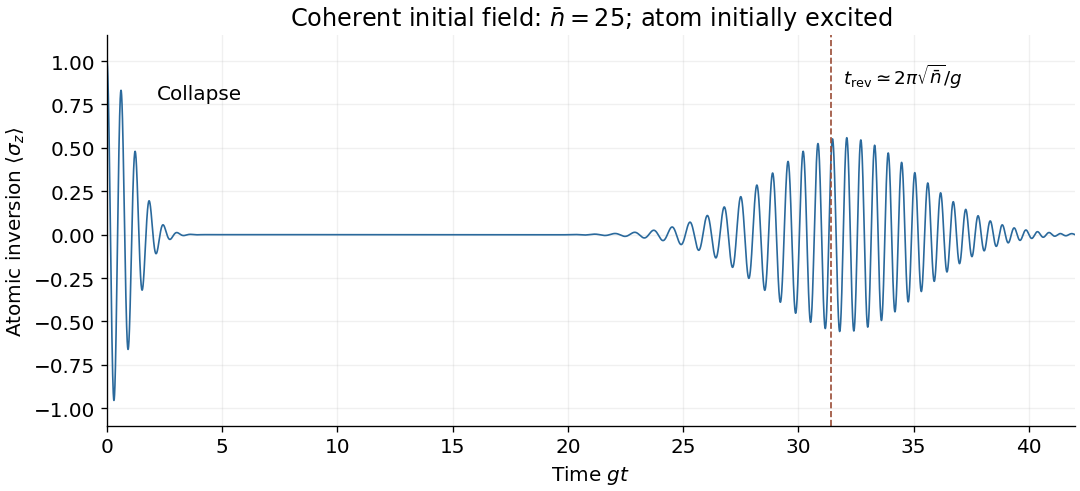
For , the Poisson distribution of photon number has width . Initially the atom therefore undergoes nearly classical Rabi oscillations at angular frequency approximately . However, the atomic inversion is a sum over slightly different frequencies:The components dephase, causing collapse of the visible Rabi oscillations on a time scale of order ; a Gaussian photon-number approximation gives an initial envelope approximately . Their discrete phases later rephase, giving revivals nearThe revival estimate follows by requiring the phase difference of neighbouring photon-number components to advance by . These Jaynes-Cummings collapse and revival effects arise from atom-field entanglement and photon-number discreteness. Large amplitude makes the initial classical description accurate over many Rabi periods, but does not eliminate quantum collapse and revival at all later times.
- It is an eigenstate of the annihilation operator, . Normally ordered field amplitudes therefore behave like a classical complex amplitude; normalized photon subtraction leaves the same state.
- Free harmonic evolution preserves its form, . The mean electric field follows a classical sinusoidal wave with an amplitude and phase set by .
- Its photon number has Poisson distribution, with and . Relative intensity fluctuations become small at large amplitude.
- Its optical quadratures and have minimum, balanced uncertainties, and . The fixed vacuum-scale fluctuation becomes small relative to the large phase-space displacement.
These properties identify a particular classical oscillation, rather than a state of definite photon number. Absolute quantum fluctuations remain even when their relative size is small.
A universal quantum gate set can approximate any unitary operation on any finite register, to arbitrary requested accuracy, using a finite sequence of its gates on the register. Unobservable overall global phase is ignored. Approximation matters: a fixed finite alphabet has only countably many finite circuits, whereas there are uncountably many exact unitary matrices.
The Hadamard gate and T gate generate a dense set of single-qubit operations, but cannot themselves entangle different qubits. Adding the controlled-NOT gate gives a universal multi-qubit set. More generally, an available two-qubit gate must be genuinely entangling: it must take at least one product input to an entangled output. A product of local unitaries, or a SWAP gate composed with local unitaries, cannot provide this resource. Together with arbitrary single-qubit control, an entangling two-qubit gate on a connected interaction network supplies universal register control.
Since , the rotation gate isFor two chronological pulses, later operations multiply on the left:Thus equatorial pulses generate arbitrary rotations about the -axis. The minus sign is an overall global phase.
For the other chronological sequence, , andThis equality has no additional overall phase under the standard definitions of and . Rotations about two nonparallel axes, such as and , generate all single-qubit operations by an Euler angles decomposition. Equivalently, the available equatorial rotations include and arbitrary rotations constructed above; for example and . Hence these rotations provide a universal single-qubit set. Overall phases do not affect any probability or isolated-register observable; a phase controlled by an additional qubit would instead be relative and could not be discarded without accounting for it.
The minimum number of distinct fixed rotation gates for approximate universality is two. One fixed gate and its powers generate a commuting subgroup and cannot approximate all noncommuting single-qubit operations. Two suitable equatorial gates suffice: for example and . Each has an angle irrational relative to , so its powers densely approximate rotations about its axis; combining the two supplies the Euler decomposition. Noncommutation alone is insufficient: two Clifford quarter-turns can generate only a finite subgroup. If continuous angles are regarded as available controls, two nonparallel rotation axes likewise suffice, now for exact Euler synthesis.
For -dimensional unitaries, . The relative propagator is unitary, and its eigenvalues lie on the unit circle. The triangle inequality gives , with equality precisely when all eigenvalues have the same phase, or . Therefore the specified trace-overlap gate fidelity lies between zero and one, is insensitive to global phase, and equals one exactly when the implemented gate has the same physical action as the target. It compares propagators independently of any particular input state; it is not the identically defined quantity as average state or average gate fidelity.
For target and actual , the relative propagator is . Its trace is , soThe absolute value is unnecessary in a sufficiently small neighbourhood of zero error, but belongs in the exact expression.
An ideal pulse is . Since , the chronological three-pulse sequence has propagatorIt implements the Pauli X gate up to global phase, for every .
For this three-pulse amplitude-error compensation, the leading error in the supplied fidelity expansion vanishes when , givingThese choices minimize the leading small-angle-error infidelity. Substituting into the fourth-order term givesThe fourth-order coefficient is nonzero, so this three-pulse sequence improves the single pulse's quadratic infidelity to quartic infidelity, rather than sixth-order infidelity.
An exact check is available. With , multiplication of the three imperfect rotation gates at either optimum givesIts Taylor expansion has precisely the fourth-order coefficient above. The improvement concerns the same systematic fractional angle error on all three pulses; other errors need not cancel.
Take to have and use angular-frequency gyromagnetic ratios. Neglecting interspin coupling, the Hamiltonian of the Zeeman energy isFor , define . The exact thermal density matrix in the order isAt high temperature, , expand both numerator and normalization to obtainFor positive , is the most populated state; a negative gyromagnetic ratio reverses that population preference under this basis convention.
For the lower-qubit controlled rotation, the control is the upper qubit and only the subspace rotates. Write and . Unitary conjugation of its diagonal populations gives and , together with off-diagonal coherences. The ideal crush gradient stipulated in the source removes those coherences without changing populations. ThereforeThe other two populations remain . This controlled-transfer gate is not unitary as a complete operation because it includes dephasing.
For an upper-qubit target, the lower qubit is the control: the mixed subspace is . ThusThe population of is unaffected in either direction because its control bit is zero. The dephasing step also leaves this diagonal population unchanged, so any sequence of these controlled-transfer gates preserves .
Use the high-temperature state consistently to first order in . Applying the lower-target controlled-transfer gate with givesThe upper-target gate with then equalizes the second and fourth populations. The result isThis is a pseudo-pure state; the identity part is unchanged by unitary gates and does not contribute to traceless NMR signals.
For equal, weakly polarized spins, the high-temperature expansion is . The all-zero population is . Preserving this largest population and averaging the other populations givesThus the signal-bearing effective purity falls approximately as at fixed small per-spin polarization. The linear expansion requires . More generally, if the exact single-spin polarization is , the same population-preserving averaging gives , which still decreases exponentially for fixed . This scaling concerns high-temperature ensemble preparation, not an impossibility theorem for every initialization method.
In heteronuclear liquid-state NMR quantum computing, different gyromagnetic ratios give well-separated resonance frequencies. A resonant transverse radio-frequency pulse selects one nucleus; its phase sets the rotation axis in the transverse plane and its duration and amplitude set the rotation angle. Detuning, free precession and rotating-frame phase changes supply rotations. For homonuclear spins, differing chemical shifts can provide frequency selectivity, but selective pulses must be narrow enough not to rotate the other spin. Exactly magnetically equivalent spins cannot be independently addressed by a spatially uniform radio-frequency field merely because they are labelled as different qubits.
In the weak-coupling regime, the secular NMR scalar coupling iswith in hertz. Free coupling evolution for gives an entangling propagator . Suitable single-qubit rotations convert it to a Controlled-Z gate, and Hadamard conjugation on the target converts controlled- to a controlled-NOT gate. Refocusing pulses remove unwanted Zeeman evolution and unwanted couplings. This construction applies to resolved, weakly coupled homonuclear spins as well as heteronuclear spins; strongly coupled or equivalent spins need a different control analysis.
These controls supply a universal gate set on a finite addressable connected register, but conventional liquid-state molecular NMR is not an architecture that scales straightforwardly to arbitrary register size. A finite chemical-shift bandwidth causes spectral crowding as more spins and coupling-split transitions are added; increasingly selective pulses become slow relative to coherence times, and complicated coupling networks require extensive refocusing. The exponentially small pseudo-pure-state signal further limits the complete ensemble scheme. Formal unitary universality therefore does not establish scalable physical addressability, gate speed or initialization.
One implementation uses type-II phase matching for spontaneous parametric down-conversion in a nonlinear birefringent crystal pumped by a coherent laser. A pump photon produces two lower-frequency photons of orthogonal polarizations, subject to energy and momentum phase matching. Collect two spatial modes in which the alternatives “horizontal photon in Alice's mode and vertical photon in Bob's mode” and the reversed assignment are indistinguishable. Compensation crystals, filters and matched optical paths erase polarization-dependent timing and spectral information. The amplitudes then add coherently to give a state proportional to ; a birefringent phase element tunes .
The essential requirement is coherent indistinguishability of the two assignments. Producing two orthogonally polarized photons with information revealing which assignment occurred would instead give a mixture without the required polarization entanglement.
Taking the partial trace over either photon of the pure pair state givesThe two Schmidt coefficients are both , so the entanglement entropy is one bit for every . A local phase gate on Alice maps to , proving local-unitary equivalence. In strict four-vector Bell-basis terminology only give the standard ; every phase nevertheless gives a maximally entangled Bell-type state.
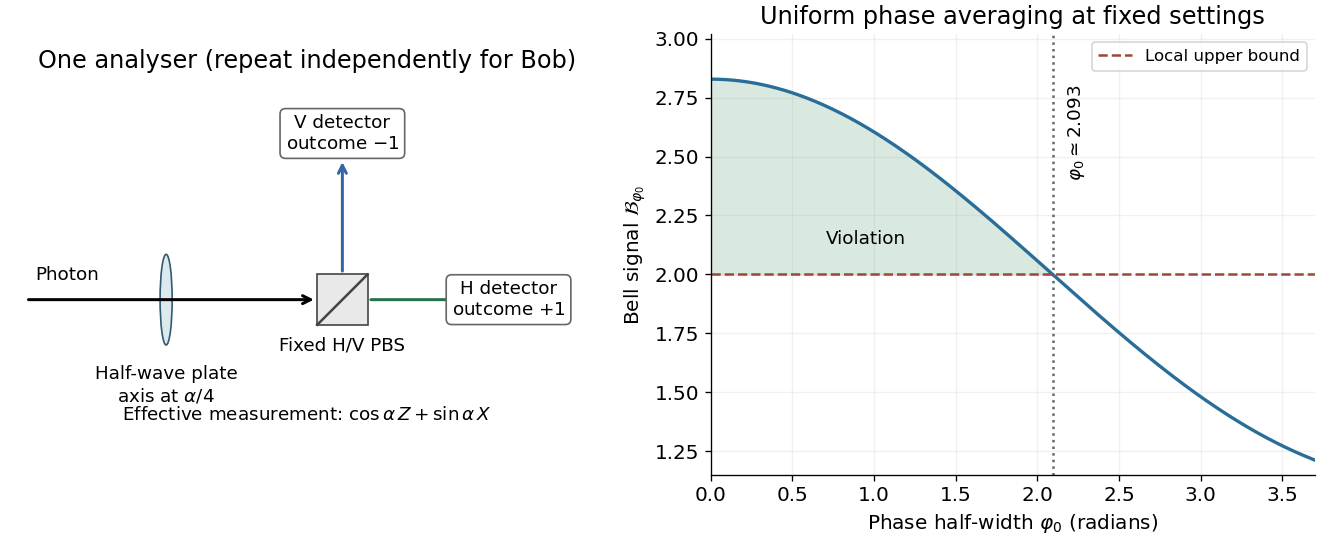
The eigenpolarizations of the requested observable areA polarizing beam splitter with its transmitted polarization axis at angle to horizontal separates these two orthogonal states. Assign outcome to its first detector and to the other. Equivalently, use a fixed horizontal/vertical splitter preceded by a half-wave plate whose fast axis is at ; the diagram shows this equivalent implementation. Bob uses for his splitter axis, or for the preceding half-wave plate.
The pair correlations are , , and . Expanding the two observables therefore givesThe half-angle between the Bloch observable parameter and the physical linear-polarization analyser angle is essential.


For a deterministic local hidden variable, write the four possible measurement results as . Its Bell combination isIf , the first bracket vanishes and the second is ; if , the second vanishes and the first is . Thus for every hidden variable. Averaging over any local hidden-variable distribution gives , and in particular the requested upper bound.
For the specified settings, the correlation formula in part b givesConsequentlyThis violates the local bound precisely whenThe maximum is at modulo . The state remains maximally entangled at other phases, even when this fixed choice of real-plane analyser settings gives no violation. Local phase compensation or adapted measurement settings can recover the optimum.
The phase averaging of a polarization Bell state gives the ensemble density matrixwith by continuity at . This follows from averaging over . An observable's expectation is linear in the density matrix, so averaging the pure-state Bell function is equivalent to evaluating the mixed-state expectation. ThereforeViolation requires . The supplied graph gives the first crossing near radians; solving more accurately givesThe inequality is strict at the upper endpoint. On the sinc function decreases to zero, so this is its only crossing in that interval. For , , excluding later violation windows. The plotted Bell signal shows the same threshold without copying the source illustration.
Articles by others on the same topic
There are currently no matching articles.