Write the optical system's spectral response as . Expanding its spectral phase around the pulse's central angular frequency givesThe group delay is , with units of time. The linear spectral phase term delays the pulse envelope by this amount. The group delay dispersion is , with units of time squared. It makes the group delay frequency dependent: . Positive group delay dispersion delays higher frequencies more and gives positive chirp. A nonzero quadratic spectral phase broadens an initially transform-limited pulse; applied to an already chirped pulse, a suitable opposite sign can compress it.
In chirped pulse amplification, an ultrashort seed pulse first passes through a dispersive stretcher, often a grating-based system. This correlates frequency with arrival time and increases pulse duration while approximately preserving pulse energy, thereby lowering peak intensity. An optical amplifier can then increase pulse energy without exposing the gain medium to the original short pulse's enormous peak intensity, reducing optical damage and unwanted nonlinear phase accumulation. A final dispersive compressor, typically using gratings, cancels the accumulated spectral phase to recover a short, high-energy pulse. The essential components are therefore a short-pulse source, stretcher, amplifier and matched compressor; spectral gain bandwidth and higher-order dispersion limit the achievable compression.
The temporal intensity is proportional to the squared field modulus:Its half-maximum points satisfy , so the intensity full width at half maximum isWith the chosen convention, the instantaneous angular frequency is minus the time derivative of the field's argument. HenceA localized Gaussian requires . It is positively chirped precisely when , or ; gives no chirp and gives negative chirp.
Let . At the port that is bright for zero delay, the ideal 50:50 Michelson interferometer givesEach arm has field amplitude one half after two beam-splitter interactions. For , approximate both real Gaussian envelopes by while retaining their rapidly varying phases. Put and . The identity giveswhereA delay-dependent constant overall phase can be shifted by a port convention, but the expression above follows directly from the specified bright-port sum.
The output intensity is a Gaussian envelope modulated by a squared cosine:The modulation maxima are separated byThis is the spacing of resolved adjacent pulse peaks when the envelope changes little over a modulation period, requiring . The source's assumption alone does not ensure several visible peaks: a weakly chirped pulse may show only one broad maximum. At the output is the original pulse and the modulation-spacing formula has no finite-peak interpretation. The figure compares the exact bright-port field sum with the small-delay approximation.
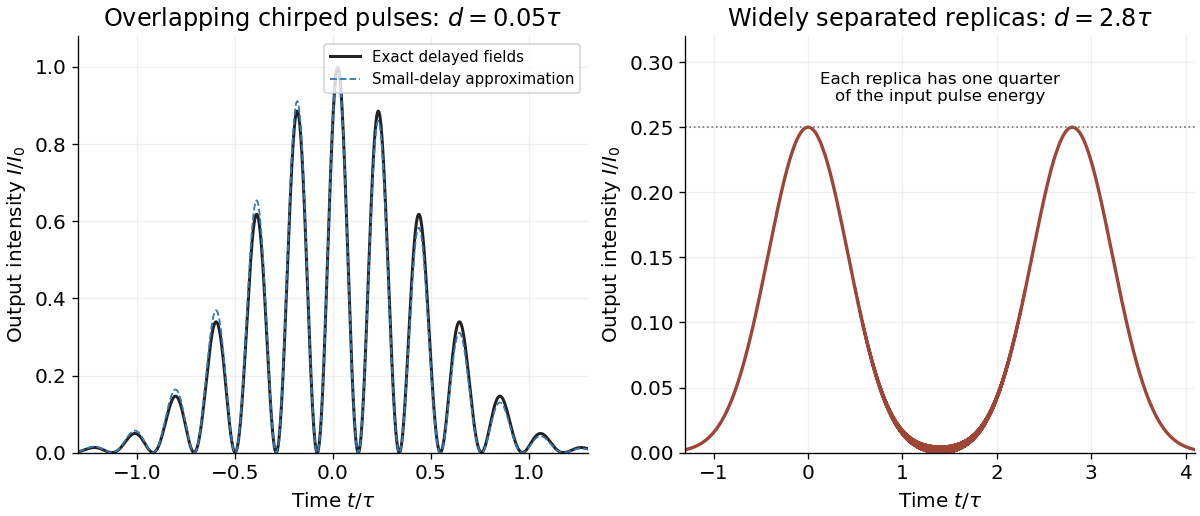
Temporal interference of chirped pulses at small and large Michelson delays
. Details. 
A time delay multiplies the spectral field by . The bright-port transfer function is thereforeThe spectral transmission maxima have angular frequency spacing . For a strongly chirped pulse the local frequency-time mapping is . Thus the filter's adjacent transmitted frequency bands emerge at times separated byas obtained directly from the temporal fields. The spectral transfer function itself is exact; mapping its features directly onto time requires a sufficiently strong chirp and overlapping envelopes.
As approaches the pulse duration, the two envelopes overlap only partly and the small-delay formula fails. For , the selected port contains two separate replicas of field amplitude , each with one quarter of the input pulse energy. Their combined energy is half the input; the other output port carries the remainder. There is no temporal overlap or corresponding time-resolved interference. A sufficiently resolving spectrometer can still reveal fine spectral fringes, whose spacing decreases as .
Articles by others on the same topic
There are currently no matching articles.