Q-switching stores excitation in a pumped laser gain medium while preventing oscillation, then rapidly changes the optical cavity from high loss, or low quality factor, to low loss, or high quality factor. The initially suppressed stimulated field can then grow rapidly from a seed and deplete a large population inversion in a short pulse. The resulting peak power is much higher than for continuous operation at the same average pumping rate. This is energy storage and release, rather than the phase locking of many longitudinal modes used in mode locking.
An active implementation uses a Pockels cell and a polarizer. An applied voltage makes the cell change the intracavity polarization, causing the polarizer to introduce sufficient loss to prevent lasing while pumping builds the inversion. Rapidly changing the voltage removes that loss and opens the high-Q state. The switching time should be short relative to the pulse build-up and depletion times. A saturable absorber provides an alternative passive Q switch: its absorption decreases as the intracavity intensity rises.
The intended quantity is , the threshold population inversion density of the cavity after switching to low loss. At this value stimulated gain exactly balances the photon-loss rate:Above threshold a nonzero seed grows; below threshold it decays. The unstarred in the subpart is shorthand for the starred threshold quantity in the displayed equations, rather than a different total atomic population. The photon lifetime fixes the photon-density loss rate .
Write , and during this derivation. Eliminating the stimulated term between the two laser rate equations gives the photon balanceIntegrate over the pulse, taking negligible initial and final stored photon densities:The photons lost from the cavity carry total energy . Since ,This identifies the supplied energy formula under the ideal extraction convention that all photon loss is useful output. If only a fraction of the loss exits the output coupler, the measured output energy is . The rate equations by themselves do not distinguish useful output from parasitic loss.
The Q-switched energy extraction efficiency in the ideal loss convention of ii isThe first factor reflects the definition of inversion: one stimulated transition reduces the upper population and increases the lower population, changing by . Thus one emitted photon consumes units of inversion. The second factor accounts for the inversion left after the pulse; finite pumping above threshold does not generally extract all the initially stored inversion. This is not the wall-plug efficiency and does not include the energy cost of pumping or the factor for imperfect output extraction.
For a nonzero photon density, divide the laser rate equations to remove time:Integrating from the initial inversion and retaining a small seed density givesThe source's pulse approximation neglects compared with the macroscopic pulse density, givingA positive seed, or a spontaneous-emission source omitted from these equations, is nevertheless needed to start the pulse. Setting exactly in the unforced equations gives the counterexample , for all time, even above threshold. The displayed formula is therefore used in the negligible-seed limit, rather than as an assertion that a pulse starts from an identically zero field.
At the end of the pulse, the photon density returns to negligible size. Put and . The result of i givesUsing , the nonzero-pulse solution obeysFor , select , corresponding to depletion below threshold. The root is also an algebraic solution for every but represents no macroscopic pulse. A positive nonzero root exists only above threshold.
The physical branch can be plotted without a nonlinear solver by parameterizingIt begins at and increases monotonically to as . Expanding near threshold gives , so . For strong over-pumping the residual inversion fraction is exponentially small, . Thus the curve saturates at the upper bound .
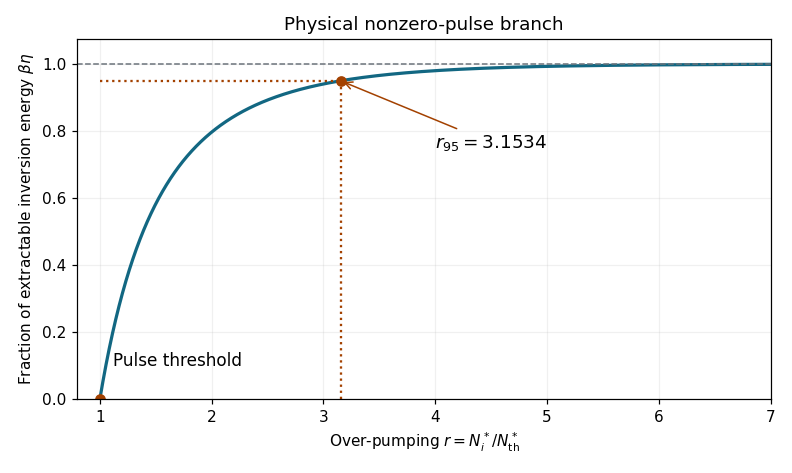

Extracting 95 percent of the maximum available inversion energy means , or . Substitution in ii givesThe degeneracy factor cancels because the target is a fraction of the maximum energy , rather than a fraction of without that factor.
During the pulse, the photon density reaches its maximum when with , so . Evaluating i at this inversion givesThe ideal instantaneous output power is . ThereforeFor , almost all the extractable energy is stored briefly as intracavity photons, and . The leading rise while the inversion remains near its initial value is , with short growth time . Depletion then takes the inversion below threshold. At late times andwhich approaches a tail with decay time at large . The pulse is consequently asymmetric, with a rapid rise and a slower approximately exponential trailing edge. The negligible-seed build-up delay depends on the seed strength. The pumping and spontaneous population decay have been neglected over the short pulse; parasitic cavity loss multiplies useful power by the output fraction described in ii.
Articles by others on the same topic
There are currently no matching articles.