For a nonzero photon density, divide the laser rate equations to remove time:Integrating from the initial inversion and retaining a small seed density givesThe source's pulse approximation neglects compared with the macroscopic pulse density, givingA positive seed, or a spontaneous-emission source omitted from these equations, is nevertheless needed to start the pulse. Setting exactly in the unforced equations gives the counterexample , for all time, even above threshold. The displayed formula is therefore used in the negligible-seed limit, rather than as an assertion that a pulse starts from an identically zero field.
At the end of the pulse, the photon density returns to negligible size. Put and . The result of i givesUsing , the nonzero-pulse solution obeysFor , select , corresponding to depletion below threshold. The root is also an algebraic solution for every but represents no macroscopic pulse. A positive nonzero root exists only above threshold.
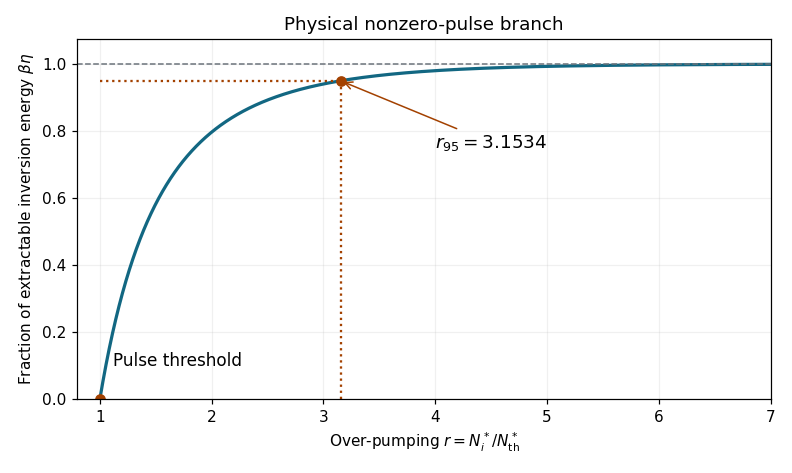
The physical branch can be plotted without a nonlinear solver by parameterizingIt begins at and increases monotonically to as . Expanding near threshold gives , so . For strong over-pumping the residual inversion fraction is exponentially small, . Thus the curve saturates at the upper bound .

Articles by others on the same topic
There are currently no matching articles.