A universal quantum gate set can approximate any finite-register unitary operator to arbitrary accuracy, disregarding a common global phase. A finite example is the Hadamard gate, T gate and CNOT gate. In the ordered one-qubit basis ,In the ordered two-qubit basis , with the first qubit the control,The one-qubit gates generate a dense set of one-qubit unitary operators, and CNOT gates supply entangling operations. Approximate universality is the appropriate qualification for a finite discrete set: its finite circuits cannot exactly equal every member of a continuous uncountable unitary group.
Without interaction, the two-qubit Hamiltonian operator is , so its evolution factors as . It maps each product state to another product state, and cannot implement an entangling two-qubit gate such as a CNOT gate.
In an ion trap, the Coulomb interaction couples the ions' displacements into collective vibrational normal modes. The qubit states are internal atomic states; lasers coupling internal excitation to creation or annihilation of a shared vibrational quantum allow that motion to carry conditional information between ions. Thus the physical mediator is a collective motional normal mode of the Coulomb-coupled chain, rather than a direct resonant exchange between isolated internal qubit transitions. Ground-state cooling and resolved motional sidebands support the ideal pulse model used here.
Track the factors only when the corresponding transition is addressed. They are common within the addressed two-state subspace, but become physically relevant relative phases between computational basis states. Using a semicolon to separate the shared motional number state, the complete paths areThe middle arrow comprises both Y pulses. In the last row those individual steps are . The two X pulses contribute for either initially excited control; the Y pair supplies a second minus sign only when the second ion is also excited.
The shared motion returns to its ground state for all four inputs, and the auxiliary internal state is empty. Quantum superposition therefore gives the two-qubit gateDiscarding the X-pulse factors would incorrectly identify with a Controlled-Z gate itself.
The extra Pauli gate on the control is removed by . Conjugating the target by a Hadamard gate then givesThus, from left to right in the network, apply , then , then and ; the last two gates commute.
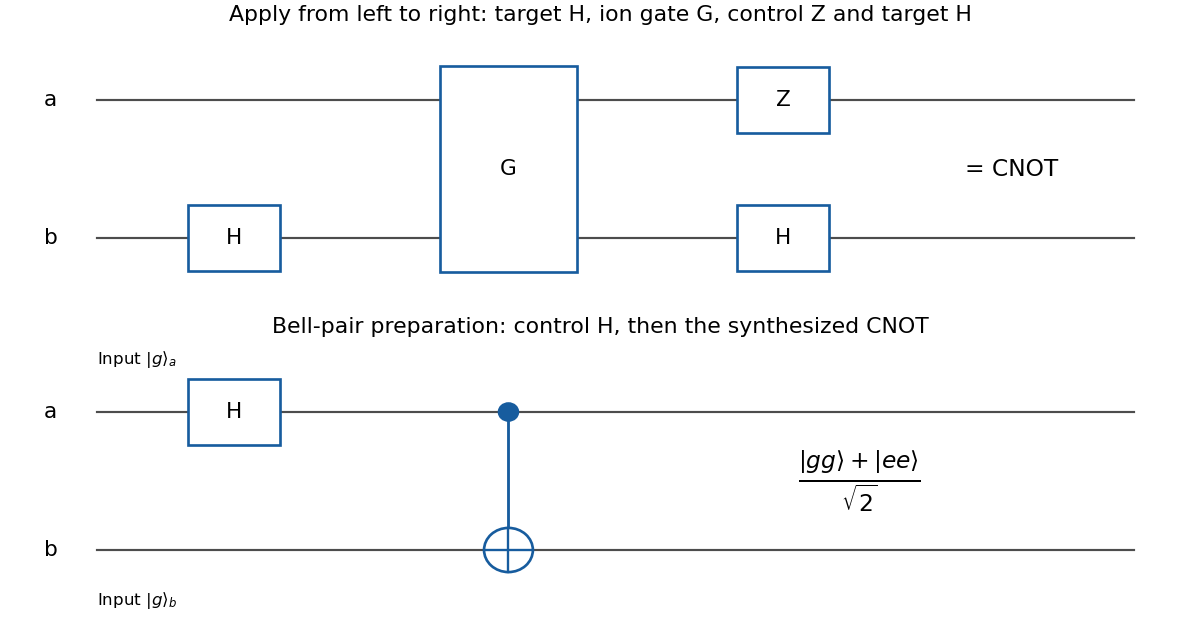

For a direct proof, the control-zero block of is and its control-one block is . Multiplication by changes the latter into . Since and , the result iswhich is exactly the CNOT gate on all inputs, including quantum superpositions.
A bipartite pure state is entangled when it cannot be written . For mixed states, the corresponding definition excludes every convex mixture of product states, not just a single product state.
Apply a Hadamard gate to ion , followed by the CNOT gate of part (d):The lower network in the figure shows this Bell pair preparation. Either ion alone has reduced density matrix , whereas the joint quantum state is pure; hence the joint quantum state cannot be a product state. The entangling operation can be expanded into exactly as above.
An AND gate maps four possible pairs to one bit and loses information, so it is not reversible. A reversible embedding retains both inputs and uses a target bit:This is the Toffoli gate; initializing computes while preserving enough information to invert the operation.
Classical reversible gates on one or two bits alone cannot synthesize every such operation. Every permutation of two bits is an invertible affine map over the finite field : there are of them, exactly the permutations. Their extensions to a larger register and their compositions remain affine. The nonlinear term in the Toffoli gate therefore cannot be generated. Three-bit reversible gates remove this obstruction, with ancillary bits initialized appropriately.
There is no conflict with quantum universality: one- and two-qubit gates may pass through quantum superpositions and use relative phases at intermediate steps. They are not restricted to permutations of computational basis states at every step. For example the Hadamard gate, T gate and CNOT gate can decompose a Toffoli gate exactly. Thus the classical affine obstruction does not apply to their intermediate unitary operators.
Articles by others on the same topic
There are currently no matching articles.