Set and , so . Direct differentiation givesSubstitute into the Black-Scholes equation and divide by :To recover the same operator on , its first-derivative coefficient must be . This givesFor this choice the last coefficient is , since . Hence , proving the required invariance. The transformation is the stock-inversion reflection for the Black-Scholes equation.
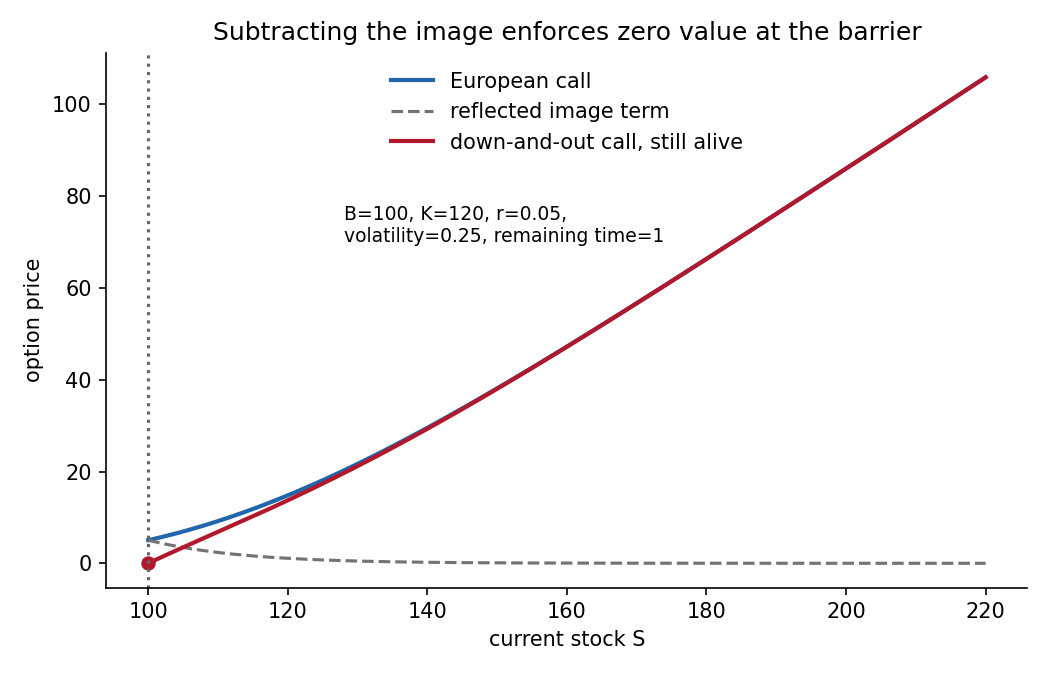
A down-and-out option with no rebate pays only if the stock has stayed above the lower barrier up to maturity; if the barrier is hit, it expires worthless. For an unknocked-out contract currently at , apply part (a) to the ordinary European call option price:Both terms solve the PDE. At they cancel, enforcing the absorbing boundary. At maturity and , the reflected stock value is , so the reflected call option is zero and the required terminal contingent claim payoff remains. Standard growth and uniqueness conditions for the killed pricing problem identify this solution as the option value.
If the contract has already hit its barrier, its value is zero regardless of a later hypothetical stock recovery. Thus the formula is conditional on survival to the current time; the barrier history is part of the contract state.

At maturity debt receives the smaller of face value and firm assets:Thus it is equivalent to a zero-coupon payment minus a European put option on the firm value. Its time- price isEquity receives the residual , hence is a European call option:put-call parity verifies , consistent with the stated balance-sheet identity. As with the replication arguments elsewhere, the physical drift does not enter these option prices.
If default liquidates the firm as soon as its value crosses below , equity is extinguished at that event. If default never occurs before maturity, equity receives . It is therefore a no-rebate down-and-out option on firm value, with strike price and barrier both equal to .
For a firm that has survived to and has , part (b) givesIf default has already occurred, . At maturity a surviving firm has equity .
The source uses a strict crossing . With nonzero volatility, continuity and immediate two-sided Brownian fluctuations at a first barrier hit make the pre-maturity absorbing value at zero as well: starting at the barrier, the process crosses below it immediately almost surely. At maturity the contingent claim payoff at equality is also zero. Thus this convention has the same pricing boundary as the usual barrier-hit convention in this nondegenerate model.
Articles by others on the same topic
There are currently no matching articles.