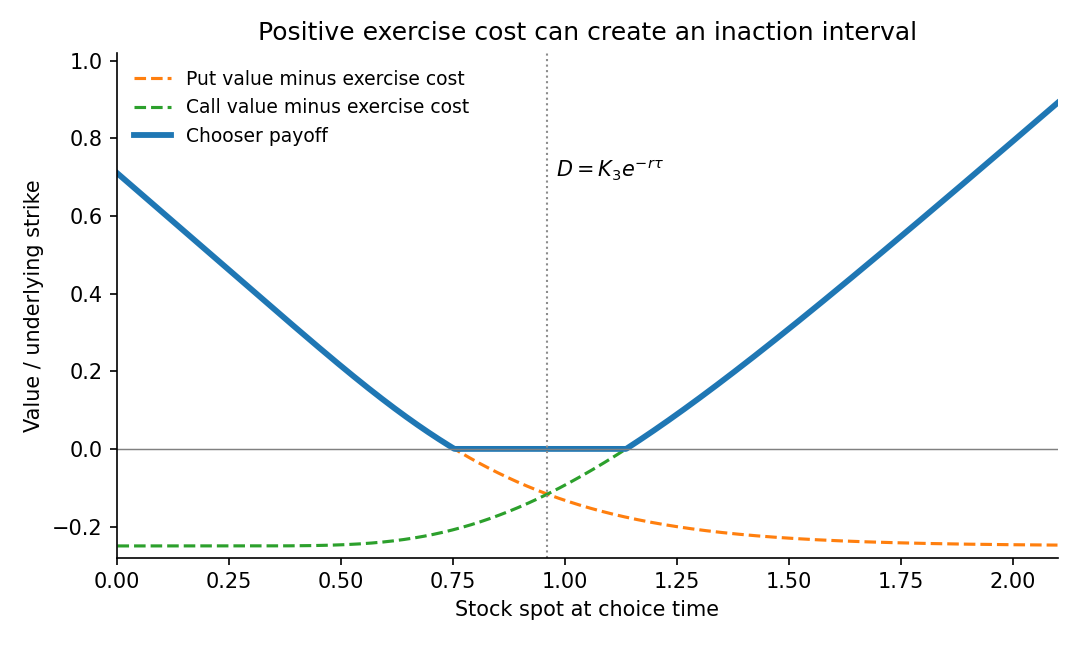
Write and . Because the right can be left unexercised, the chooser with positive exercise cost has payoffLet and . Put-call parity gives . Thus the put is selected for and the call for ; the two are equal at . Before truncation at zero, the payoff is decreasing on the left and increasing on the right.
At the meeting point, the Black-Scholes formula givesIf , the payoff has a positive minimum at . If , it touches zero there. If , each side has a distinct exercise threshold and the payoff is zero between them. If , even the left-end put value cannot cover the exercise cost, and only the right call branch can be positive. The illustration shows the middle case, including the competing underlying option values.

Articles by others on the same topic
There are currently no matching articles.