Write . In the Black-Scholes formula, both and depend on only through . Replacing them by leaves that ratio unchanged. Each prefactor in the put formula acquires the same factor , givingThis is degree-one homogeneity of the European put option price in its spot and strike together.
Differentiate the homogeneity identity from part (a) with respect to at . The chain rule gives Euler homogeneous function theorem in the formUsing the supplied put option spot derivative and the given price,For positive strike, division by gives the put-price strike derivativeIt is nonnegative, as increasing the strike increases the terminal put payoff.
At , with underlying spot , the call option on a put option paysLet . The underlying put option value is strictly decreasing and convex in , with limits at zero and zero at infinity. If , there is a unique at which that put value equals . Hence the compound option payoff is a decreasing convex curve from to zero on , followed by a horizontal zero segment. There is an upward kink at . If , the payoff is identically zero.
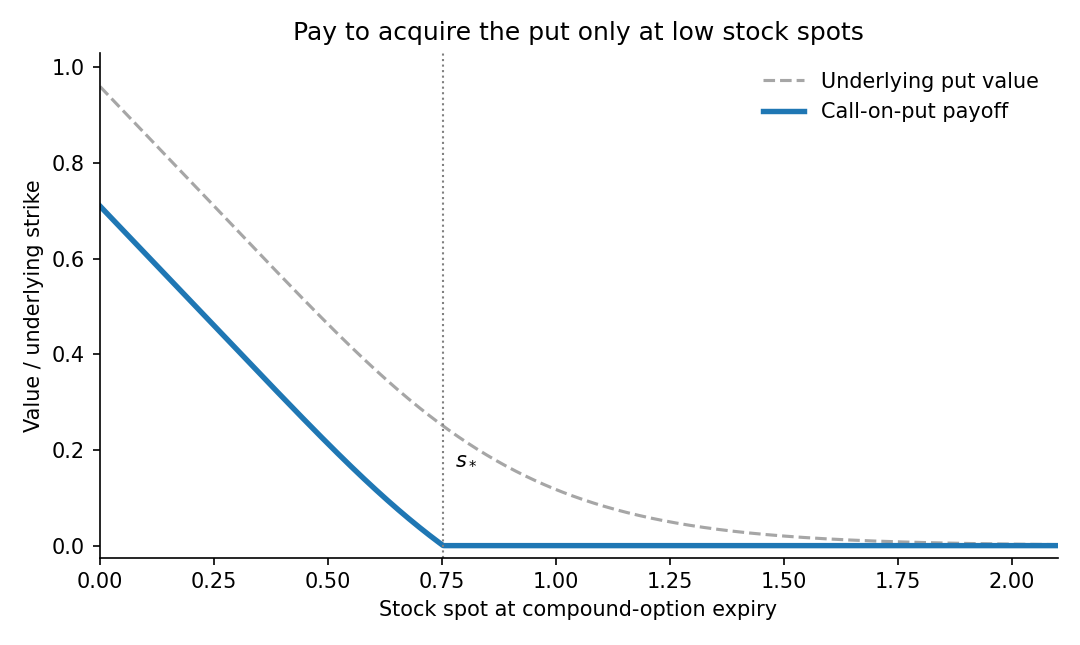
For , the holder obtains the underlying put at no cost, so the payoff is its full value at . The discounted put price is a martingale under the risk-neutral measure. Using the tower property in the risk-neutral pricing,Explicitly, this is with evaluated over . The intermediate choice time disappears when its exercise cost is zero.
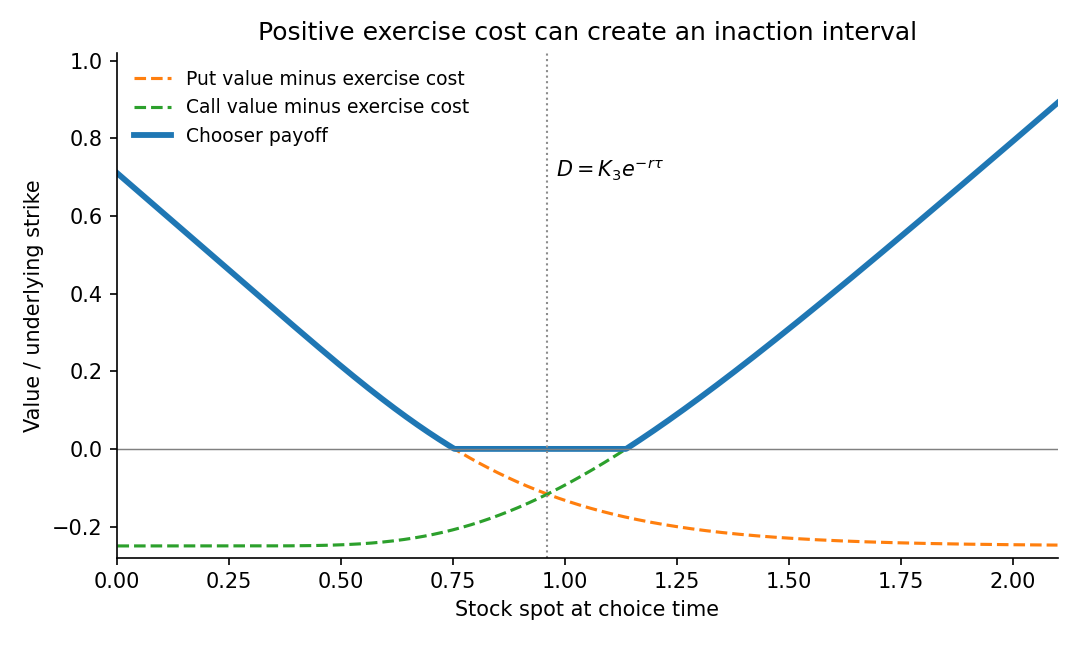
Write and . Because the right can be left unexercised, the chooser with positive exercise cost has payoffLet and . Put-call parity gives . Thus the put is selected for and the call for ; the two are equal at . Before truncation at zero, the payoff is decreasing on the left and increasing on the right.
At the meeting point, the Black-Scholes formula givesIf , the payoff has a positive minimum at . If , it touches zero there. If , each side has a distinct exercise threshold and the payoff is zero between them. If , even the left-end put value cannot cover the exercise cost, and only the right call branch can be positive. The illustration shows the middle case, including the competing underlying option values.


Articles by others on the same topic
There are currently no matching articles.