Apply Itô's formula to for positive initial value . The drift correction is , soThis is geometric Brownian motion. Under the physical probability measure, has the standard normal distribution. For positive volatility,The drift here is , because this is a physical bankruptcy probability. The risk-neutral measure will instead give drift for pricing. If , the value is deterministic and the default probability is the indicator of ; the usual positive-volatility convention is used in the remaining formulas.
In the Merton model, the total equity payoff is , exactly a European call option on the company value with strike . Total debt pays . The first payoff has slope zero below and slope one above it; the second has slope one below and is constant above it.
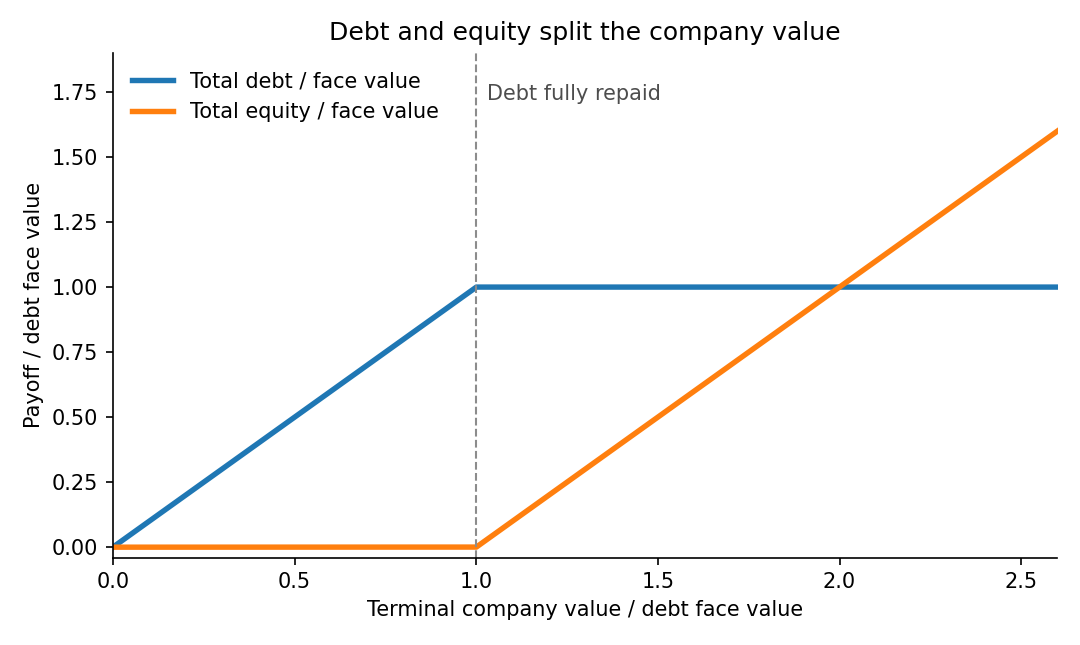
LetThe Black-Scholes formula gives total equity value . Because the total company value is a traded asset, replication gives total debt value . Divide by the numbers of securities to obtainThese are prices per security; the payoff diagram represents the two aggregate claims.
As insurance against credit default, the payment is the positive shortfall of recovery below face value:Thus the credit default swap in this question is one th of a European put option on the firm value. Its price isEquivalently, adding this insurance to one corporate bond produces a sure unit payment, so its price is minus the bond price from part (b). This also fixes the positive orientation of the printed “difference”: insurance compensates face value minus recovery.
At maturity, one stock share is worth . For a nonnegative strike , the digital call option therefore pays one exactly onUnder the risk-neutral measure, is normal with mean and variance . The risk-neutral pricing consequently givesThe effective company-value strike is , because both the outstanding debt and the number of shares matter. At , the strict positive-share event remains .
Write . In the Black-Scholes formula, both and depend on only through . Replacing them by leaves that ratio unchanged. Each prefactor in the put formula acquires the same factor , givingThis is degree-one homogeneity of the European put option price in its spot and strike together.
Differentiate the homogeneity identity from part (a) with respect to at . The chain rule gives Euler homogeneous function theorem in the formUsing the supplied put option spot derivative and the given price,For positive strike, division by gives the put-price strike derivativeIt is nonnegative, as increasing the strike increases the terminal put payoff.
At , with underlying spot , the call option on a put option paysLet . The underlying put option value is strictly decreasing and convex in , with limits at zero and zero at infinity. If , there is a unique at which that put value equals . Hence the compound option payoff is a decreasing convex curve from to zero on , followed by a horizontal zero segment. There is an upward kink at . If , the payoff is identically zero.
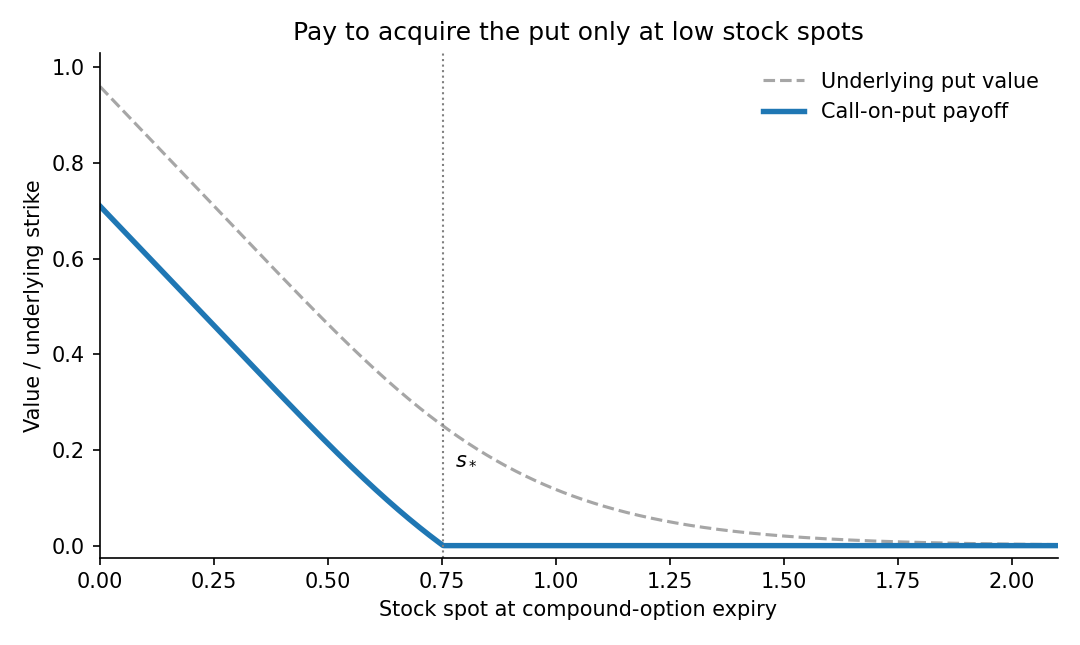
For , the holder obtains the underlying put at no cost, so the payoff is its full value at . The discounted put price is a martingale under the risk-neutral measure. Using the tower property in the risk-neutral pricing,Explicitly, this is with evaluated over . The intermediate choice time disappears when its exercise cost is zero.
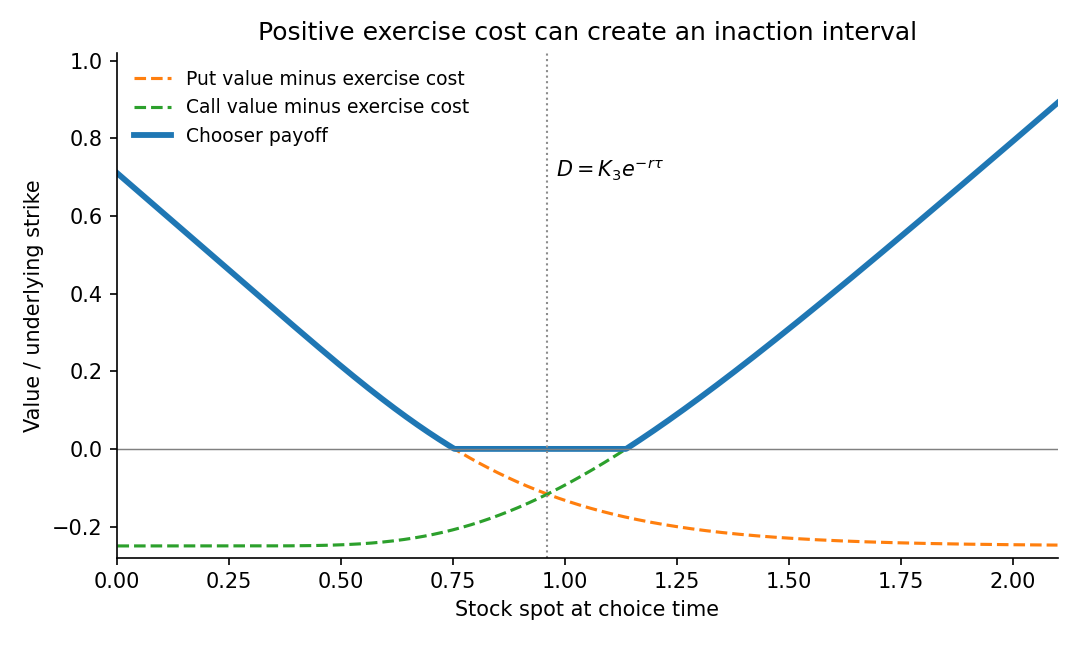
Write and . Because the right can be left unexercised, the chooser with positive exercise cost has payoffLet and . Put-call parity gives . Thus the put is selected for and the call for ; the two are equal at . Before truncation at zero, the payoff is decreasing on the left and increasing on the right.
At the meeting point, the Black-Scholes formula givesIf , the payoff has a positive minimum at . If , it touches zero there. If , each side has a distinct exercise threshold and the payoff is zero between them. If , even the left-end put value cannot cover the exercise cost, and only the right call branch can be positive. The illustration shows the middle case, including the competing underlying option values.


If , buy of stock 1 and sell of stock 2. Initial cost is zero; the one-period payoff is in the up state and in the down state. This is an arbitrage. If terminal rather than time-one arbitrage is required, reinvest the positive receipts in either positive-price stock.
For , define the one-period Arrow state pricesThe denominator is positive because . Both state prices are strictly positive and satisfy for . Thus every portfolio's present value equals the positive state-price-weighted value of its two future payoffs.
Use the same strictly positive pricing rule at every node of the two-period tree. A nonnegative terminal payoff that is positive in at least one state has strictly positive price by backward induction, so a zero-cost self-financing strategy cannot generate an arbitrage. Therefore the market is arbitrage free when , despite having no initially supplied bond. This is a two-stock binomial market without a supplied bond.
For holdings , a sure payment of 100 requiresSubtracting gives , so and . Thus sell one share of stock 1 and buy two shares of stock 2. Its initial cost is .
This synthetic zero-coupon bond pays exactly its initial cost after one period, and thereforeAt later nodes the holdings can be rescaled to generate the same one-period risk-free return; a physical bond need not be listed separately.
With the rate , the risk-neutral probability in a binomial market must satisfyThe first stock gives , hence . The second gives , confirming the same answer. ThusTake the successive up/down choices independent under this measure, so both stock prices are martingales. The martingale transition condition applies from times zero to one and one to two; the displayed condition in the source should be read for these two transitions.
The exchange option has terminal payoffs determined by the two successive up/down moves:The two stocks span both one-step states, so this finite market is complete. The risk-neutral pricing uses the independent transition probabilities and . Since the synthetic risk-free rate is zero,The price is approximately 7.56 in the currency units of the stock prices.
Articles by others on the same topic
There are currently no matching articles.