Almost sure convergence meansThus a single event of probability one supports ordinary pointwise convergence. Convergence in probability means that for every ,The exceptional event is allowed to change with in the second definition.
Fix and use the indicator random variables . Almost sure convergence gives almost surely, while . The Reverse Fatou lemma states that for random variables bounded above by an integrable random variable,It follows thatSince was arbitrary, this proves convergence in probability. The integrable upper bound is essential to the application of the Reverse Fatou lemma.
Independent random variables satisfy, for every finite selection of distinct indices and Borel sets ,The Second Borel-Cantelli lemma says that if events are independent and , thenHere is the event that infinitely many of the occur.
By convergence in probability, choose recursively so thatThe corresponding events have a summable sequence of probabilities. The First Borel-Cantelli lemma, which requires no independence, therefore makes the probability of infinitely many of them zero. On the complementary event, for all sufficiently large , provingThe recursively chosen indices are strictly increasing and hence tend to infinity.
Suppose first that complete convergence holds. For each positive integer , apply the First Borel-Cantelli lemma to . Outside a countable union of null events, only finitely many of these exceedances occur for every . This is almost sure convergence, with no independence assumption.
For the converse, an important point is that independence of does not immediately imply independence of . Instead use the fact that an almost-sure limit of independent random variables is constant. Indeed, is measurable for the tail sigma-algebra. The Kolmogorov zero-one law makes each event , , have probability zero or one. Since almost surely and is finite, these probabilities form the distribution function of a point mass: there is a finite constant with almost surely.
Now are independent events. Almost sure convergence says that their infinitely-often event has probability zero. The contrapositive of the Second Borel-Cantelli lemma givesReplacing by the almost surely equal leaves each probability unchanged. Thus complete convergence and almost sure convergence are equivalent for independent sequences.
Let have the uniform distribution on , set , and take . The variable is finite almost surely, so almost surely. For any and all sufficiently large ,The harmonic series diverges, soThis dependent sequence fails complete convergence. All its members are scalar multiples of the same nonconstant random variable, which explains why the independence hypothesis cannot be dropped.
For the asserted inequality is equality. For , let . If , the inequality is automatic. Otherwise Hölder's inequality on the probability space givesThus , using that the total measure is one.
Write and for . If , then is -measurable. The martingale property and linearity of conditional expectation giveThe product is integrable by Cauchy-Schwarz inequality. The pull-out property of conditional expectation, followed by its tower property, therefore givesFor unbounded , the pull-out identity follows by truncation and Cauchy-Schwarz inequality. This proves martingale-difference orthogonality, including orthogonality to the initial value.
Expand in the Hilbert space . Orthogonality gives the exact identityThe terms are nonnegative and , so boundedness of the left side over is equivalent to convergence of the series on the right.
Conditional on , put . The two possible values have conditional meanThe process is adapted and bounded, hence integrable. Consequently it is a martingale. Since , the martingale convergence theorem gives an almost surely finite limit , necessarily in .
Moreover and these squared differences tend to zero almost surely. The dominated convergence theorem gives . Thus the Bernoulli polarization martingale converges almost surely and in .
Conditional on , the increment is with probability , and with probability . ThereforeTaking expectations using the tower property yieldsThis is the conditional variance that drives the Bernoulli polarization martingale toward its endpoints.
The martingale is bounded in , so the increment-square series from part (a)(ii) is finite. The identity just obtained implies , hence . By almost sure convergence and the dominated convergence theorem,The integrand is nonnegative because . It must vanish almost surely, giving .
The martingale has constant expectation . Its convergence implies convergence by Cauchy-Schwarz inequality, and hence . ThereforeThe limiting law is the Bernoulli distribution with parameter .
Independent and identically distributed random variables are independent as in question 1, and all have the same probability distribution. Their tail sigma-algebra isAn event is a tail event when it belongs to every sigma-algebra in this intersection. The Kolmogorov zero-one law says for every .
Use the intended simple symmetric random walk with ; the printed lower summation index zero refers to an undefined . For each , removing the finite initial sum changes all later positions by one finite constant. This cannot change whether the lower limit is or the upper limit is . Thus and belong to , and
Each increment has the same law as its negative, and their independence makes the joint law of invariant under simultaneous sign reversal. Under this transformation, the simple symmetric random walk becomes , and the event becomes . ThusThis uses symmetry of the entire increment sequence, rather than just the one-dimensional distributions of the positions.
Use ; the printed does not define the intended trivial sigma-algebra. With the simple symmetric random walk convention from part (a), is adapted and integrable because . Independence givesBy linearity, the pull-out property for the -measurable , and preservation of measurable variables by conditional expectation,This proves the square-minus-time martingale of a simple symmetric random walk.
For the hitting time in question,Each event in the union is in because is adapted. This proves is a stopping time for every positive integer .
The optional stopping theorem applies to at the bounded stopping time . As , it yields the valid stopped second-moment identity for a simple symmetric random walkThe printed bound on is false. Before hitting the positive level , the walk can travel arbitrarily far downwards, so is unavailable.
Here is a valid proof of finiteness of . For a positive integer , stop instead at . The same identity and the bound giveThe monotone convergence theorem makes , so almost surely. Applying optional stopping to at and then using dominated convergence gives . Since , this meansConsequently for every , and letting proves almost surely.
In fact this is the infinite mean first passage of a simple symmetric random walk. If , the first displayed identity would bound the second moments of uniformly. Their uniform integrability and their almost sure convergence to would imply . But the optional stopping theorem applied to at every bounded makes each expectation zero, a contradiction. Hence the correct conclusion is
Intersecting the probability-one hitting events over all positive integers shows that the simple symmetric random walk reaches arbitrarily large positive levels almost surely. The hitting times of levels tending to infinity also tend to infinity, since . Hence , and in particular .
Alternatively, the union conclusion, the equal probabilities from symmetry, and the Kolmogorov zero-one law force both probabilities to equal one. Thus almost every path has arbitrarily large positive and negative excursions. A nearest-neighbor integer path must pass through zero between a positive and a negative excursion. Such crossings occur after every finite time, givingThis is recurrence of the simple symmetric random walk.
Apply Itô's formula to for positive initial value . The drift correction is , soThis is geometric Brownian motion. Under the physical probability measure, has the standard normal distribution. For positive volatility,The drift here is , because this is a physical bankruptcy probability. The risk-neutral measure will instead give drift for pricing. If , the value is deterministic and the default probability is the indicator of ; the usual positive-volatility convention is used in the remaining formulas.
In the Merton model, the total equity payoff is , exactly a European call option on the company value with strike . Total debt pays . The first payoff has slope zero below and slope one above it; the second has slope one below and is constant above it.
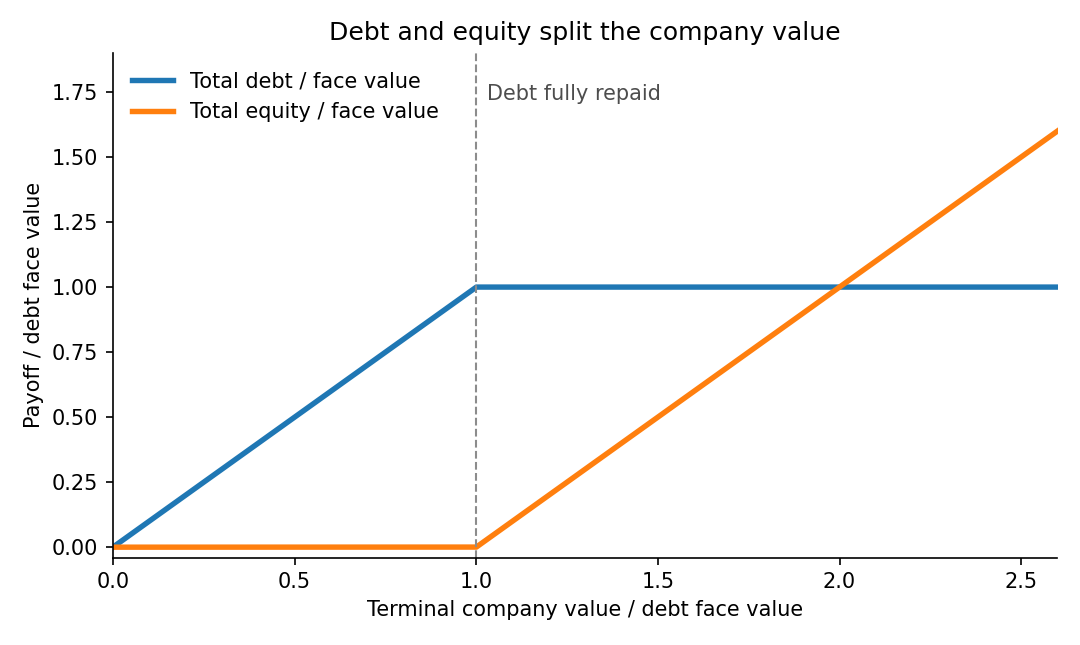
LetThe Black-Scholes formula gives total equity value . Because the total company value is a traded asset, replication gives total debt value . Divide by the numbers of securities to obtainThese are prices per security; the payoff diagram represents the two aggregate claims.
As insurance against credit default, the payment is the positive shortfall of recovery below face value:Thus the credit default swap in this question is one th of a European put option on the firm value. Its price isEquivalently, adding this insurance to one corporate bond produces a sure unit payment, so its price is minus the bond price from part (b). This also fixes the positive orientation of the printed “difference”: insurance compensates face value minus recovery.
At maturity, one stock share is worth . For a nonnegative strike , the digital call option therefore pays one exactly onUnder the risk-neutral measure, is normal with mean and variance . The risk-neutral pricing consequently givesThe effective company-value strike is , because both the outstanding debt and the number of shares matter. At , the strict positive-share event remains .
Write . In the Black-Scholes formula, both and depend on only through . Replacing them by leaves that ratio unchanged. Each prefactor in the put formula acquires the same factor , givingThis is degree-one homogeneity of the European put option price in its spot and strike together.
Differentiate the homogeneity identity from part (a) with respect to at . The chain rule gives Euler homogeneous function theorem in the formUsing the supplied put option spot derivative and the given price,For positive strike, division by gives the put-price strike derivativeIt is nonnegative, as increasing the strike increases the terminal put payoff.
At , with underlying spot , the call option on a put option paysLet . The underlying put option value is strictly decreasing and convex in , with limits at zero and zero at infinity. If , there is a unique at which that put value equals . Hence the compound option payoff is a decreasing convex curve from to zero on , followed by a horizontal zero segment. There is an upward kink at . If , the payoff is identically zero.
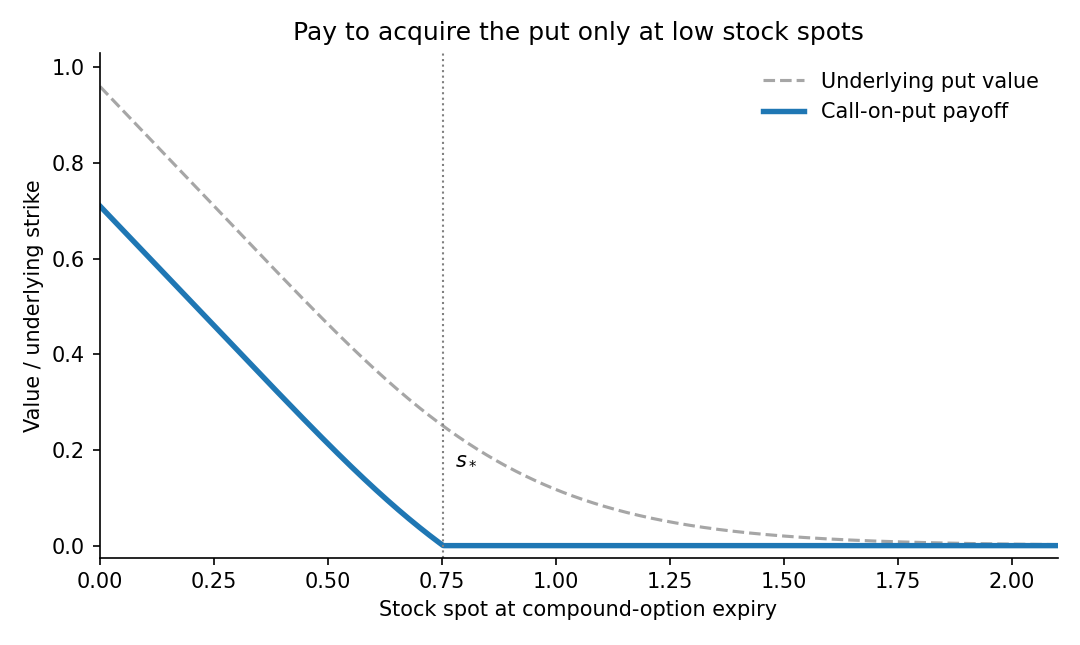
For , the holder obtains the underlying put at no cost, so the payoff is its full value at . The discounted put price is a martingale under the risk-neutral measure. Using the tower property in the risk-neutral pricing,Explicitly, this is with evaluated over . The intermediate choice time disappears when its exercise cost is zero.
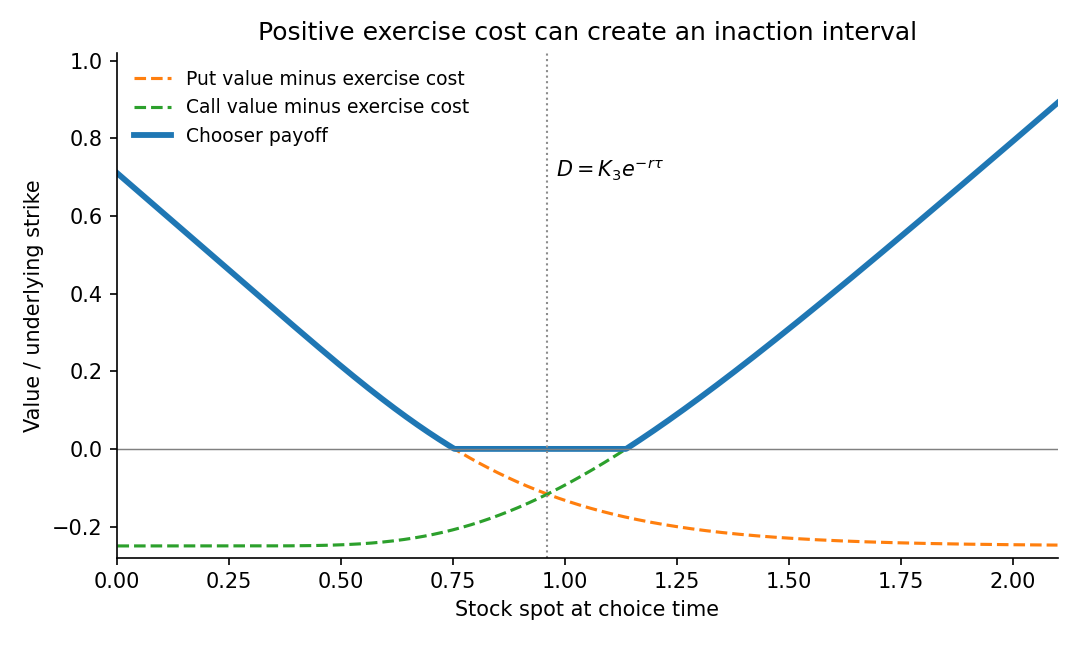
Write and . Because the right can be left unexercised, the chooser with positive exercise cost has payoffLet and . Put-call parity gives . Thus the put is selected for and the call for ; the two are equal at . Before truncation at zero, the payoff is decreasing on the left and increasing on the right.
At the meeting point, the Black-Scholes formula givesIf , the payoff has a positive minimum at . If , it touches zero there. If , each side has a distinct exercise threshold and the payoff is zero between them. If , even the left-end put value cannot cover the exercise cost, and only the right call branch can be positive. The illustration shows the middle case, including the competing underlying option values.


If , buy of stock 1 and sell of stock 2. Initial cost is zero; the one-period payoff is in the up state and in the down state. This is an arbitrage. If terminal rather than time-one arbitrage is required, reinvest the positive receipts in either positive-price stock.
For , define the one-period Arrow state pricesThe denominator is positive because . Both state prices are strictly positive and satisfy for . Thus every portfolio's present value equals the positive state-price-weighted value of its two future payoffs.
Use the same strictly positive pricing rule at every node of the two-period tree. A nonnegative terminal payoff that is positive in at least one state has strictly positive price by backward induction, so a zero-cost self-financing strategy cannot generate an arbitrage. Therefore the market is arbitrage free when , despite having no initially supplied bond. This is a two-stock binomial market without a supplied bond.
For holdings , a sure payment of 100 requiresSubtracting gives , so and . Thus sell one share of stock 1 and buy two shares of stock 2. Its initial cost is .
This synthetic zero-coupon bond pays exactly its initial cost after one period, and thereforeAt later nodes the holdings can be rescaled to generate the same one-period risk-free return; a physical bond need not be listed separately.
With the rate , the risk-neutral probability in a binomial market must satisfyThe first stock gives , hence . The second gives , confirming the same answer. ThusTake the successive up/down choices independent under this measure, so both stock prices are martingales. The martingale transition condition applies from times zero to one and one to two; the displayed condition in the source should be read for these two transitions.
The exchange option has terminal payoffs determined by the two successive up/down moves:The two stocks span both one-step states, so this finite market is complete. The risk-neutral pricing uses the independent transition probabilities and . Since the synthetic risk-free rate is zero,The price is approximately 7.56 in the currency units of the stock prices.
Articles by others on the same topic
There are currently no matching articles.