At two-phase equilibrium, the endpoints of a common tangent to the two molar free-energy curves give the coexisting compositions. They are not the separate curve minima. Reading the graph gives approximately and , with a few atomic-percent graphical uncertainty.
Let be the fraction of atoms in the precipitate thermodynamic phase. Conservation of the overall B fraction givesand henceAbout85percent remains in the B-richer matrix. Smooth readings of the original curves put the result near14–15percent; the graph does not justify many significant figures. The result is an atomic or molar thermodynamic phase fraction. Its identification with a volume fraction in the next estimate requires comparable atomic volumes of the two thermodynamic phases.
Assume the two thermodynamic phases have similar atomic volumes, so use . Model the stated average pitch by one sphere per representative cubic volume . If the sphere diameter is ,Using the more literal lever-rule reading0.145 gives about0.65micrometres instead, within graphical uncertainty. The central estimate is therefore a diameter of roughly two-thirds of a micrometre.
A random distribution does not make a nearest-neighbor mean distance exactly equal to the cube root of inverse number density. The representative cubic spacing is an explicit geometric closure, not evidence that the precipitates actually form a cubic lattice. Unequal molar volumes or a different spacing statistic would change the inferred size.
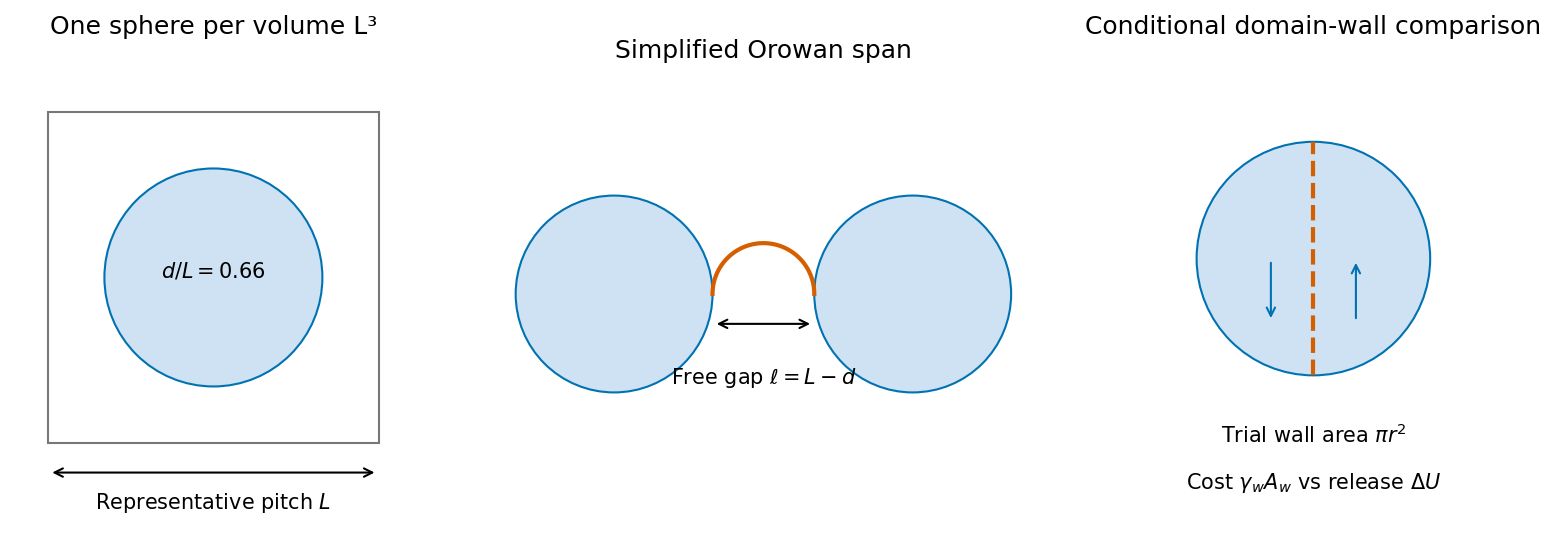
Original geometric estimates for a spherical precipitate fraction, a dislocation free gap and a trial internal domain wall
. Details. 
Orowan bypass bows a dislocation around an unshearable obstacle and leaves a loop. A dislocation line-tension estimate for a segment with tension gives the limiting shear-stress scalewhere is a free obstacle gap on the slip plane. For an FCC perfect dislocation,Using and the simple gap estimate givesConverting to tensile stress requires an orientation factor. With an explicitly assumed polycrystalline FCC Taylor factor ,The graph and spacing approximations do not justify a precise last digit. A favorably oriented single crystal with Schmid factor1/2 would instead give , around110MPa.
This is a line-tension estimate. A true slip-plane obstacle distribution, line character, logarithmic elastic corrections and precipitate size distribution are not specified. If the quoted pitch is used directly as an effective free spacing, neglecting diameter, the same simplified calculation gives and . The larger gap-corrected estimate explicitly uses the size inferred above; the tensile factor and spacing convention must not be silently treated as provided measurements.
A single-domain precipitate has no internal domain wall available to move. Magnetization changes therefore require rotation, curling or reversal of a particle's magnetization, rather than ordinary wall displacement through that particle. Relative to a larger multidomain material this can increase coercivity, but the actual coercivity depends on anisotropy, shape and particle interactions. If thermal activation over the anisotropy barrier is rapid on the observation timescale, superparamagnetic behavior can instead suppress remanence. Ferromagnetic composition plus small size alone does not prove a permanent hard magnet.
For an elementary wall-energy comparison, imagine one planar wall through a sphere of radius . Its area is . If that trial two-domain state removes essentially all of the specified stray-field energy while adding wall energy , stability of the uniform state requiresWith and the supplied ,This is the requested scale under a full stray-energy-release and one-planar-wall approximation; it is a lower-bound estimate within that model.
A more exact comparison uses the actual energy reduction of the competing domain pattern, not necessarily the whole original stray energy:No domain geometry, anisotropy energy or barrier is supplied to determine or establish that the observed state is the thermodynamic ground state rather than kinetically trapped. Thus the given information alone does not establish an unconditional positive numerical lower bound independent of the competing pattern; the elementary estimate must retain its stated assumptions.
Articles by others on the same topic
There are currently no matching articles.