A Bravais lattice is a set of equivalent points generated by integer combinations of three independent translation vectors. A crystal motif is the arrangement of atoms attached identically to every lattice point. Together they specify the periodic crystal structure: lattice translations repeat the motif without changing its internal arrangement.
A unit cell is a region whose translations tile the structure. A primitive unit cell contains one lattice point after sharing boundary points with neighboring cells. A conventional cell can contain more than one lattice point to display the crystal's symmetry with simple axes and angles; for example, a conventional face-centered cube has four lattice points but a less visually symmetric primitive cell has one.
Rotational symmetry compatible with a periodic three-dimensional lattice has order or , as expressed by the crystallographic restriction theorem. A crystallographic fivefold axis is excluded from an ordinary periodic crystal. This statement concerns exact lattice symmetry; it does not exclude local fivefold atomic arrangements or nonperiodic ordered structures.
The body-centered tetragonal lattice has points at and in the conventional cell. Add the two-atom motif to each. Reducing coordinates modulo integer translations givesThus the cell contains four atoms, not merely the two lattice points. In projection along , label each projected point by its fractional height ; the four sites do not all lie in the same plane.
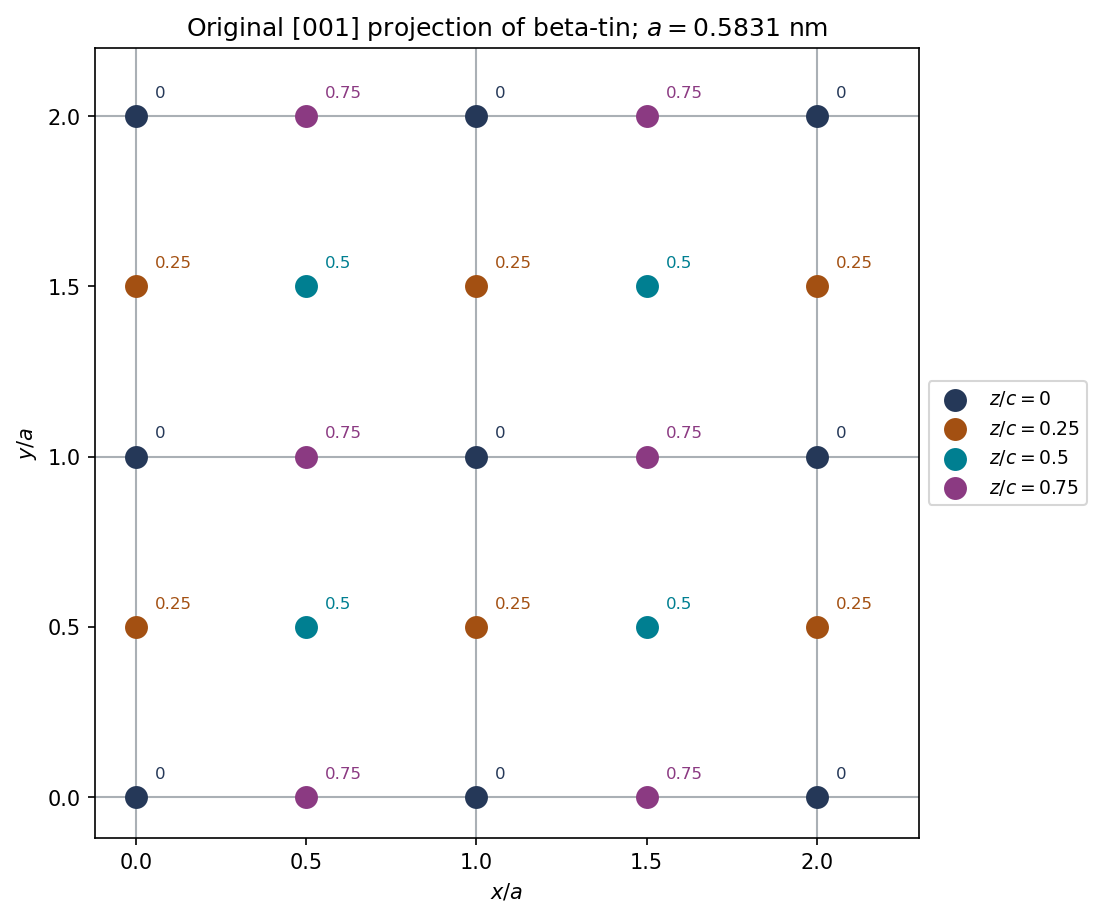
Original calculated projection of two-by-two conventional beta-tin cells; colors and labels give fractional height, not different chemical species
. Details. 
The plotted repeat is in both horizontal directions. Atoms on the outer drawing boundary are repeated images needed to show neighboring cells, rather than additional unshared atoms in the four-cell counting volume.
The metallic conventional cell has four tin atoms, whereas the conventional diamond cubic structure cell has eight. Therefore the volume per atom isThe fractional change for metallic to nonmetallic tin isThe atom count is unchanged, so this is also the unconstrained bulk volume change for complete transformation under the model. If it were macroscopically isotropic, the corresponding free linear expansion would be .
Such a large transformation strain creates stresses where transformed and untransformed regions constrain one another. Cracking, loss of mechanical integrity and disintegration can follow: the phenomenon is tin pest. The calculation establishes the volume mismatch, not the transformation rate; temperature, nucleation and impurities affect when a real specimen changes.
The 020 reflection is extinguished by the diamond basis, even though it satisfies the face-centered lattice parity rule. Write the diamond structure as an FCC lattice with identical atoms at basis positions and .
The structure factor separates into lattice and basis terms:At , all indices are even, so the first bracket is . The second bracket is . The two identical sublattices scatter with opposite phases and cancel:For all-even reflections of diamond, the additional allowed condition is divisible by four. This is a systematic absence, not an absence of the corresponding family of geometrical planes.
Articles by others on the same topic
There are currently no matching articles.