For a disordered face-centered cubic lattice, equal average scattering factors on the four sites give reflections only when are all even or all odd. Bragg's law also requires . With Fe K wavelength , the upper bound is . The allowed sums are , givingThe next allowed family, , has squared-index sum and cannot satisfy the diffraction condition for this wavelength. This list assumes the full geometrically accessible angular range, rather than an instrument-specific cutoff.
Successive planes normal to are chemically ordered Au and Cu layers. The supplied four-site cell is a convenient doubled description of the primitive tetragonal lattice: valid primitive translations areThey give a square basal cell of side , containing an Au basis atom at the origin and Cu at fractional . That last vector exchanges chemical species and is not a Bravais translation. Thus a face-centred-looking atomic arrangement does not make the chemically ordered material an FCC Bravais lattice. This is the L10 crystal structure; the following indices retain the larger cell specified in the question.
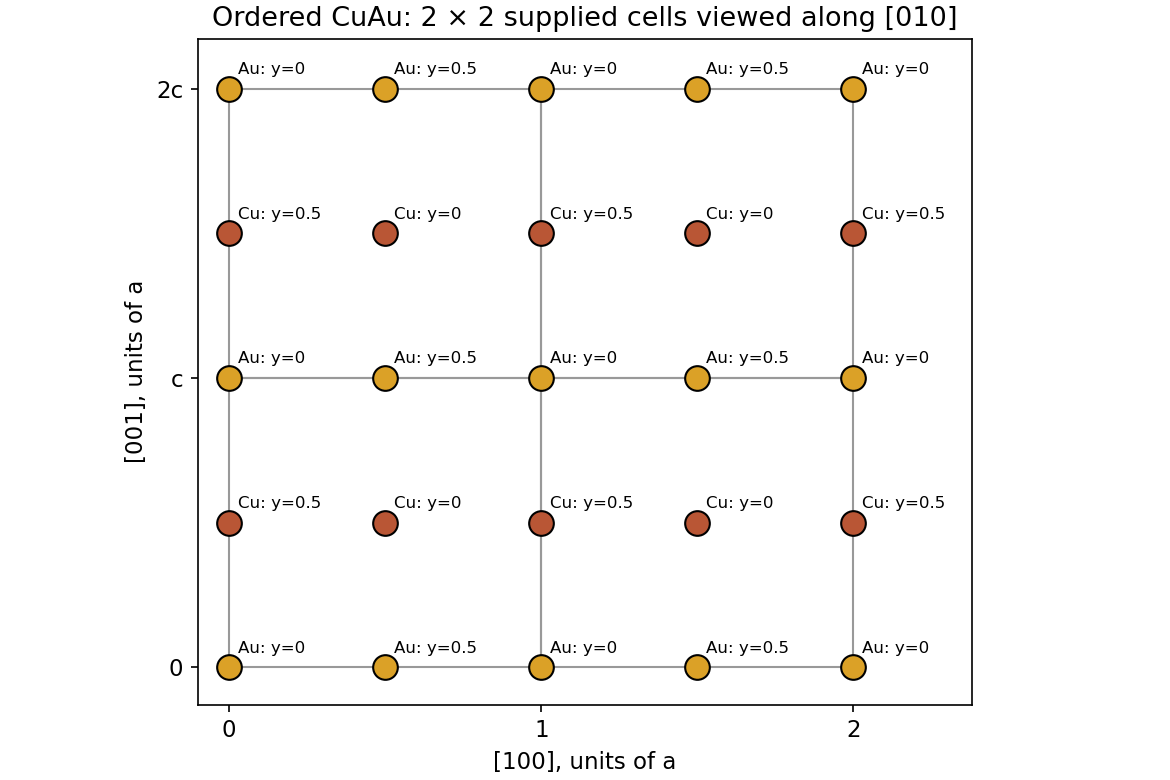

Summing phase-weighted atomic scattering factors over the four positions givesIf have different parity, the reflection vanishes. If they have equal parity, this becomes . The difference reflections reveal chemical order; they disappear when all sites instead have the same average scattering factor.
Ordering reflections by with , the first three nonzero families are , and . The family is extinct. Their structure factors areThe atomic scattering factors in each expression are evaluated at that reflection's scattering vector, so equal symbolic forms need not mean equal numerical amplitudes at different angles. In particular, the low-angle superlattice peaks need not be the strongest peaks.
The first peak is , with ; the second is , with . Applying Bragg's law with givesThus , consistent with the approximate ratio used to order the reflections. These are the lengths of the supplied larger basal cell; the primitive basal lattice parameter is .
At a common test temperature and otherwise comparable microstructure, chemical order generally raises the yield strength. An ordinary FCC dislocation displaced by can interchange Au and Cu sublattices, creating an antiphase boundary behind it. This additional energy resists slip; paired dislocations can restore the order after the second member passes. The disordered phase does not pay the same ordering penalty. Comparing specimens actually tested at their different phase-stability temperatures also includes temperature-dependent mobility and recovery, so the ordering argument alone does not predict a unique measured strength ratio.
Articles by others on the same topic
There are currently no matching articles.