Put , , and . Substituting a sine-and-cosine trial solution for the forced harmonic oscillator givesThe complementary solution is , where . Every nonzero such solution is unbounded as , so boundedness on the whole negative time axis forces . This fixes the phase as well as the amplitude. In particular,
After the force is removed, the damped harmonic oscillator evolves freely. There is no impulsive force at zero, so both displacement and velocity are continuous. Matching the values in part (i) givesEquivalently,This is bounded in positive time, completing the unique globally bounded solution. The formulas also include , for which the forcing and solution both vanish.
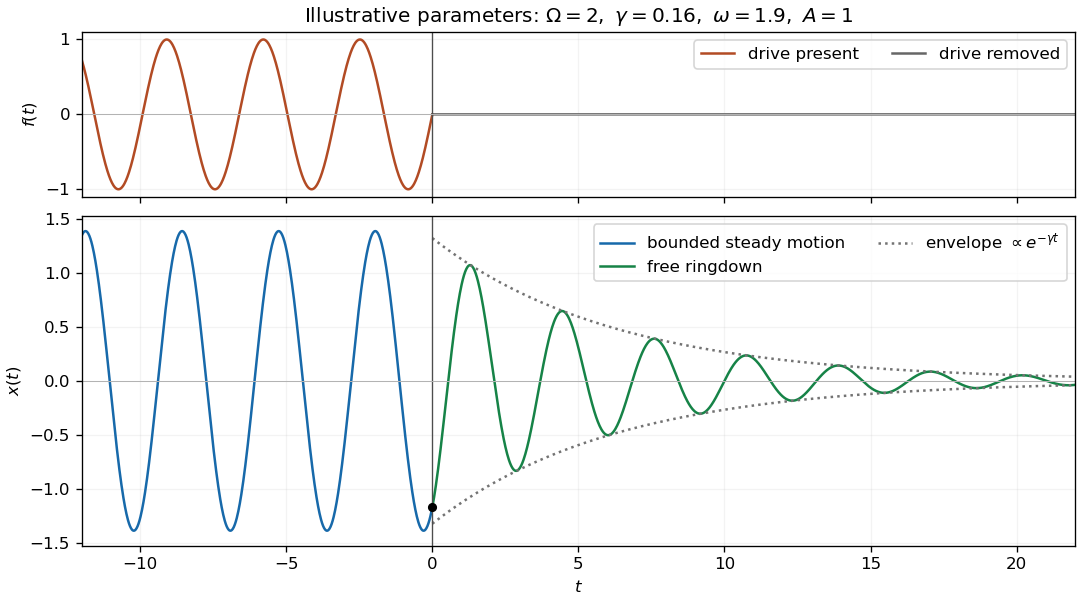

For a sinusoidal drive of variable positive angular frequency, the average absorbed power is proportional toIt peaks at . The absorbed-power bandwidth of a viscously damped oscillator is the separation of its half-power frequencies: solving givesThe usual quality factor is . Large means a narrow response band relative to the resonant frequency. The post-drive motion has amplitude envelope , connecting a narrow bandwidth to a long ringdown. For weak damping, the cycle-averaged energy decays as and is also times stored energy divided by the energy lost per cycle. The exact instantaneous energy has an oscillatory factor, so this cycle interpretation uses the weak-damping approximation.
Articles by others on the same topic
There are currently no matching articles.