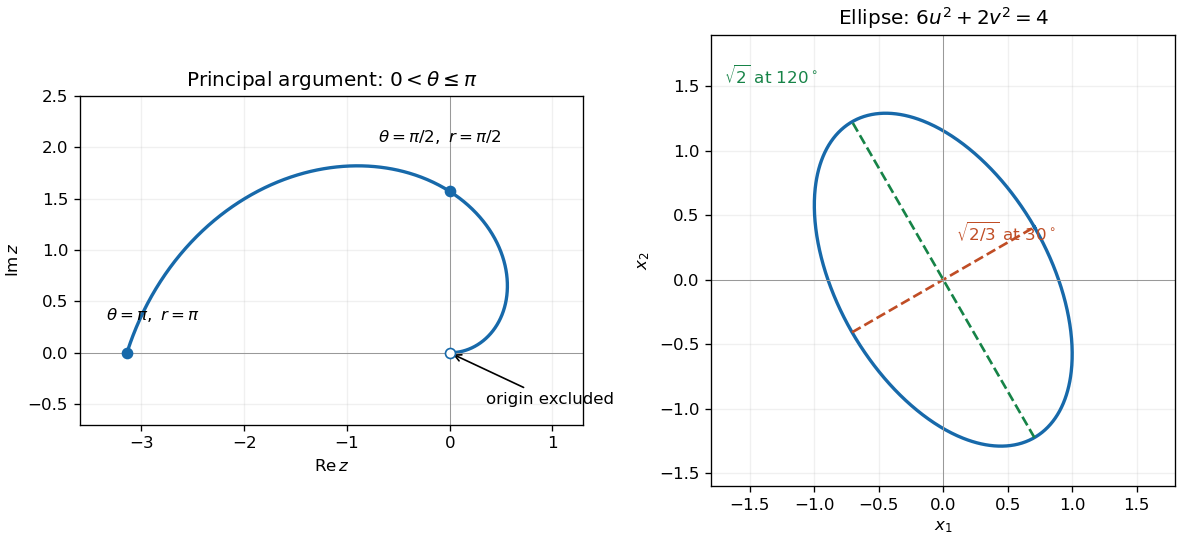
Use polar coordinates , where . The equation sets , giving an Archimedean spiral. The origin is excluded because the complex argument of zero is undefined. With the principal complex argument in , the locus isIt approaches the excluded origin along the positive real axis, passes through , and ends at . The choice of argument matters: the convention instead gives , while allowing all values of the complex argument gives every turn with .
All complex logarithms of are for integer . By complex exponentiation,Every value is positive and real. If the power is defined using the principal logarithm, the single value is . Keeping the logarithm branch explicit distinguishes this value from the full multivalued set.
An integrating factor for the first-order linear differential equation is . Multiplication givesSubstitute in the antiderivative: . ThereforeDifferentiating verifies the equation everywhere on the real line; no division by restricts the solution.
The addition formulas for the hyperbolic functions implySince , its fourth matrix power isAlternatively, the orthonormal eigenvectors have eigenvalues . Raising these eigenvalues to the fourth power gives the same result by spectral decomposition.
Taking the conjugate transpose reverses the product order: . ThusThe necessary and sufficient additional condition is that the two Hermitian matrices commute.
Complex conjugation changes to , and transposition reverses the factors. HenceThus the expression is a Hermitian matrix without any additional condition. Equivalently, the commutator of two Hermitian matrices is skew-Hermitian.
The diagonal entries of a Hermitian matrix satisfy , so each is real. Consequently their sum, the trace, is real. No additional condition is required. The same conclusion follows by summing the real eigenvalues.
If and , the Hermitian matrix identity givesbecause both eigenvalues are real. Thus eigenvectors belonging to distinct eigenvalues are automatically orthogonal. A simple spectrum guarantees this for an arbitrary choice of one eigenvector per eigenvalue.
Within a degenerate eigenspace, arbitrary independent eigenvectors need not be orthogonal. The Gram-Schmidt process always supplies an orthonormal basis of that eigenspace. Accordingly the existence of an orthonormal eigenbasis requires no additional condition, whereas automatic orthogonality of arbitrary independent eigenvectors is ensured by distinct eigenvalues. Scalar multiples of the same nonzero eigenvector are of course not mutually orthogonal.
The characteristic polynomial is . Corresponding normalized eigenvectors areThese form an orthonormal basis. Write ; the quadratic form becomesThe locus is an ellipse centred at the origin. Its minor semiaxis has length along the direction from the positive horizontal axis; its major semiaxis has length along . The right panel of the figure in part 1 shows these principal directions.
Subtract the first vertex from the remaining three to obtain edge vectors , , . Their scalar triple product isA tetrahedron occupies one sixth of the corresponding parallelepiped, so its volume isThe absolute value removes the orientation sign of the determinant.
The Leibniz formula for determinants is unchanged by interchanging rows and columns, or equivalently replacing each permutation by its inverse. Thus
Use the multiplicativity of the determinant on :The denominator is nonzero because is an invertible matrix.
Multiplying by multiplies each of its columns by . The multilinearity of the determinant therefore givesThis includes .
For an integer , repeated multiplicativity of the determinant, with the inverse identity for negative powers, givesFor an arbitrary real , an invertible real matrix does not by itself define a unique real matrix power. For example, the scalar matrix has no real square root. If a matrix logarithm has been chosen with and is defined as , the matrix exponential determinant identity gives the precise formulaThis cannot always be replaced by an independently chosen scalar branch of . For instance, has the complex square root , whose determinant is , while the principal scalar square root of is . For a positive-definite symmetric matrix with its usual positive spectral power, all eigenvalues are positive and the familiar formula holds for every real .
Let have columns and let have columns . The cross-product formulas defining the reciprocal basis giveprovided the original scalar triple product is nonzero. Taking determinants yields the reciprocal basis involution identityWhen , the displayed reciprocal vectors are undefined, so there is no additional zero-denominator case to evaluate.
In one dimension the nonzero vector already spans the real line. Hence , and translating it by leavesThis is an affine subspace containing the origin for every allowed choice of the three vectors.
The affine subspace is . If are linearly independent, their linear span is all of , so is the whole plane. If they are proportional, is the line through in direction . This line passes through the origin exactly when . Because is nonzero, the set cannot be a single point.
If are linearly independent, is the plane through with normal . Its equation isso it contains the origin exactly when . If are proportional, is the line through in direction , containing the origin exactly when is proportional to . The linear span of two nonzero vectors has dimension one or two, so neither a single point nor all of occurs.
For the remaining distance calculation with , every point on the line is . The nearest point to is found by orthogonal projection onto :Indeed, differentiating sets its component along to zero. Its second derivative is , proving this is the minimum.
A negative value of either radius makes the intersection empty. Assume henceforth and put . If , the two spheres are concentric: their intersection is the entire sphere when , the origin when , and empty otherwise.
For , subtract their squared equations to obtain the planeThe centre of the circle of intersection of two spheres is , whereEvery point of that plane can be written with . Its remaining equation isThus the intersection is a circle of centre and radius if ; a single point at either equality; and empty otherwise. These include tangency to a zero-radius sphere. A negative places the circle centre beyond the first sphere's centre on the side opposite .
In for , the same calculation gives an -dimensional sphere in the perpendicular affine hyperplane when , a point when , and the empty set otherwise. In two dimensions the positive-radius case consists of two points. In one dimension the perpendicular hyperplane has only one point, so a nonconcentric intersection exists only when . Concentric equal-radius sets coincide in every dimension.
Put , , and . Substituting a sine-and-cosine trial solution for the forced harmonic oscillator givesThe complementary solution is , where . Every nonzero such solution is unbounded as , so boundedness on the whole negative time axis forces . This fixes the phase as well as the amplitude. In particular,
After the force is removed, the damped harmonic oscillator evolves freely. There is no impulsive force at zero, so both displacement and velocity are continuous. Matching the values in part (i) givesEquivalently,This is bounded in positive time, completing the unique globally bounded solution. The formulas also include , for which the forcing and solution both vanish.
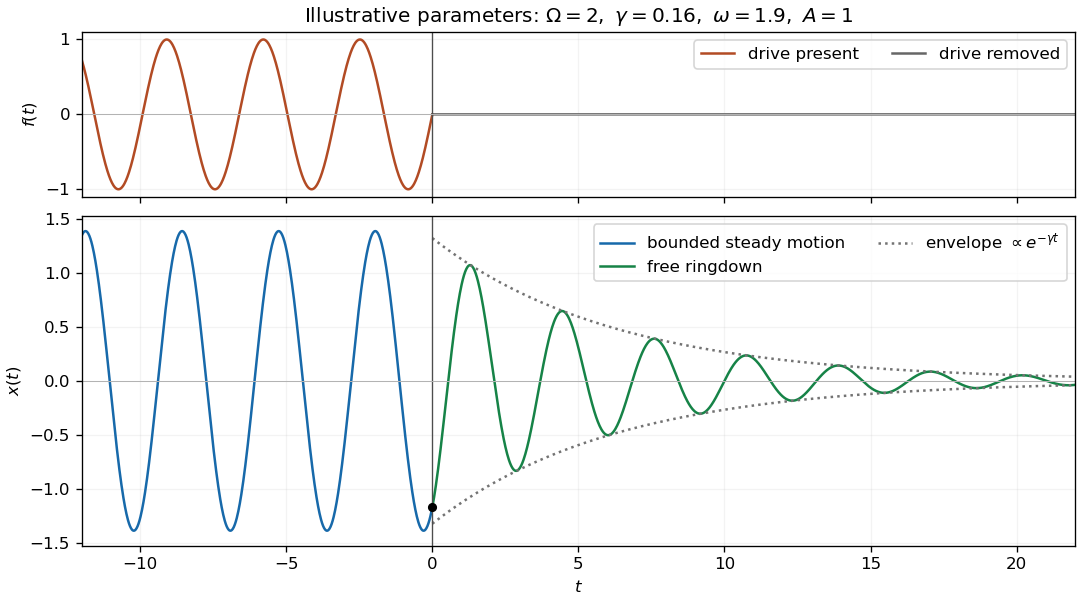


For a sinusoidal drive of variable positive angular frequency, the average absorbed power is proportional toIt peaks at . The absorbed-power bandwidth of a viscously damped oscillator is the separation of its half-power frequencies: solving givesThe usual quality factor is . Large means a narrow response band relative to the resonant frequency. The post-drive motion has amplitude envelope , connecting a narrow bandwidth to a long ringdown. For weak damping, the cycle-averaged energy decays as and is also times stored energy divided by the energy lost per cycle. The exact instantaneous energy has an oscillatory factor, so this cycle interpretation uses the weak-damping approximation.
Direct multiplication of the Pauli matrices gives , and its cyclic permutations; reversing unequal factors changes the sign. Hence, using the Levi-Civita symbol,Repeated is summed, while the Kronecker delta handles the equal-index case.
For , multiplying each Pauli matrix between and givesAll three components are real. Moreover . Thus normalized two-component spinors map to the radius- version of the Bloch sphere; the usual unit-radius convention multiplies these coordinates by two.
Each Pauli matrix is Hermitian and the coefficients are real, so . Taking the conjugate transpose of the absolutely convergent matrix exponential series yieldsThe exponents and commute. Therefore , proving that is unitary.
If with , induction gives for every nonnegative integer . Substituting into the matrix exponential series givesThus each eigenvector of is an eigenvector of , with eigenvalue . Different eigenvalues of can produce the same exponential eigenvalue.
The anticommuting unequal Pauli matrices cancel the cross terms, leavingAlso , so its eigenvalues are . ConsequentlyFor , the matrix exponential for a scalar square also gives . At , its continuous limit is . The two exponential eigenvalues coincide when , making .
With only nonzero, andFor , the eigenvectors are the nonzero multiples of and . When , and every nonzero vector is an eigenvector.
The transformed components are , . Hence , while the two moduli are unchanged. Taking real and imaginary parts in the expression from part (ii) givesThis is a right-handed active rotation through about the third axis. The minus sign follows from the positive sign in ; changing that convention reverses the rotation. A spatial rotation changes the spinor sign while leaving the three-vector unchanged.
A fixed point obeys . Thus the necessary and sufficient existence condition isIf is not an eigenvalue of , then is an invertible matrix and the unique constant solution is . If is singular but the equation is consistent, all constant solutions are for any particular solution . For an existing fixed point, ; the successive difference in the question likewise obeys .
Repeated substitution in the affine iteration givesTherefore the required matrix polynomials areThese formulas do not require an inverse. If is an invertible matrix, multiplying the finite geometric sum by gives .
For a diagonalizable matrix, write . Relative to an existing fixed point,Convergence to the same fixed point for every initial vector therefore holds exactly whenHere is the spectral radius. Necessity follows by choosing an initial displacement in each eigenspace; sufficiency follows because every displayed scalar power tends to zero. The condition also makes an invertible matrix, so that fixed point exists uniquely for every .
If instead different initial vectors may converge to different constant solutions, an eigenvalue is allowed: all other eigenvalues must have modulus less than one, and the component of in the eigenspace for must vanish. That component of the initial vector then remains unchanged. No other unit-modulus eigenvalue is compatible with convergence for arbitrary initial vectors.
Because is a real symmetric matrix, differentiating the quadratic form givesThus the stationary vectors are precisely , and at every one of themThe zero vector is always stationary. Nonzero stationary vectors exist exactly when is an eigenvalue of , and are exactly its nonzero eigenvectors with that eigenvalue. There is no norm constraint here; introducing one would change the stationary-value problem.
The second gradient is . Combining its vanishing with givesThe zero vector always works. A nonzero common stationary vector exists exactly when have a common eigenvector with respective eigenvalues ; both stationary values are then zero. Commuting symmetric matrices have a common orthonormal eigenbasis, so commutation is sufficient to find such vectors for the paired eigenvalues in that basis. It does not guarantee an arbitrary prescribed pair.
Commutation is also not necessary for one common eigenvector. For example,are real symmetric matrices sharing with eigenvalues , but . This separates the question's common-vector condition from the stronger simultaneous diagonalization of the entire space.
Articles by others on the same topic
There are currently no matching articles.