Assume , and . The spring constant measures restoring force per displacement from the equilibrium position . The term is linear drag, with damping rate in inverse-time units. Writing , the equation isFor small positive damping it gives underdamped motion: oscillations about with a decaying amplitude. If , the motion is undamped simple harmonic motion.
Set . The real solution of the damped harmonic oscillator equation is . The initial displacement fixes , and release from rest gives . ThereforeThe exponential decay rate of the amplitude is , while the weak-damping energy decay rate is .
The amplitude envelope falls by when , so . Dividing by the period givesThis is a cycle-count estimate in the small-damping regime, not necessarily an integer. With zero damping there is no amplitude decay and no finite such time.
The weak-damping mechanical energy is proportional to the squared oscillation amplitude, so it decays as . Over one period , the fractional loss is . HenceFor the release-from-rest solution, comparison at successive corresponding turning points gives the more precise ratio . The quality factor is ; the requested energy-to-loss ratio itself has the extra factor .
The moving equilibrium produces a forced harmonic oscillator:A particular solution is , where . The denominator equals , so it cannot vanish for real under the given underdamping condition. Imposing both initial conditions givesFor , , so the entire oscillatory term vanishes:The body is tracking an exponentially moving equilibrium without oscillation. There is no spring extension in this special motion: linear drag alone supplies . An underdamped homogeneous equation does not require every forced solution to contain an oscillatory transient.
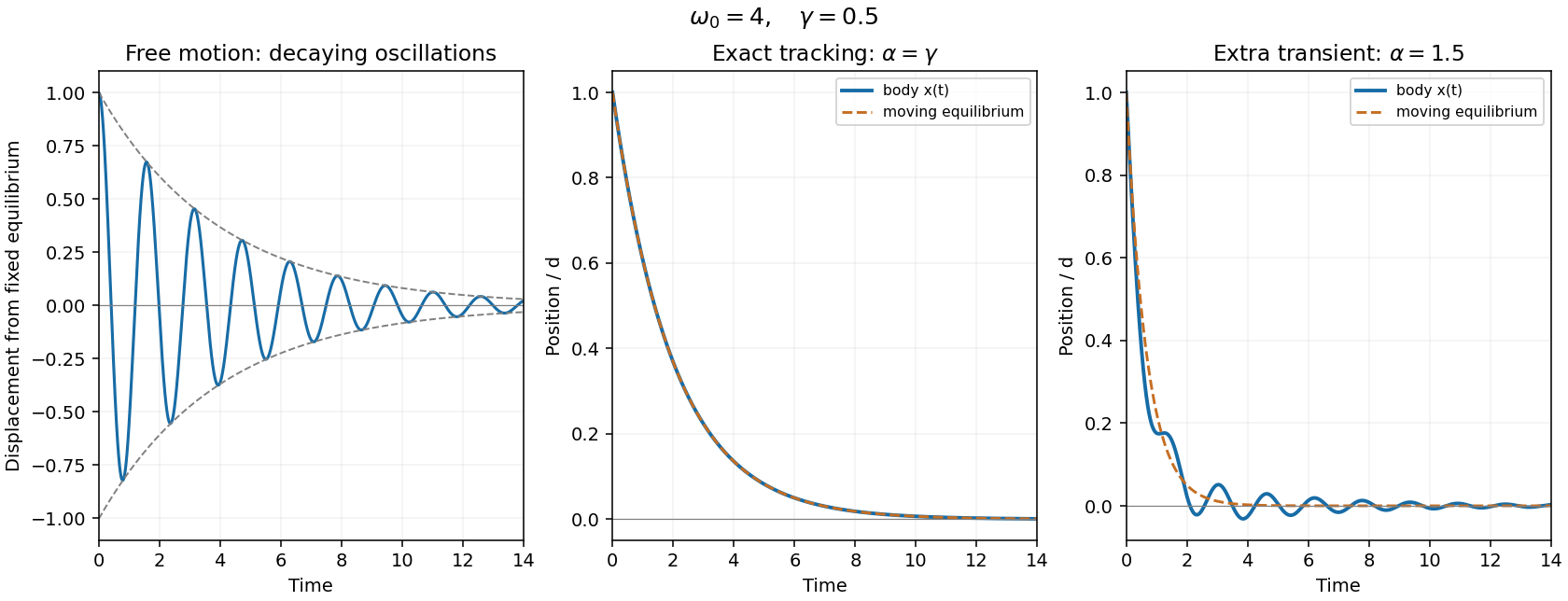
Free damped oscillations and exact tracking of an exponentially moving equilibrium
. Details. 
Articles by others on the same topic
There are currently no matching articles.