Write . The three complex roots areOn the Argand diagram, these are three equally spaced points on the circle , with arguments . They are isolated points, rather than the whole circle.
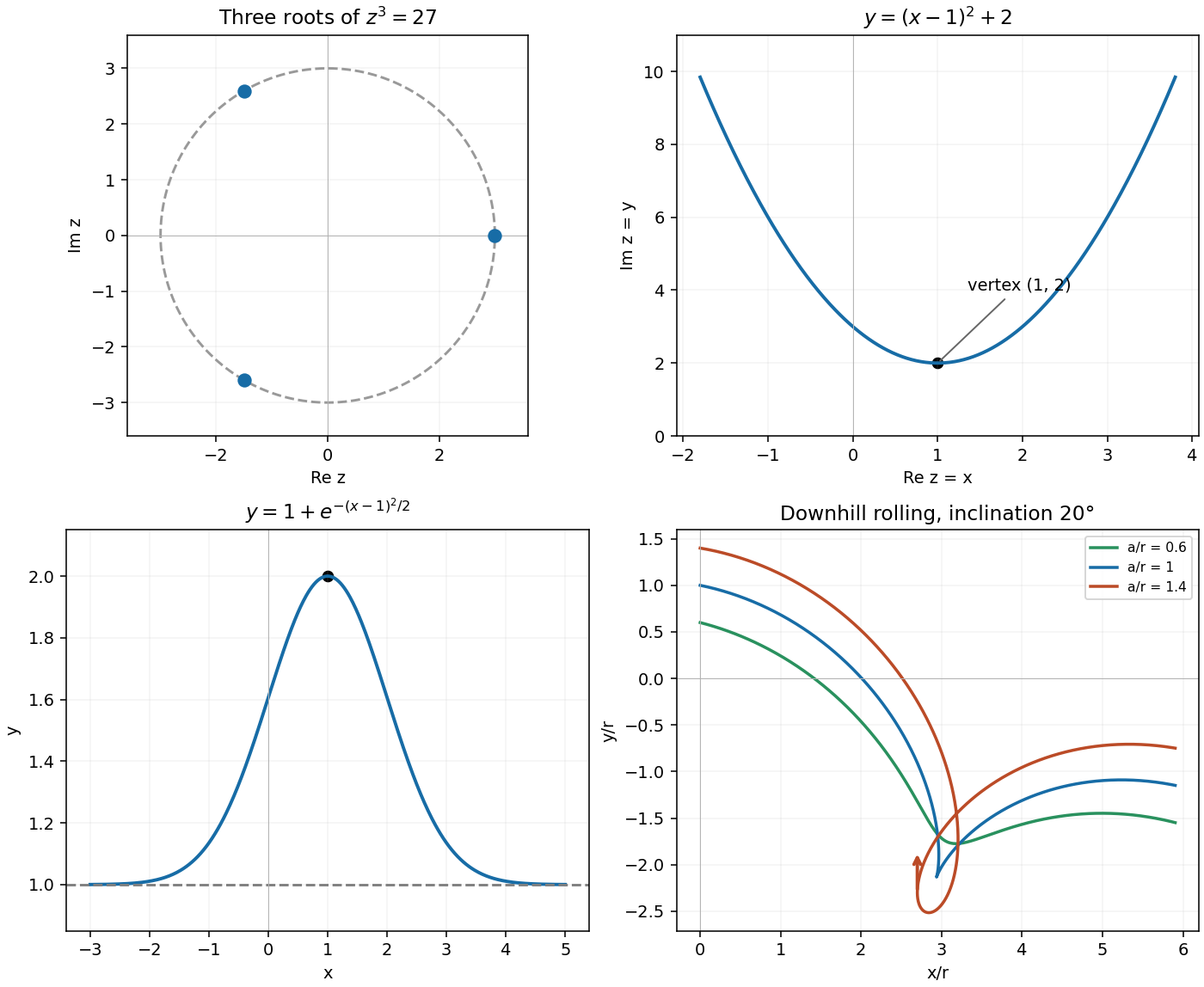
Complex root and parabola loci, a first-order differential-equation solution, and rolling-point trajectories
. Details. Put and . The first two squared terms are complex conjugates, so their sum is . Also . The equation therefore reduces toThus the locus is the upward-opening parabolawith vertex and axis in the Argand diagram.
Expanding the determinant along its first row givesThe required factorization isEach factor is a symmetric polynomial. The second is , making its permutation symmetry especially transparent. This factorization holds over both real and complex coefficients.
Let , and . For distinct centres, the two spherical surfaces intersect exactly whenStrict inequalities give a nondegenerate circle; equality gives a single tangency point. If , equal radii give coincident spheres and unequal radii give no intersection, so the circle-centre formula below does not apply.
Subtracting the squared sphere equations gives the radical planeThe centre of the circle of intersection of two spheres is the projection of either sphere centre onto this plane. Write ; substitution gives and henceThe circle radius squared is , providing another check of the intersection conditions.
Its centre equals precisely when , or . For a positive first radius, the intersection is then a great circle of the first sphere. A triangle from its centre to an intersection point and then to the second centre is right-angled at , explaining the Pythagorean theorem relation geometrically.
Choose the cylinder centre's initial position as the coordinate origin, with downhill motion to the right and . For rolling without slipping, the clockwise angular speed is . A point initially vertically above the axis therefore hasA different origin adds constant coordinates without changing the following velocity test. Setting gives and .
For strictly upward motion, and . The first condition fixes ; choose the negative sine branch to maximize . Positivity then requiresAt the relevant point is momentarily stationary, not moving upward. Thus a material point inside or on an ordinary cylinder cannot move exactly vertically upward in this motion. The mathematical extension describes the looping trochoid of a point beyond the rolling radius, illustrated in the figure.
Rearrange as and put . The resulting linear differential equation is , soThe initial condition gives . Its graph is a Gaussian function above the horizontal asymptote , symmetric about , with its maximum there. It rises for and falls for , since .
A plane through the three points also contains the origin exactly when their position vectors are linearly dependent. The scalar triple product isThus . The resulting plane is , which contains all three points and the origin. The points are not collinear: the differences and cannot be proportional, since their last two components would require . Therefore the plane used in the argument is well defined.
For a diagonal matrix, each diagonal entry separately obeys . Hence all four possibilities areFor the second form, givesBecause are linearly independent and , the coefficient forces ; the coefficient then gives . ThusBoth constants are nonzero, as required.
For the Bernoulli differential equation, work on a branch where and the required powers are defined. Multiplication by makes the chain rule useful:Thus , and . The case is already linear and must be treated separately, because the proposed substitution would be constant. Solutions lost by dividing by a power of , particularly when it solves the original equation, must also be checked separately.
Here , so obeys . An integrating factor is , givingThe nonzero solutions are thereforeThe additional solution is . Each formula is interpreted on an interval where is defined and its displayed denominator is nonzero.
The given particular solution suggests the standard reduction of a Riccati equation. Substitution of givesOn either side of , an integrating factor is , so . Hencealong with the separately recovered particular solution . The denominator must remain nonzero on the solution interval; is a singular point of the divided differential equation.
For the positive- branch, and . Nonsingular endpoint values exclude , soThe particular solution gives the same value directly. These evaluations concern one solution branch, with a common integration constant, rather than independently chosen solutions at the two points.
Both expressions are the same scalar:This identity uses the ordinary transpose and remains true for complex entries. A Hermitian inner product uses a conjugate transpose instead and has conjugate symmetry, not this bilinear symmetry.
The coordinate is an independent eigen-direction, while the block is . Thuswhich gives . The eigenspaces areDivide the two diagonal vectors by to obtain an orthonormal eigenbasis. The eigenvalue one has multiplicity two; giving only the axis would omit an independent eigenvector.
Because is symmetric, translating givesThe linear term vanishes when . Solving gives . Since , the remaining constant isThis is completing the square for a quadratic form.
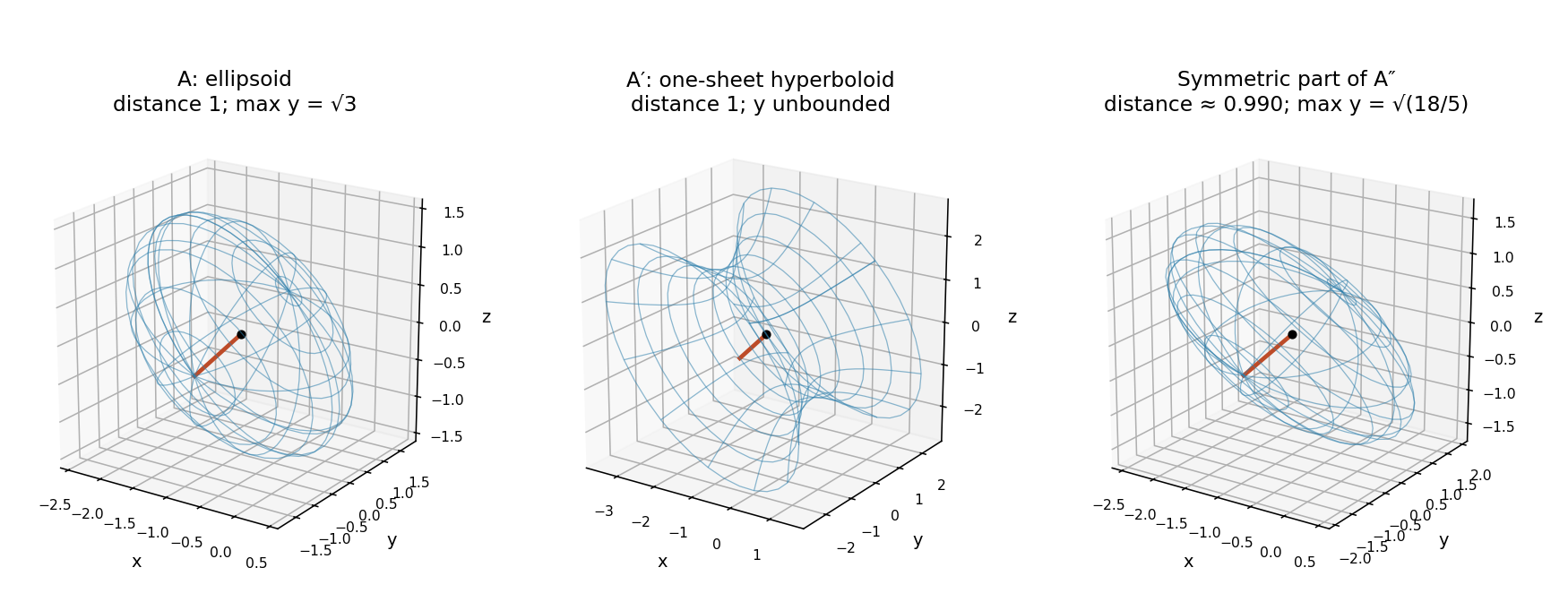
An orthogonal transformation to the eigenvectors preserves distance from the centre and writes the surface as . It is an ellipsoid with semi-axes . ThereforeThe original axis is one of the eigen-directions with eigenvalue one, and the centre has . Consequently , attained when the other centred coordinates vanish, so .
For , the centre and constant remain and . Its eigenvalues are , so rotated coordinates put the surface in the form . This is a one-sheet hyperboloid. Since , the nearest centre-to-surface distance is at least one, attained in the eigen-direction with eigenvalue three. The coordinate is unbounded, because arbitrarily large can be balanced by or . Thus the nearest distance is one, and there is no maximum value of .
For the printed nonsymmetric , use the symmetric part of a matrix:The skew-symmetric part contributes zero to this scalar. The same centre solves , and again . Sylvester's positive principal minors are , so this surface is an ellipsoid.
Let be the largest eigenvalue of . Its characteristic equation is , and the Rayleigh quotient givesFor the maximum , the support function of a centred ellipsoid gives the bound below. Equivalently, apply the Cauchy-Schwarz inequality in the -weighted inner product: . The inverse entry is , and equality is attained for a centred vector proportional to . Thus


Using the eigenvalues of the raw nonsymmetric would be incorrect: it is its symmetric part that determines the surface and its Euclidean geometry.
The vector is an eigenvector with eigenvalue one. The other two orthogonal directions give eigenvalues two and five, leading toIts columns are an orthonormal eigenbasis, so and . Multiplying by and gives . Eigenvector signs and the joint order of columns and diagonal entries may be changed consistently.
The matrix exponential acts entrywise on a diagonal matrix, soFor the two-dimensional matrix , direct multiplication gives , hence for . Summing its defining power series givesFinally, , so each diagonal entry is a weighted sum of these exponential eigenvalues, with weights equal to squared eigenvector components:
In a submultiplicative matrix norm, the exponential series is absolutely convergent. Its Cauchy product can therefore be grouped by the total degree:When , the inner sum is by the binomial theorem. Thus . The commutation assumption is used precisely in that binomial expansion; absolute convergence alone does not supply it.
Assume , and . The spring constant measures restoring force per displacement from the equilibrium position . The term is linear drag, with damping rate in inverse-time units. Writing , the equation isFor small positive damping it gives underdamped motion: oscillations about with a decaying amplitude. If , the motion is undamped simple harmonic motion.
Set . The real solution of the damped harmonic oscillator equation is . The initial displacement fixes , and release from rest gives . ThereforeThe exponential decay rate of the amplitude is , while the weak-damping energy decay rate is .
The amplitude envelope falls by when , so . Dividing by the period givesThis is a cycle-count estimate in the small-damping regime, not necessarily an integer. With zero damping there is no amplitude decay and no finite such time.
The weak-damping mechanical energy is proportional to the squared oscillation amplitude, so it decays as . Over one period , the fractional loss is . HenceFor the release-from-rest solution, comparison at successive corresponding turning points gives the more precise ratio . The quality factor is ; the requested energy-to-loss ratio itself has the extra factor .
The moving equilibrium produces a forced harmonic oscillator:A particular solution is , where . The denominator equals , so it cannot vanish for real under the given underdamping condition. Imposing both initial conditions givesFor , , so the entire oscillatory term vanishes:The body is tracking an exponentially moving equilibrium without oscillation. There is no spring extension in this special motion: linear drag alone supplies . An underdamped homogeneous equation does not require every forced solution to contain an oscillatory transient.
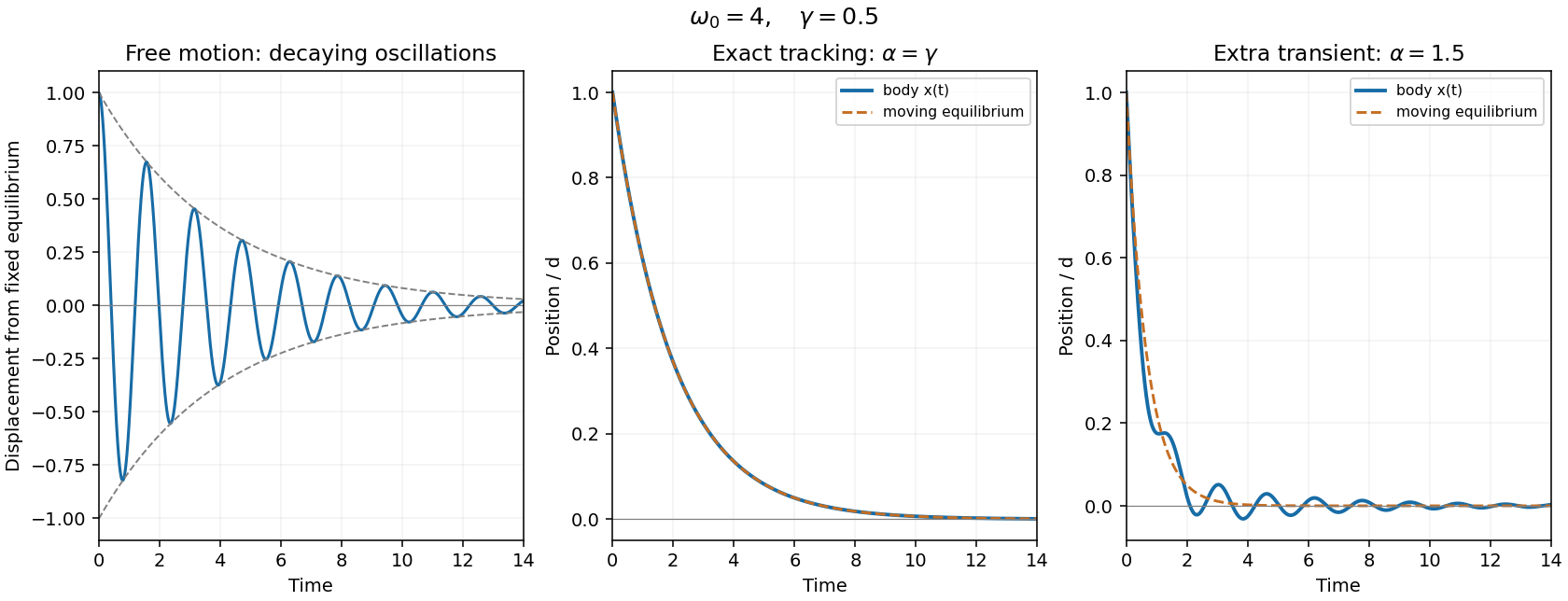
Free damped oscillations and exact tracking of an exponentially moving equilibrium
. Details. 
Articles by others on the same topic
There are currently no matching articles.