Measure the car's vertical displacement from its static equilibrium, so gravity's constant contribution is already balanced. Both the spring and the viscous damper act on motion relative to the wheel. The base-excited oscillator therefore satisfiesFor dimensional clarity write the road profile as ; the printed notation sets the implicit wave number in the chosen length units. Constant forward speed gives forcing angular frequency . With complex amplitudes , the steady response isSet for the expression in the question's notation. Assuming and , the transient response decays, leaving this steady-state response.
For a useful sketch define , and damping ratio . The displacement transmissibility isIt starts at , rises to a finite maximum for finite positive damping, crosses at , then tends to zero. Differentiation with respect to gives the maximum at .
Very small damping permits large resonant oscillations near , producing discomfort and potentially large suspension travel. At exactly zero damping the assumed decay of transients fails, and resonant forcing produces secular growth. Very large damping makes the car follow the bumps over a wide range of speeds, sacrificing vibration isolation: at each fixed forcing frequency, as . For any fixed finite damping the response still eventually decreases at sufficiently high frequency. These two limits should not be interchanged.
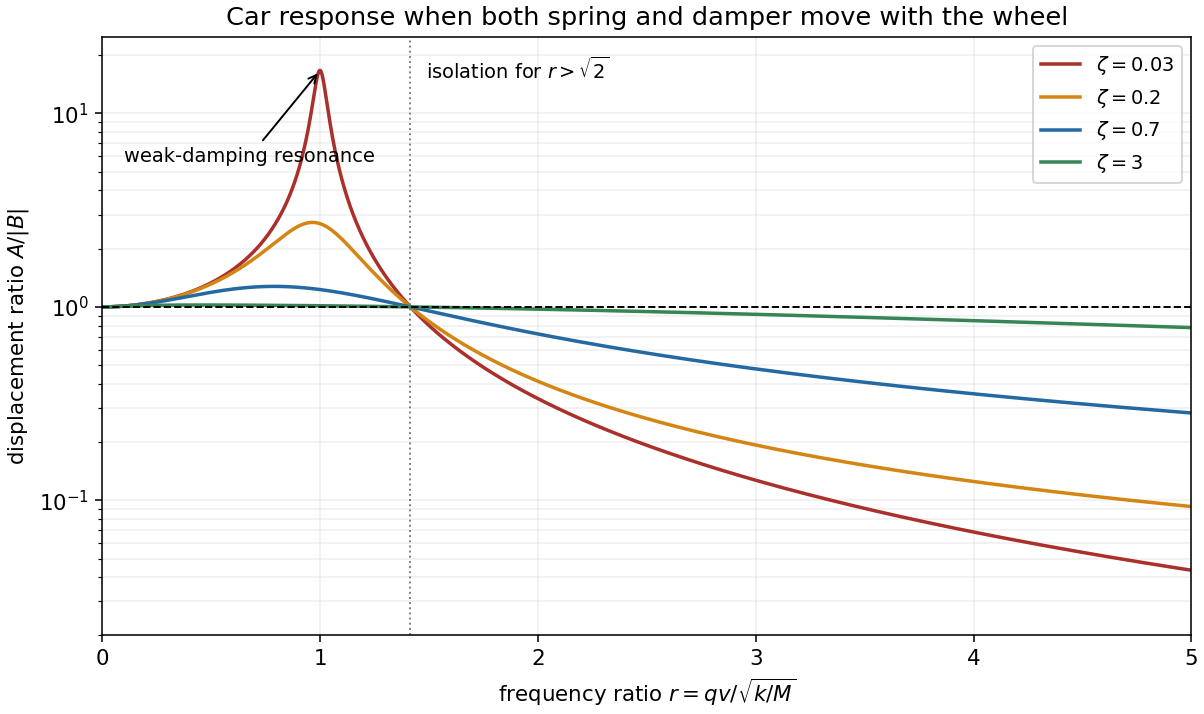
Base-excited car displacement response for several damping ratios, including the weak-damping resonance and isolation threshold
. Details. 
Articles by others on the same topic
There are currently no matching articles.