Hooke's law and Newton's second law give , so . The initial conditions select the simple harmonic motionThe kinetic energy and elastic potential energy exchange periodically while their sum is constant.
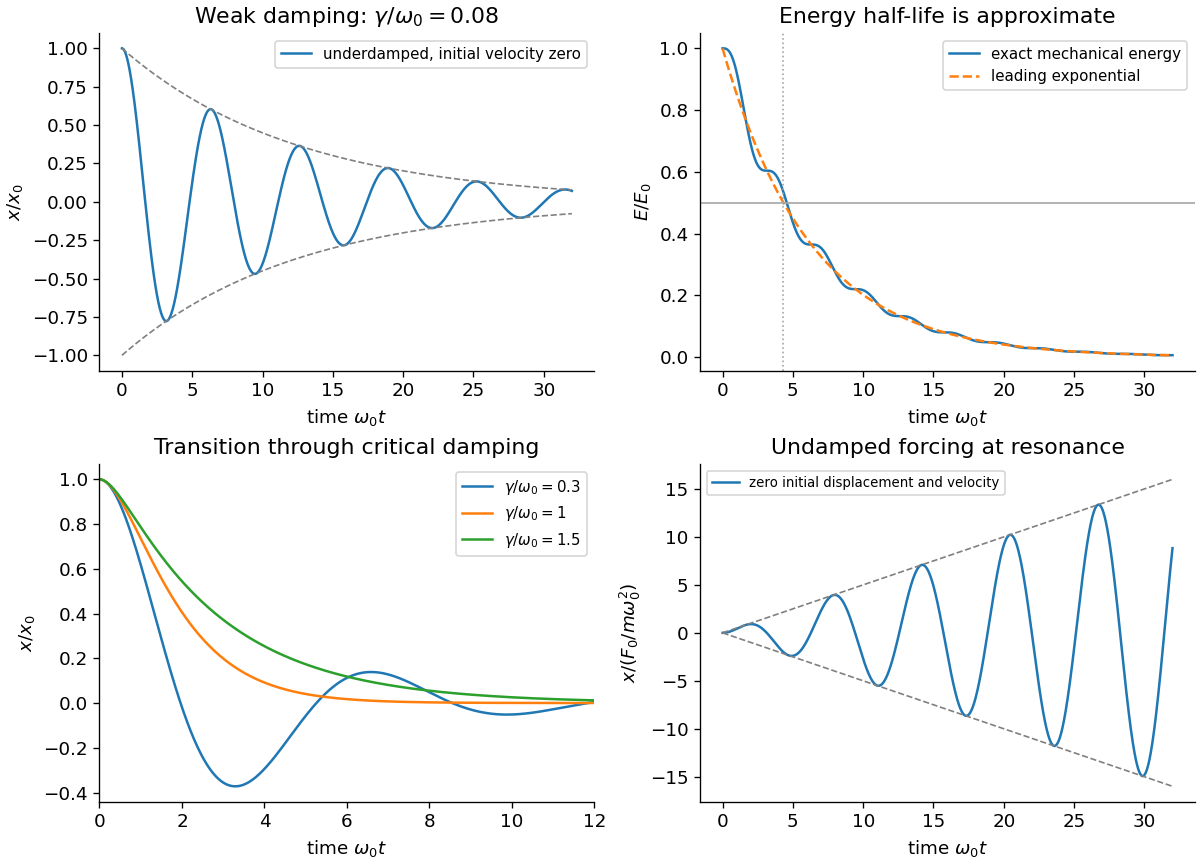
For the damped harmonic oscillator, the characteristic polynomial is . When , its roots are , with . ThusHere and are arbitrary real constants. The frequency is , and the amplitude envelope decays with time constant when ; the zero-damping limit recovers simple harmonic motion.
At critical damping, the characteristic polynomial has the repeated root . Its independent solutions are and , givingThe factor supplies the second independent solution that would be lost by using just one exponential. There is no oscillatory factor at this boundary between the underdamped and overdamped regimes.
The initial conditions in the underdamped solution give and . ConsequentlyThe exact mechanical energy is thereforeFor weak damping, , the bracket differs from one by a bounded relative correction of order . To leading order the energy and its half-life areThe exact identity confirms dissipation. The small rapid variation of the exponential-normalized energy does not mean that total energy increases; the half-life formula is a weak-damping approximation, not an exact equality for arbitrary .

Divide the external force by . Away from resonance a particular solution has the forcing frequency, so the general forced harmonic oscillator solution isThe two homogeneous terms cannot be discarded in an undamped system: they do not decay. If the same initial conditions are imposed, then , , where .
For , the forced displacement approaches : its amplitude decreases quadratically and it is in antiphase with the force. This statement concerns the forced component; a freely excited component at can remain.
At resonance the preceding denominator is zero and the appropriate solution isIts amplitude grows linearly because the external force supplies energy coherently. For , , choose and . Physical damping or nonlinear response ultimately limits the ideal resonant growth.
Articles by others on the same topic
There are currently no matching articles.