By De Moivre's theorem, . Expanding the cube and equating its real part givesThe last form uses ; comparing the imaginary parts similarly gives the corresponding sine identity.
A root of unity satisfies , hence has modulus one. Writing , its argument satisfies for some integer . The three distinct complex roots are thereforeThey are equally spaced on the unit circle. Taking exhausts them, since adding three to repeats a root and a nonzero polynomial of degree three has at most three distinct roots.
Factor out the same half-angle phase from the numerator and denominator:Here Euler's formula converts the bracketed sums to cosine and sine. Both sides require ; at the excluded angles the original denominator vanishes.
For , divide by to obtain the linear ordinary differential equation . An integrating factor is on either interval not containing zero. Thus andSubstituting gives directly. No classical solution can include , since the original equation there would assert ; constants on the two separate intervals need not agree.
The real logarithm requires . The identically zero function is a solution and must be retained before dividing by . For a nonzero solution, divide by and make the Bernoulli differential equation substitution . This givesIntegration yields . Consequentlywith each nonzero branch restricted to an interval where its denominator is nonzero. The right-hand side of the first-order equation is locally Lipschitz in for , so a nonzero solution cannot cross the zero solution at a finite positive .
An orthogonal matrix satisfies . Taking determinants and using gives , soThis calculation remains valid over the complex numbers: orthogonality uses the transpose, whereas a unitary matrix uses the conjugate transpose.
For a two-dimensional complex orthogonal matrix, let . Since , comparison with the two-by-two matrix inverse formula forces the second row to be if the first is . Thus the complete family isConversely direct multiplication gives and , proving sufficiency. The two parameters obey a bilinear constraint, not ; replacing squares by absolute squares would incorrectly impose unitarity.
The hyperbolic functions satisfy , so a useful family isFor real this gives a one-real-parameter family of complex orthogonal matrices, which is enough to exhibit the requested hyperbolic parametrization. It does not parametrize every matrix in part (ii). For example obeys the constraint but cannot have with real , since then .
Allowing complex gives the full parametrization: , so choose a complex logarithm with . Then and . A general complex pair therefore needs a complex parameter; the real-parameter restriction in the question should not be mistaken for a completeness claim.
Gaussian elimination of the first two equations gives and . The third then reduces to . HenceIn the infinite family , and , for . This makes the distinction between an inconsistent linear system and a free parameter explicit; its coefficient matrix has determinant .
With , the eliminated equation gives . Back substitution yieldsThe three left-hand sides are respectively , and , verifying the solution in the original linear system. Its determinant is , so this solution is unique.
For nonparallel lines, is perpendicular to both direction vectors. Every displacement between the lines differs from by a vector in their span, so its component along is fixed. Varying the two parameters cancels the component in that span. The shortest distance between skew lines is thereforeThis also gives zero for intersecting nonparallel lines. For parallel lines the denominator vanishes and the correct separate formula is .
The given lines have vector formsHere and . Their scalar triple product is , givingAs a constructive check, the closest parameters are and , where the connecting vector is and is perpendicular to both lines.
Hooke's law and Newton's second law give , so . The initial conditions select the simple harmonic motionThe kinetic energy and elastic potential energy exchange periodically while their sum is constant.
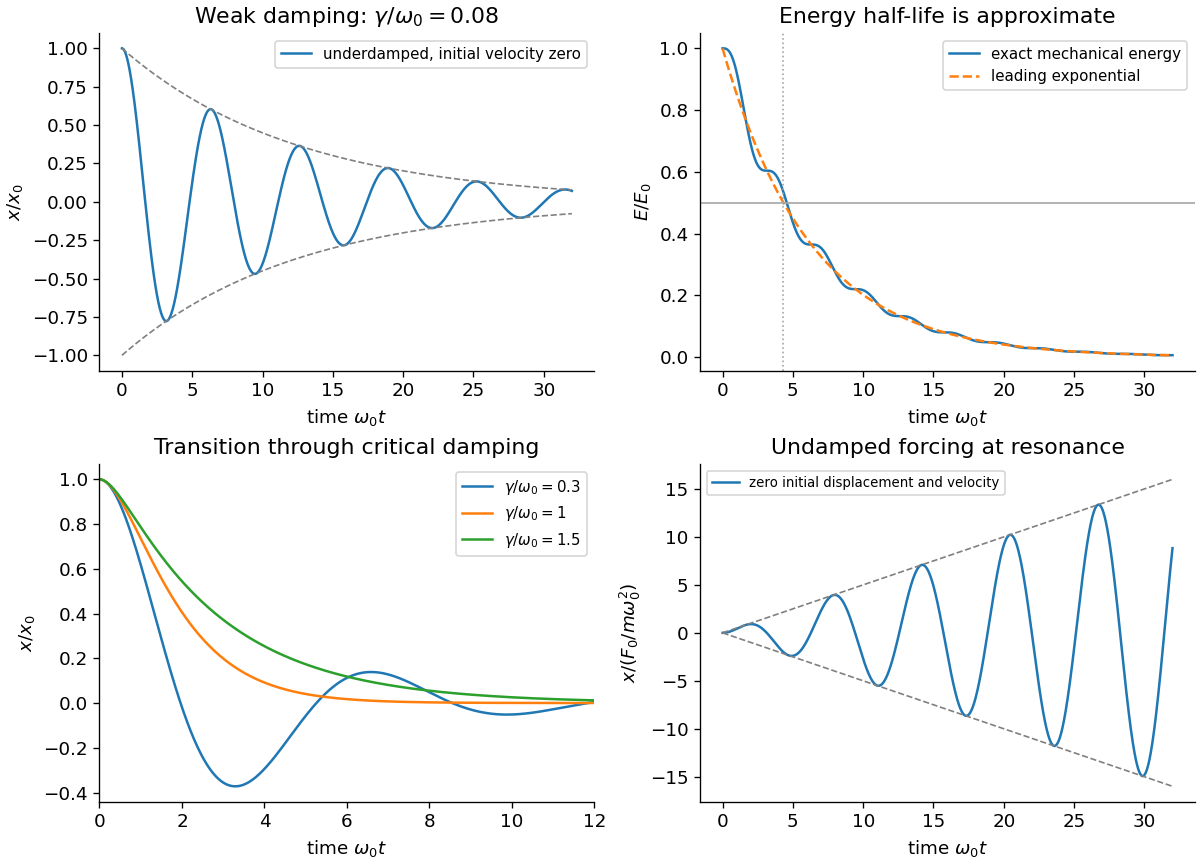
For the damped harmonic oscillator, the characteristic polynomial is . When , its roots are , with . ThusHere and are arbitrary real constants. The frequency is , and the amplitude envelope decays with time constant when ; the zero-damping limit recovers simple harmonic motion.
At critical damping, the characteristic polynomial has the repeated root . Its independent solutions are and , givingThe factor supplies the second independent solution that would be lost by using just one exponential. There is no oscillatory factor at this boundary between the underdamped and overdamped regimes.
The initial conditions in the underdamped solution give and . ConsequentlyThe exact mechanical energy is thereforeFor weak damping, , the bracket differs from one by a bounded relative correction of order . To leading order the energy and its half-life areThe exact identity confirms dissipation. The small rapid variation of the exponential-normalized energy does not mean that total energy increases; the half-life formula is a weak-damping approximation, not an exact equality for arbitrary .

Divide the external force by . Away from resonance a particular solution has the forcing frequency, so the general forced harmonic oscillator solution isThe two homogeneous terms cannot be discarded in an undamped system: they do not decay. If the same initial conditions are imposed, then , , where .
For , the forced displacement approaches : its amplitude decreases quadratically and it is in antiphase with the force. This statement concerns the forced component; a freely excited component at can remain.
At resonance the preceding denominator is zero and the appropriate solution isIts amplitude grows linearly because the external force supplies energy coherently. For , , choose and . Physical damping or nonlinear response ultimately limits the ideal resonant growth.
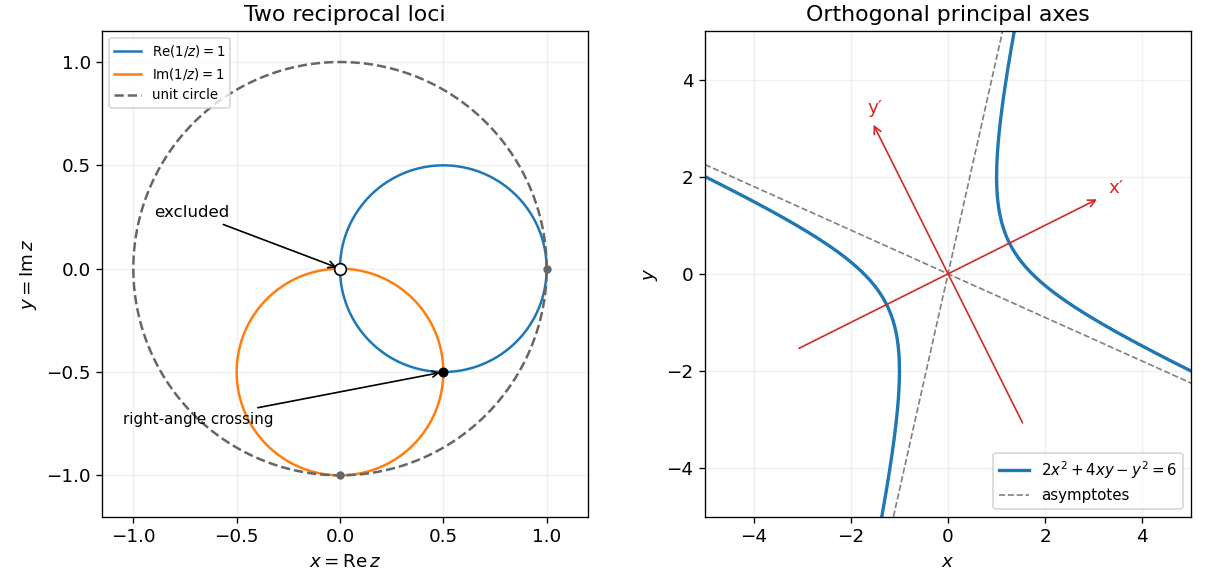
Write . Since , the two loci areThus they are radius- circles centred at and , each missing the origin. Their circle equations intersect at and , but only the latter belongs to the original loci. At that point the radius vectors are and , so the tangents meet at a right angle.
Every point on either circle has distance at most from the origin. Equality occurs only at on the first or on the second. The unit circle is therefore internally tangent to both and crosses neither. The sketch marks the excluded origin explicitly, rather than treating it as a second intersection.

The plane has normal vector of length seven. Projecting the displacement from any point on the plane onto the unit normal gives the distance from a point to a planeFor example the perpendicular foot is . Substitution places it on the plane, and its displacement from is parallel to , verifying that this is the minimum distance.
For nonzero vectors with angle , and . Hence gives Lagrange's identityIf either vector is zero both sides vanish, so this covers every case. Alternatively, expansion of the three cross product components gives the same identity without introducing an angle.
For the quadratic form of a squared cross product, express the two scalar terms as quadratic forms in :Then . In particular, for ,The cancellation is structural: , while its action on every vector perpendicular to a nonzero is multiplication by . Its eigenvalues are therefore ; for the whole matrix is zero.
The vectors are linearly independent over if with implies for every . Otherwise there is a nontrivial linear dependence. Forming a matrix with the displayed vectors as columns givesThusis the unique dependent case. At that value the explicit relation verifies the dependence.
Use the convention that the Hermitian inner product is conjugate-linear in its first argument and linear in its second. In orthonormal coordinates, . It satisfies conjugate symmetry, sesquilinearity and positive definiteness. Expanding in the orthonormal basis givesApplying the Hermitian inner product and yieldsThis identifies exactly where complex conjugation enters; replacing the first factor by would generally be wrong under this convention.
With a fixed unit normal , the Householder reflection is . It is a linear map because both the identity and the map are linear. Decompose , where and . ThenThus the tangential component is unchanged and the normal component reverses. Its norm and absolute normal component are preserved, proving equality of the physical incidence and reflection angles measured against the appropriate normal. Angles of the incident and reflected directed vectors to one fixed oriented normal are instead supplementary; equality uses the conventional acute angle to the normal line, or reverses the incident direction.
Since , direct multiplication gives . Every eigenvalue therefore satisfies . More specifically, the tangent plane is the eigenspace and the normal line the eigenspace. In the stated orthonormal basis, with the first two vectors tangent to the plane,This also proves both signs occur, rather than merely showing that any eigenvalue must belong to .
Matrix multiplication is associative, soThe uniqueness of the matrix inverse then givesThe order is reversed; does not generally work because matrix multiplication need not be commutative.
A symmetric matrix has , without conjugation. One invertible example with nonreal off-diagonal entries isIt is symmetric but not Hermitian, illustrating the importance of the distinction over .
A Hermitian matrix has . ChooseIts off-diagonal entries are complex conjugates and its diagonal entries are real, so the defining condition holds. It is also invertible.
A unitary matrix has . For example,This example is invertible, has nonreal off-diagonal entries, and preserves the standard Hermitian inner product. Although it is also symmetric, that additional property is not required for unitarity.
The quadratic form has symmetric matrixNormalized eigenvectors for and are and . They form the columns of the rotation matrixThus the new axis is rotated counterclockwise by , withThe opposite signs of the eigenvalues classify each positive level as a hyperbola. For the original level six its standard equation is ; for the final level one it is . The printed change of level therefore changes the scale, but not the principal axes or asymptotes.
Articles by others on the same topic
There are currently no matching articles.