Let be any smooth curve in the level surface . Differentiating the constant value along it givesThe curve tangent can be any tangent vector to a regular level set, soThe nonzero-gradient condition matters for determining a normal direction. For example, has the plane as a level set, but its gradient vanishes there and supplies no direction, even though the geometric plane has a well-defined normal.
Use the ambient position coordinates and a fixed point . The distance is , so . Taking its gradient gives . Therefore, away from ,It points from to . The gradient is taken in the surrounding space and then evaluated on the surface; the intrinsic surface gradient of restricted distance would instead be its tangential projection and need not have unit magnitude.
For reflection between the foci of an ellipse, assume and define . From part (b),On the ellipse this sum is normal to the tangent. Thus a unit tangent obeys . The magnitudes of the projections of the two unit focal directions on the tangent are equal, provingfor the corresponding acute, unoriented line angles.
More explicitly, let . The law of reflection maps an incoming unit ray towhich points from toward . Thus the equal-angle property has the correct incoming/outgoing ray orientation, rather than merely an algebraic bisector assertion.
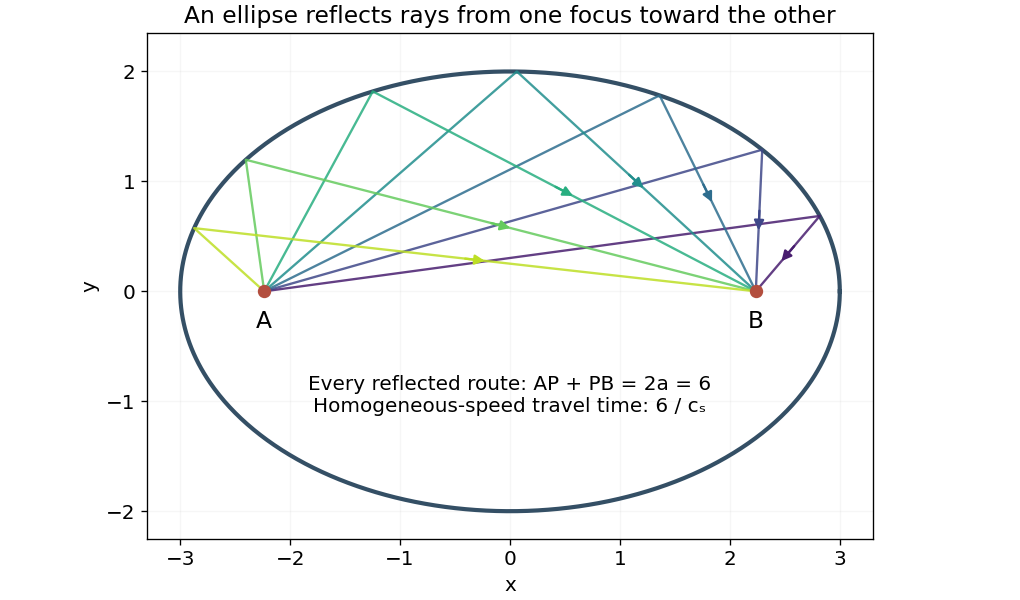

In a homogeneous medium and the short-wavelength ray approximation, a smooth reflecting elliptical boundary sends a ray from focus to focus after one specular reflection, by the equal-angle property just proved. Moreover, every such route has the same path length , hence the same propagation time for constant sound speed .
An ideal two-dimensional elliptical reflector, or the corresponding ellipsoidal geometry, therefore concentrates sound near the other focus; equal travel times also support coherent arrival for a monochromatic source with a consistent reflection phase. Finite wavelength, imperfect surfaces, absorption and three-dimensional room geometry limit the focusing. The result predicts a finite physical focal region, not an infinite intensity at a mathematical point.
Articles by others on the same topic
There are currently no matching articles.