For a right-moving sinusoidal string displacement , the instantaneous energy flux of a transverse string wave is . Averaging over one period gives . Since and ,The displayed power is a cycle average, not the time-dependent instantaneous power. Here denotes linear mass density, rather than the volume density used in the surface-wave calculation.
The wave speed is , so the frequency is and . Substituting the amplitude in metres,Power scales with the square of amplitude; converting millimetres to metres before squaring is essential.
Write the complex displacements as and . At a massless join, continuity of displacement and transverse force givesEliminating gives the displacement transmission coefficient and reflection coefficient,The angular frequency is shared across a stationary interface, whereas the wavelength changes. The equal-tension assumption is used in the slope condition.
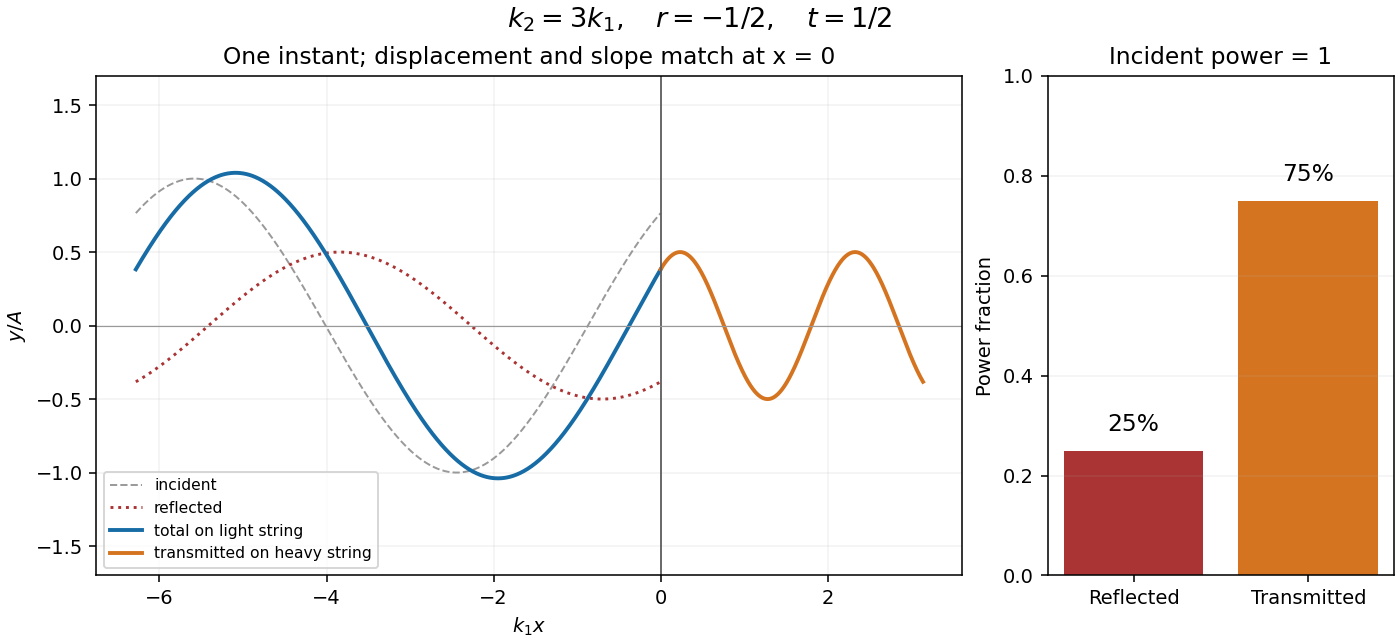

At the same tension, , so , and . The transmitted power fraction is not , because the two strings have different wave impedances. Using the energy flux of a transverse string wave,The reflected fraction is , so . The transmitted displacement amplitude is and its wavelength is . The negative indicates a reflected phase reversal; it does not mean negative reflected energy.
Articles by others on the same topic
There are currently no matching articles.