For the zero normal mode, . The molecule translates uniformly; a common constant displacement is the special case . For the lower vibrational normal mode, put :The end atoms move oppositely with equal amplitudes, while the central atom remains stationary. In the higher vibrational normal mode, with ,The ends move together and the centre moves in the opposite direction, with central amplitude times an end amplitude. Both internal modes keep the centre of mass fixed and obey mass-weighted orthogonality. The zero mode instead describes motion of that centre of mass.
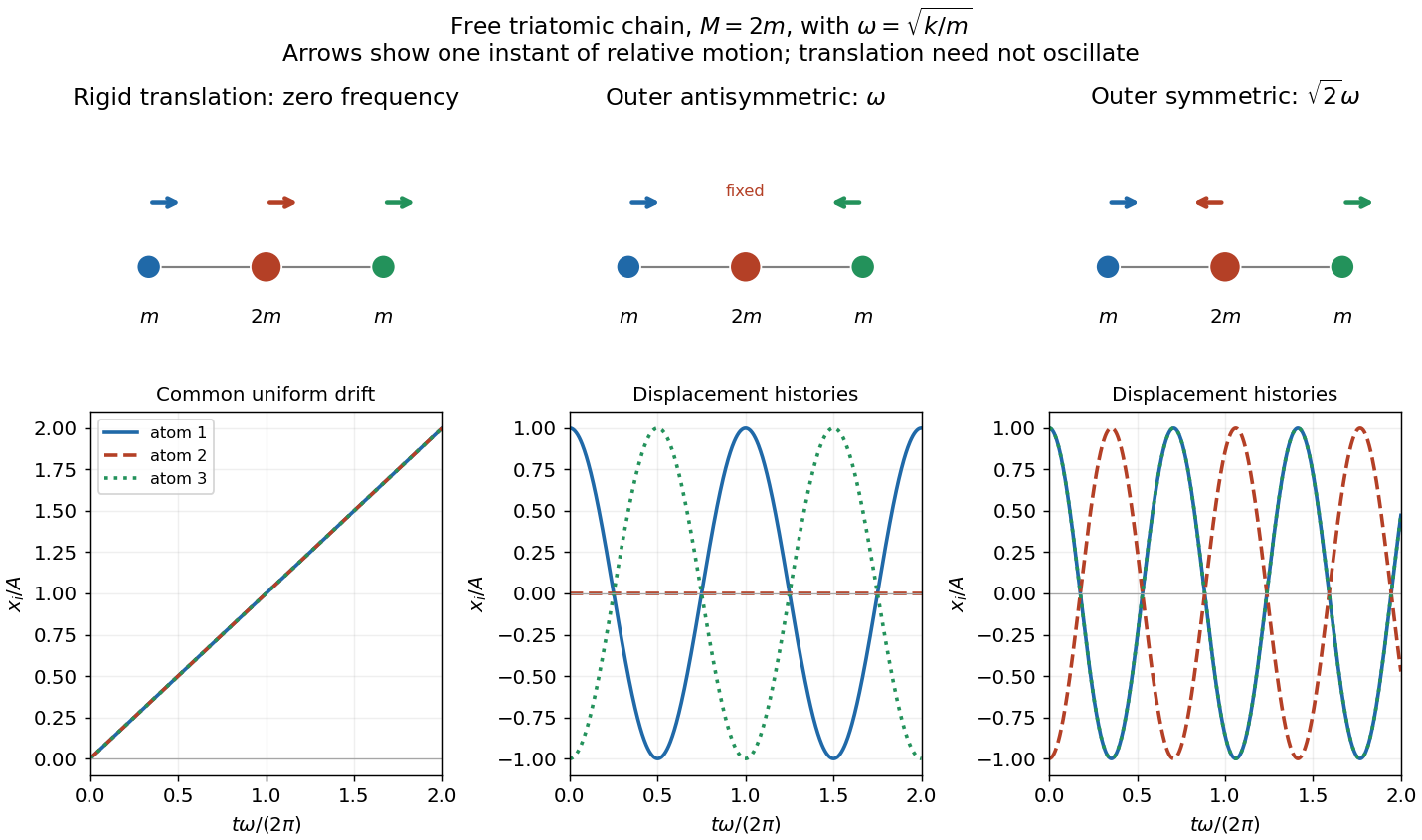
Three free-chain mode shapes and their displacement histories, shown for central mass twice an end mass
. Details. 
Articles by others on the same topic
There are currently no matching articles.