Each spring force is its extension multiplied by the spring constant, acting to restore the equilibrium. The equations of motion areNo end is attached to a wall. The spring extensions are and , giving potential energy .
A normal mode has a fixed pattern of relative displacements, with every coordinate proportional to one common time-dependent factor. There are three independent normal modes in this three-coordinate model: two internal vibrations and one zero-frequency rigid-body translation. The latter moves all three atoms together without stretching either spring. This count concerns the specified one-dimensional model, rather than a molecule with unrestricted three-dimensional motion.
Write the displacement as . The generalized eigenvalue problem isThe symmetry of the two end atoms suggests an end-antisymmetric shape and two end-symmetric shapes. Direct substitution gives the normal modes of three masses connected by two equal springs:These three independent eigenvectors exhaust the three-dimensional system. The ordinary frequencies are ; the values above are angular frequencies.
For the zero normal mode, . The molecule translates uniformly; a common constant displacement is the special case . For the lower vibrational normal mode, put :The end atoms move oppositely with equal amplitudes, while the central atom remains stationary. In the higher vibrational normal mode, with ,The ends move together and the centre moves in the opposite direction, with central amplitude times an end amplitude. Both internal modes keep the centre of mass fixed and obey mass-weighted orthogonality. The zero mode instead describes motion of that centre of mass.
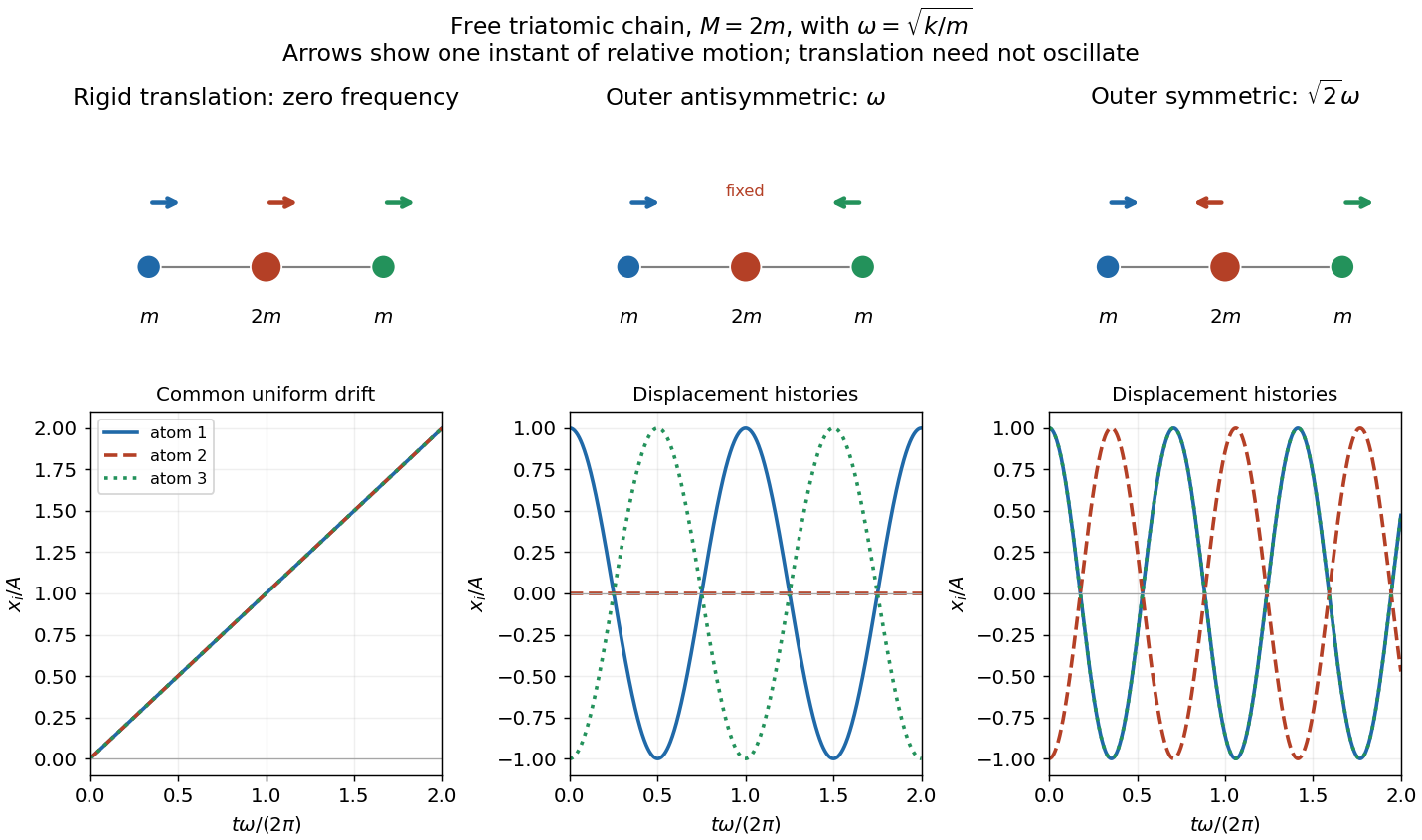
Three free-chain mode shapes and their displacement histories, shown for central mass twice an end mass
. Details. 
For , take the mode shapes , and . Their angular frequencies are , and . The initial displacement decomposes asAll initial velocities vanish, so the zero-mode coefficient stays constant and the two oscillatory coefficients use cosines. ThusThe conserved centre of mass is . Omitting the zero mode would incorrectly force this to zero. The two vibrational frequencies are in the ratio , so there is no common nonzero period.
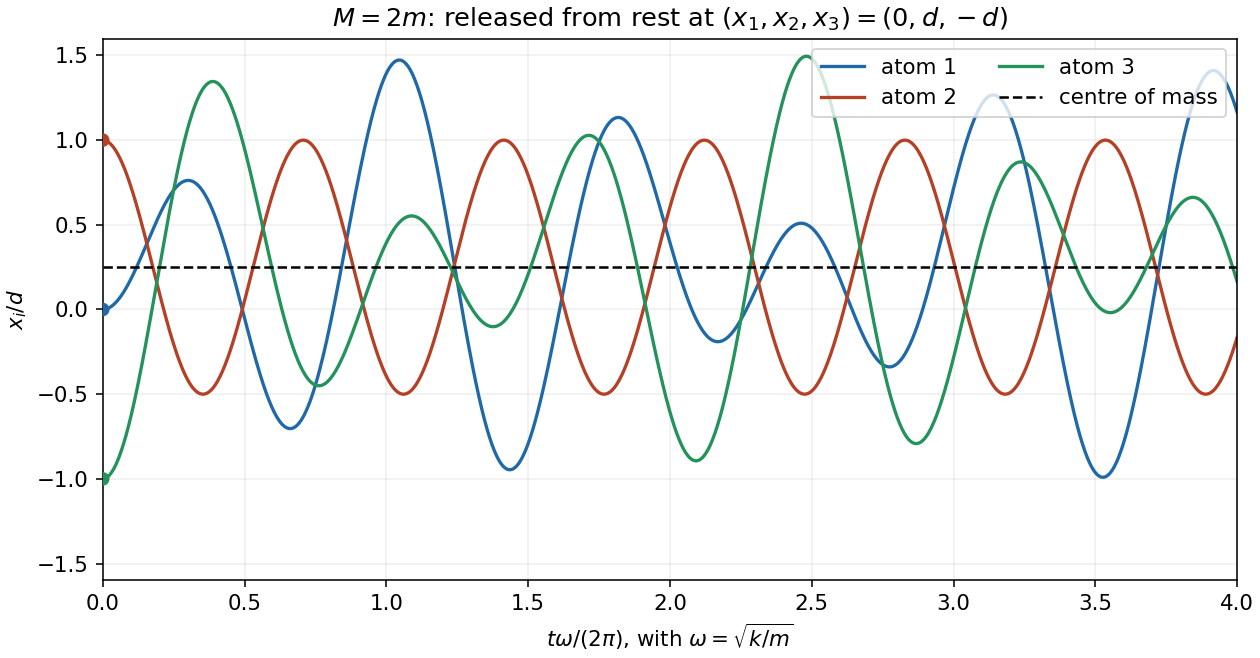
Triatomic-chain motion from the specified initial displacement, including its constant centre of mass
. Details. 
Articles by others on the same topic
There are currently no matching articles.