The arc length of this parametric curve is the integral of its speed. Differentiation gives and , soFor a positive scale parameter this is . The absolute value is necessary when is allowed to be any real constant; gives a degenerate curve of zero length. The nondegenerate curve is an involute of a circle.
Recognize the derivative of the exponential function at :Here and the chain rule supplies the factor .
For the real-valued expression, first consider the one-sided limit . Its natural logarithm is . Since ,using . The continuity of the exponential function therefore gives right-hand limit .
The printed two-sided notation needs qualification: for , so raising it to an arbitrary real power does not define a real-valued function throughout a left neighbourhood of zero. There is consequently no ordinary two-sided real limit on an open punctured neighbourhood with the expression as written. The value is the natural right-hand interpretation.
Use implicit differentiation while holding fixed. Writing , the constraint givesThe chain rule applied to now yieldsThis local formula requires , as in the implicit function theorem; that denominator equals at the specified point.
The divergence theorem includes every part of the closed boundary, including the two vertical cut faces. Its volume integrand simplifies because the terms linear in cancel:In cylindrical coordinates, the remaining integration region is , , . With the Jacobian determinant , the outward flux isThe angular range is three quarters of a full revolution. The volume calculation already accounts for the base and cut faces, so no additional surface terms should be appended.
The first-order multivariable Taylor expansion isTaking gives the linear approximationTo assess its significant figures, the quadratic Taylor polynomial supplies the correction for , . Direct evaluation gives . Thus the estimate is correct to four significant figures: both round to , whereas to five significant figures the exact value is and the approximation is . The unexpectedly small quadratic correction results partly from cancellation of its mixed and unmixed terms.
Construct a global vector-field potential rather than relying only on vanishing curl:Thus is a conservative vector field. The endpoints of the given parametric curve are and . The fundamental theorem for line integrals givesThe intervening turns of the curve have no effect because this line integral is path independent.
- : a strict local minimum, with ;
- : a strict local maximum, with ;
- and : saddle points, both with .
The positive-definite and negative definite cases give small closed level curves around the minimum and maximum. At each saddle, the zero contour crosses itself. In fact,so the entire zero level curve is the union of the line and the ellipse . This factorization fixes the topology of a rough contour sketch. Neither local extremum is global, since the cubic is unbounded above and below.
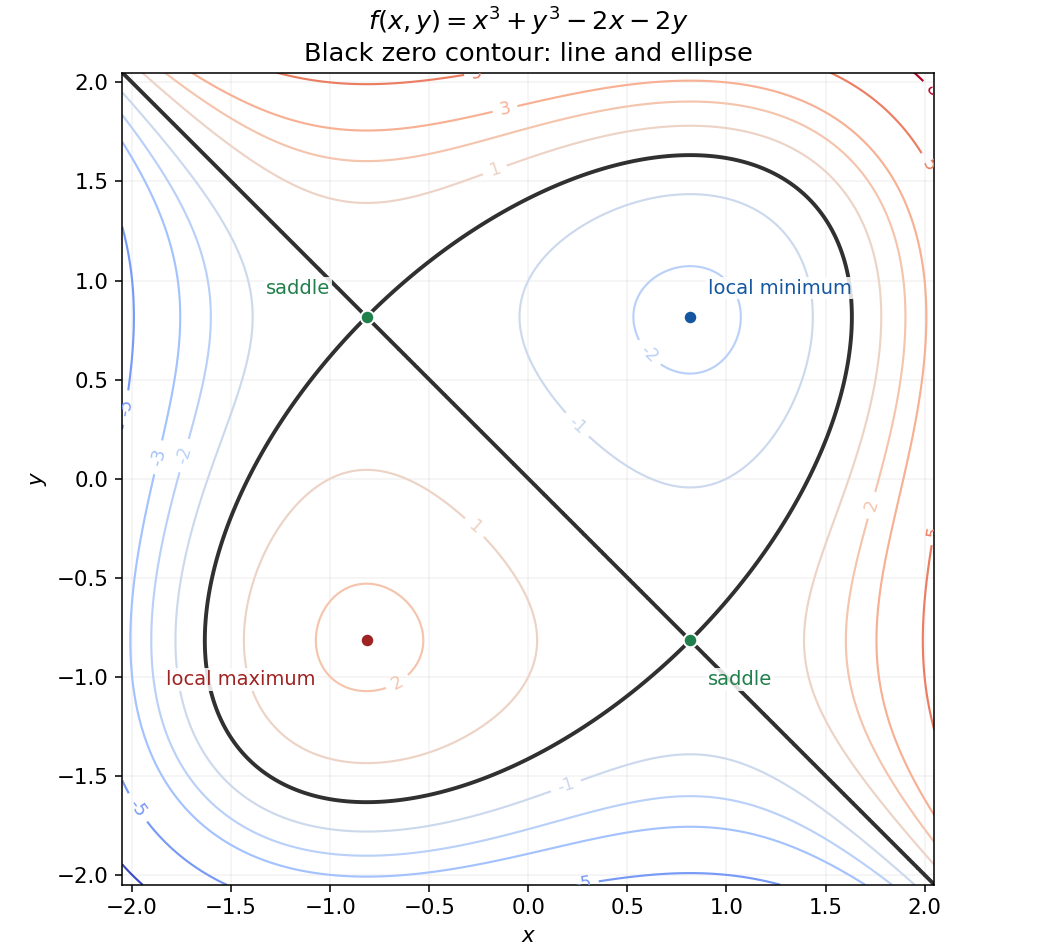
Contours of the cubic surface, with its two local extrema, two saddles and exact zero contour
. Details. For a continuously differentiable vector field near a piecewise smooth oriented surface , Stokes theorem statesThe circulation around the whole boundary equals the flux of the curl through the surface. The unit normal vector and boundary direction must be compatible with the right-hand rule: curling the right-hand fingers in the boundary direction points the thumb along the normal. Reversing both orientations reverses both integrals.
Apply Stokes theorem to , with an arbitrary constant vector. The curl product rule for a scalar field reduces to . Using the scalar triple product,Since these scalar products agree for every , the vectors agree. This proves the vector-valued Stokes identityIn particular, the ordering of the cross product is normal crossed with gradient; reversing it would change the sign.
By Stokes theorem, it suffices to calculate the boundary line integral. On the plane, and , soThis exact differential has zero integral around a closed curve. ThereforeThe argument applies to any admissible spanning surface, including a curved one; the surface itself need not lie in the plane.
Choose the oriented surface parametrization , with . Then and . The surface integral isFor the compatible boundary direction, use successive vertices , , , and back. The four line integrals are respectivelyTheir sum is , agreeing with the surface integral. Choosing the opposite normal and reversing the boundary direction gives on both sides. Stating an orientation is necessary because the question does not prescribe one.
Each spring force is its extension multiplied by the spring constant, acting to restore the equilibrium. The equations of motion areNo end is attached to a wall. The spring extensions are and , giving potential energy .
A normal mode has a fixed pattern of relative displacements, with every coordinate proportional to one common time-dependent factor. There are three independent normal modes in this three-coordinate model: two internal vibrations and one zero-frequency rigid-body translation. The latter moves all three atoms together without stretching either spring. This count concerns the specified one-dimensional model, rather than a molecule with unrestricted three-dimensional motion.
Write the displacement as . The generalized eigenvalue problem isThe symmetry of the two end atoms suggests an end-antisymmetric shape and two end-symmetric shapes. Direct substitution gives the normal modes of three masses connected by two equal springs:These three independent eigenvectors exhaust the three-dimensional system. The ordinary frequencies are ; the values above are angular frequencies.
For the zero normal mode, . The molecule translates uniformly; a common constant displacement is the special case . For the lower vibrational normal mode, put :The end atoms move oppositely with equal amplitudes, while the central atom remains stationary. In the higher vibrational normal mode, with ,The ends move together and the centre moves in the opposite direction, with central amplitude times an end amplitude. Both internal modes keep the centre of mass fixed and obey mass-weighted orthogonality. The zero mode instead describes motion of that centre of mass.
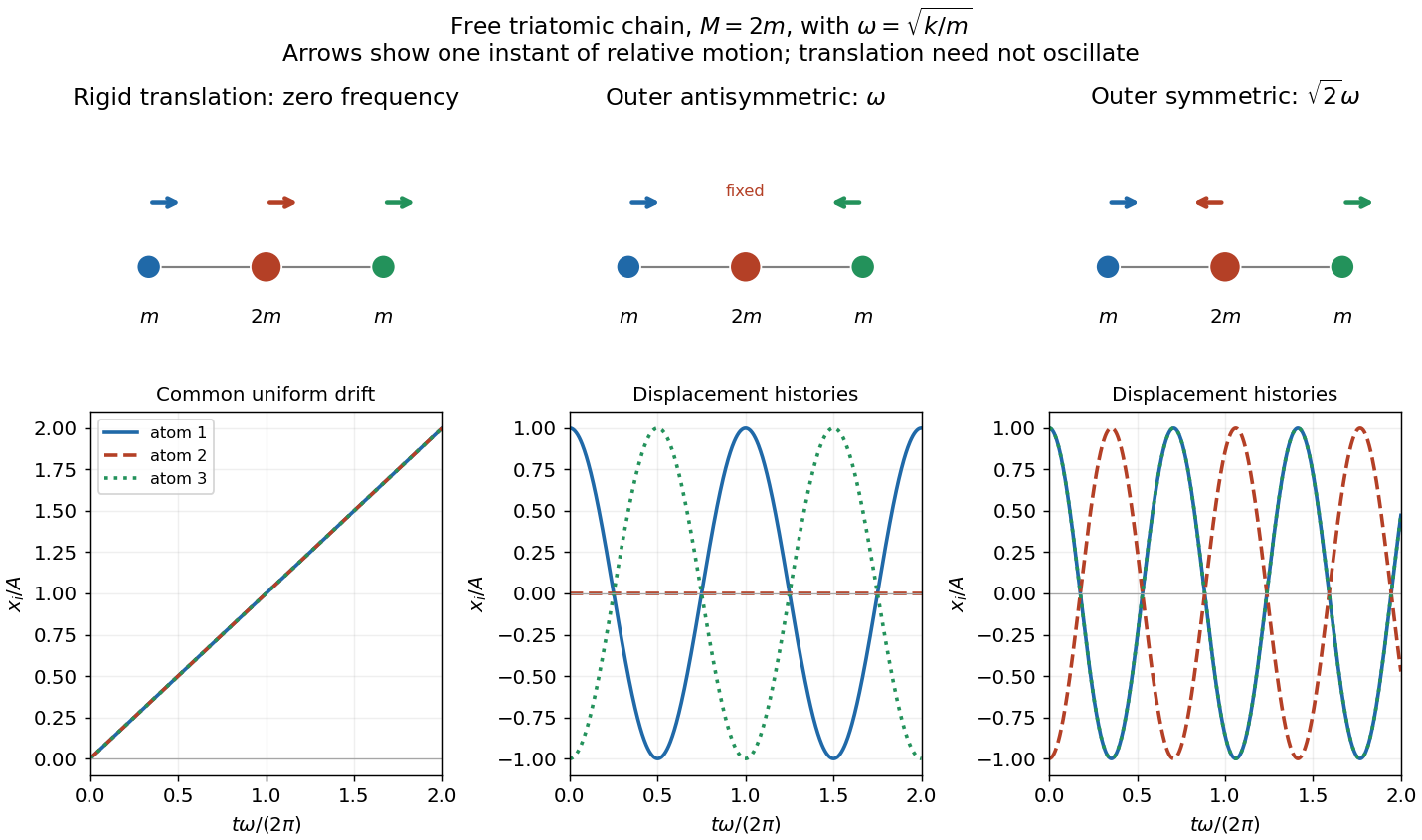
Three free-chain mode shapes and their displacement histories, shown for central mass twice an end mass
. Details. For , take the mode shapes , and . Their angular frequencies are , and . The initial displacement decomposes asAll initial velocities vanish, so the zero-mode coefficient stays constant and the two oscillatory coefficients use cosines. ThusThe conserved centre of mass is . Omitting the zero mode would incorrectly force this to zero. The two vibrational frequencies are in the ratio , so there is no common nonzero period.
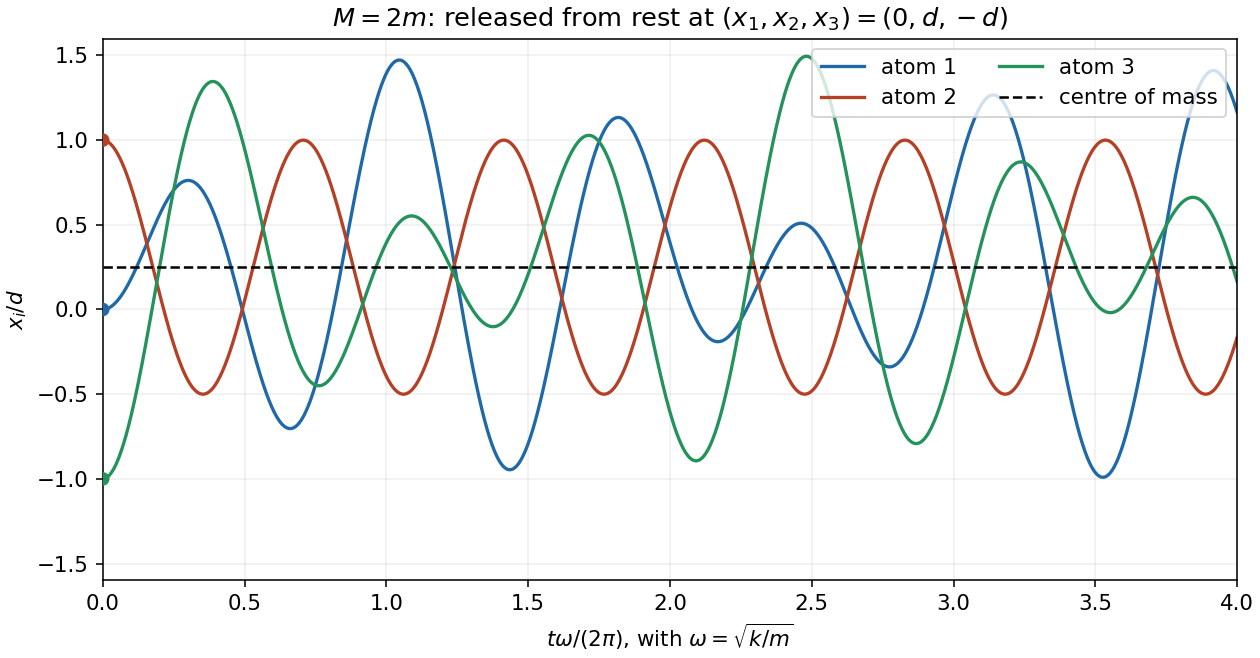
Triatomic-chain motion from the specified initial displacement, including its constant centre of mass
. Details. Parametrize the graph by over its projection onto the plane. The tangent vectors are and , so their cross product is . Hence the scalar surface element isandThe printed subscript is shorthand for integrating over the projected parameter region: belongs to , while the square-root factor converts projected area into actual surface area. The corresponding upward vector surface element of a graph is .
Use the cone parametrization for , . Its surface element is . Since , the scalar surface integral isThis uses only the curved conical surface. There are no closing discs in the specified integration surface.
The plane cuts the positive coordinate axes at , and . Choose its unit normal vector , pointing away from the origin. In the parametrization , the vector surface element for this orientation is . Thusand the triangular projection givesFor the opposite orientation the answer is . The normal direction must be stated because this open surface has no prescribed orientation in the question.
Substituting into the wave equation on a string gives . Wherever both factors are nonzero,The left side depends only on and the right side only on , so both equal a separation constant . ThereforeThe resulting differential equations extend through zeros of or by continuity; division at a node is unnecessary.
The fixed-end boundary conditions require . For , the spatial solution is linear and both endpoints force it to vanish; for , the exponential solutions likewise cannot satisfy both conditions nontrivially. Write with . Then and , givingTheir angular frequencies are . Unlike the freely translating chain, this fixed string has no translational zero normal mode.
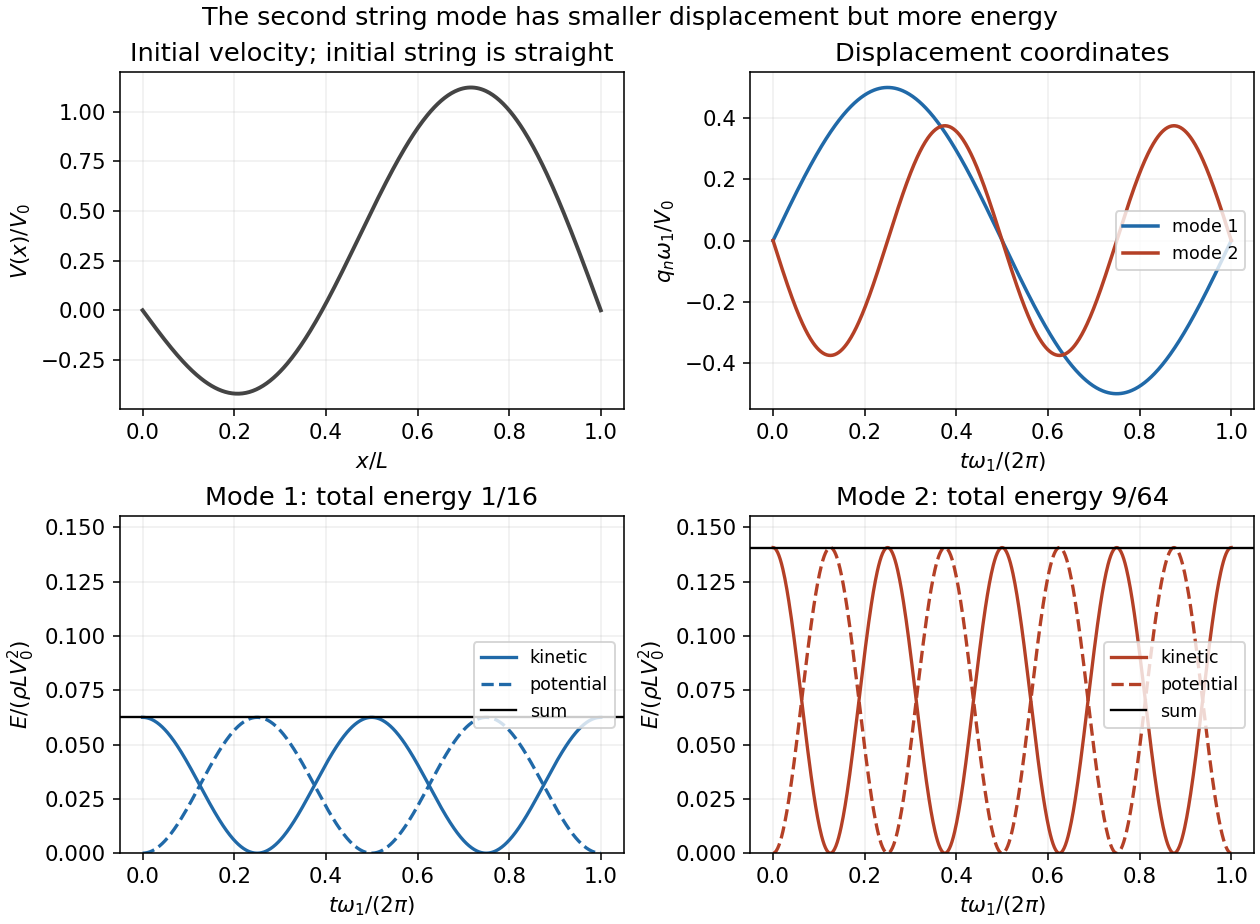
The zero initial displacement selects sine time factors. Put . The Fourier sine series of the initial velocity has coefficients , , with all other coefficients zero. Since differentiation in time multiplies a sine by its angular frequency,The normal mode coordinates are and . Their peak displacement amplitudes are and . Both the initial displacement and the initial velocity can be checked directly from this expression.
For either normal mode, let and write its contribution as . The product-to-sum identity givesThis standing wave is a superposition of two travelling waves of equal amplitude , moving oppositely with phase velocity . Their cancellation at enforces the fixed-end boundary conditions at every time.
For small transverse displacements, the string's kinetic energy and extra elastic potential energy areThe orthogonality of trigonometric functions removes cross terms between the two normal modes. For a mode , use and to obtainConsequently the modal energy distribution isThe second mode contributes more total energy at every time, despite its smaller displacement amplitude. The total energy is , with fractions and in the first and second modes. Each mode exchanges kinetic energy and potential energy, while its sum is conserved; the comparison is of these sums, not of instantaneous kinetic energies alone.


Articles by others on the same topic
There are currently no matching articles.