The mixed partial derivative measures how the slope changes as varies while is fixed:when this limit exists. For a small rectangle, the cross-difference is approximately if the second derivatives are continuous. It measures a change of transverse slope, rather than either first slope alone. Mere continuous differentiability does not ensure that this second derivative exists; equality with follows under the usual hypotheses of Clairaut's theorem.
An interior stationary point has . Assuming twice continuous differentiability nearby, the two-dimensional Taylor series about it iswhere , and . Let . The second-derivative test gives a strict local minimum if , a strict local maximum if , and a saddle point if .
For example, if , the quadratic form is , which proves these sign tests. If , the quadratic part is inconclusive: has a minimum while has a saddle at the origin, although both have zero Hessian matrix there. Higher-order terms or direct inequalities must then be examined.
Writing , the absolute lower bound is , attained exactly whenEvery point on these circles is a global and local minimum, but not a strict minimum: neighbouring points on the same circle have exactly the same value. At such a point the radial Hessian eigenvalue is one and the tangential eigenvalue is zero, illustrating why a degenerate second-derivative test does not exclude a minimum.
There are no other local minima: between successive multiples of , moving radially changes the value monotonically. The positive even-radius circles are maxima. At the origin the apparently singular radial expression is smooth, since , and the origin is a strict local maximum.
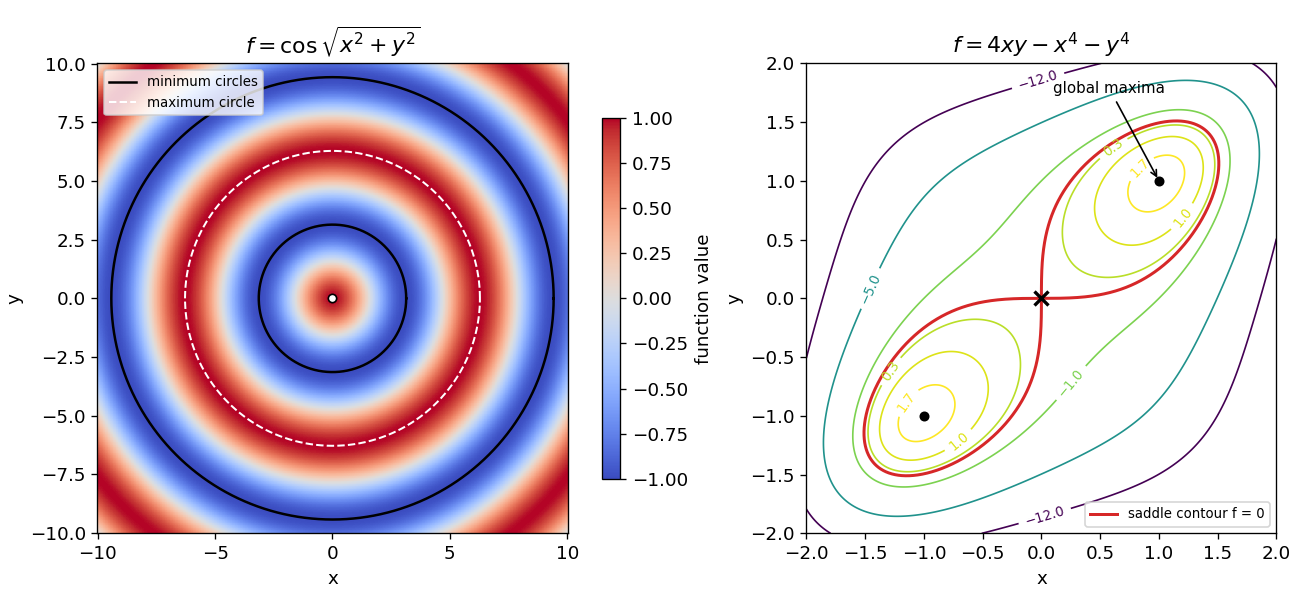
Nonisolated radial minima and a two-lobed saddle contour
. Original level plots. The left panel marks whole circles of global minima; the right marks the saddle at the origin, two global maxima and the exact zero contour. Details.
The gradient equations are and . Their real solutions are , and . The Hessian matrix is , so the origin has eigenvalues and is a saddle point, with value zero. At either other point the eigenvalues are , giving strict maxima with value two. They are global maxima becauseand equality occurs precisely at those two points.
In polar coordinates, the zero contour isBesides the saddle , its nonzero branches satisfyThe denominator is positive; real radii require . The branches form two closed lobes in the first and third quadrants, meeting at the origin. Positive contours lie inside these lobes around the maxima, and negative contours extend outside. Along the coordinate axes the function is negative away from the saddle, whereas along it is initially positive; these signs show the crossing geometry in the sketch.
Articles by others on the same topic
There are currently no matching articles.