For an exact differential , equality of the mixed partial derivatives requires . Here these are and , so . Integrating with respect to gives . Comparison with gives , and the specified value fixes the integration constant. ThereforeDifferentiating recovers both coefficients, and . The explicit potential function also proves exactness globally, without relying only on a local compatibility test.
Set , , . For nonzero , the absolute Jacobian determinant is , and the transformed interior is the ball . Its radius is two, soIf are taken as positive semiaxis parameters, this is . The actual semiaxes are ; omitting the factor two in the transformed radius would make the volume eight times too small.
Expand about , with increment one. Since and , the second-order Taylor series approximation isThe third derivative is , decreasing on . The Taylor remainder is therefore positive and less than , so .
For real sufficiently close to zero, . Taking the logarithm and using its Maclaurin series givesContinuity of the exponential then givesThis is a two-sided real limit on the punctured neighbourhood where the base is positive.
Stokes theorem states that , with consistent boundary orientation. Here , so the circulation around the positively oriented planar curve equals its area. Substituting the given parametrization givesThe curve closes at the origin, passes along the right side to and returns along the left side, so it is anticlockwise. ConsequentlyEquivalently its two sides are , , whose horizontal width integrates to the same result.
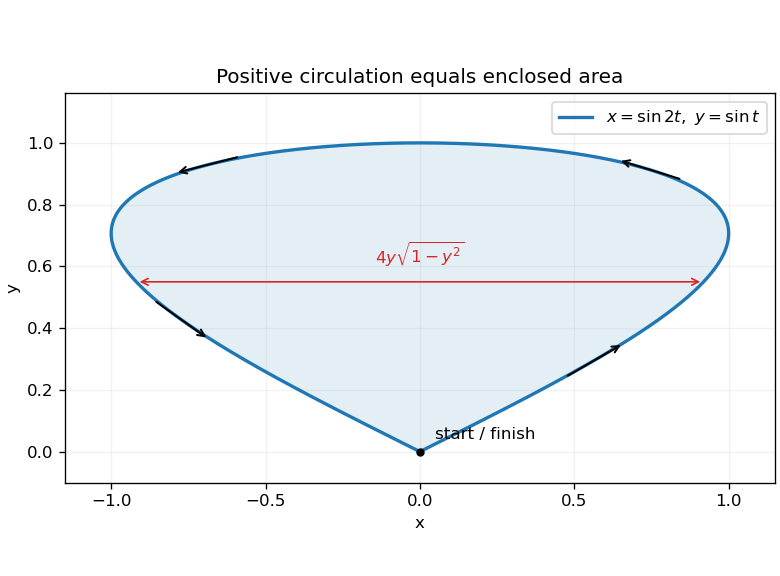
The enclosed lobe and its positive boundary orientation
. Original analytic plot. Arrows follow increasing parameter from the origin along the right side and back along the left; horizontal widths provide an independent area integral. Details.
Let . The fundamental theorem of calculus gives . Applying the chain rule to givesNo elementary antiderivative of is needed: differentiation of the variable upper limit supplies the integrand directly.
A standing wave has a fixed spatial amplitude profile and oscillates in time, with stationary nodes of a standing wave. It arises from equal-amplitude waves of the same frequency travelling in opposite directions. For a uniform string with linear mass density , the wave speed is and a separated mode has .
The fixed boundary requires , while the free boundary requires . Thus and , givingThe fixed end is a node of a standing wave and the free end an antinode. Arbitrary small motions are superpositions of these normal modes; the tension alone determines their frequencies only when is also specified.
Holding fixed gives , whereas holding fixed gives and . The chain rule therefore gives and . Multiplication yieldsThe subscripts specify the independent coordinate held fixed; they are necessary because changing coordinates changes which direction a partial derivative follows.
Let and place the hole axis along . At the rim, . A horizontal slice at is an annulus of area . Thus the napkin ring problem givesEach slice depends only on and , explaining the independence from the original sphere radius, rather than obtaining it merely by cancellation after integration.
The divergence theorem states for a sufficiently smooth field and a piecewise smooth closed boundary with outward unit normal. Choose . Since ,The factor comes from the three spatial dimensions; the outward orientation is especially important on the inner wall of the drilled solid.
The boundary consists of the spherical zone and the inner cylindrical wall. On the sphere, , so . Its area element is , giving the fluxOn the inner cylinder, the outward normal of the remaining material points towards the hole: . Therefore , and , giving flux . There are no planar end faces of positive area: the two surfaces meet along the rim circles. HenceUsing the cylinder's radial normal with the opposite sign would count the hole as extra material and lose the required cancellation.
For small horizontal displacement , the gravitational restoring force is . A spring between adjacent bobs has extension equal to their displacement difference; Hooke's law pulls each bob towards its neighbour's displaced position. Thus comparison with the stated equations givesThe small-angle approximation makes the bob motion horizontal to first order; its vertical shift changes spring geometry only at higher order. Multiplying all force equations by minus one puts the positive restoring coefficients on the displayed right-hand side.
In one normal mode, all moving bobs share the same frequency and fixed amplitude ratios. A real mode vector allows their phases to be chosen equal or differing by , according to the signs of its components. A component equal to zero means that bob remains at rest in that mode and has no oscillation phase to assign.
The squared-frequency matrix isThe dimensionless spring matrix has an orthonormal eigenbasiswith eigenvalues . Adding the gravitational term therefore givesThe uniform mode leaves both springs unstretched. The other two modes deform the springs and so have higher frequencies.
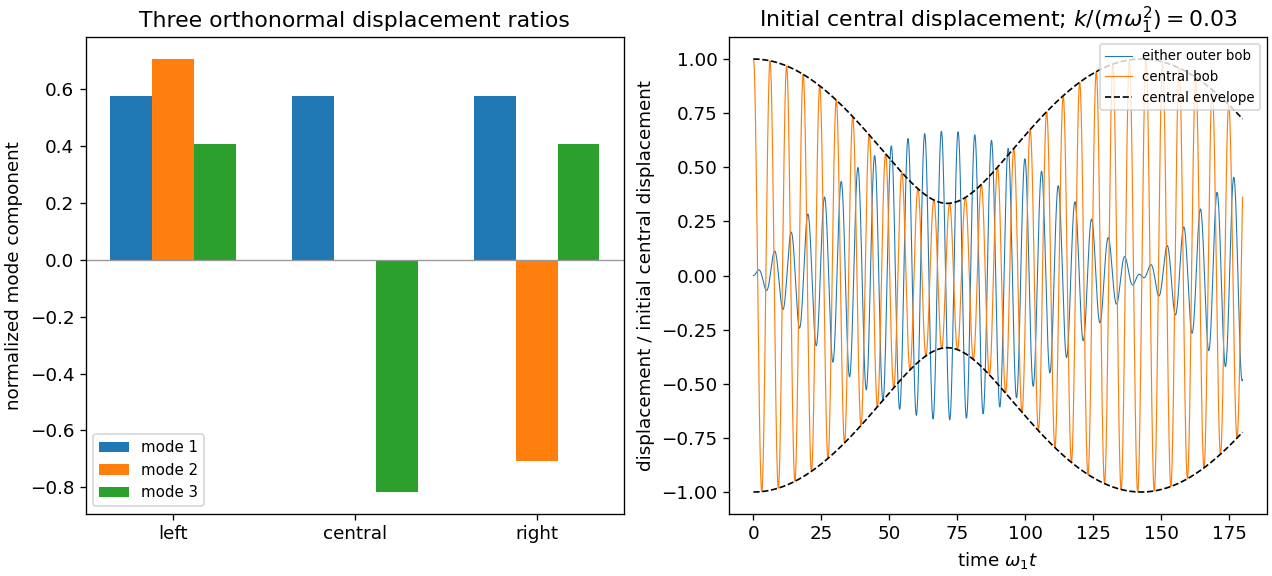
With zero initial velocities, choosing the initial displacement proportional to one eigenvector excites only its normal mode. Suitable ratios areThe overall scale must remain small compared with . Release each configuration from rest; its subsequent vector is its initial displacement multiplied by . The middle bob is stationary in the second mode, while it moves oppositely with twice either outer amplitude in the third.
For a central displacement in three freely ended coupled pendulums, the initial vector decomposes as . The antisymmetric second mode is absent. HenceLet and . The outer displacement is , explicitly exhibiting an amplitude modulation. The middle displacement is , whose modulation envelope isIt ranges from to , so it does not vanish completely. These are beats between the two excited frequencies. A slow envelope well separated from the carrier requires ; in that limit . The exact two-mode formulas remain valid without that additional weak-coupling assumption.

For a short length , the kinetic energy is . For small slope, its increase in length is , so its elastic potential energy is . For a travelling wave , and . Using givesWriting a pulse as yields . Thus energy is proportional to amplitude squared for a fixed shape and width. Width must also be retained when comparing pulses on different strings.
At fixed frequency , so the displacement reflection and transmission coefficients areThe heavy-string speed is and the light-string speed is . ThereforeA displacement amplitude greater than the incident amplitude does not mean energy is created: the transmitted pulse also has a different width and propagates in a different medium.
After the first encounter, the reflected pulse travels backwards through the heavy string with amplitude and width . The transmitted pulse has amplitude and speed . Its temporal duration is unchanged at the stationary junction, so its spatial width doubles to . Both pulses retain the original displacement sign.
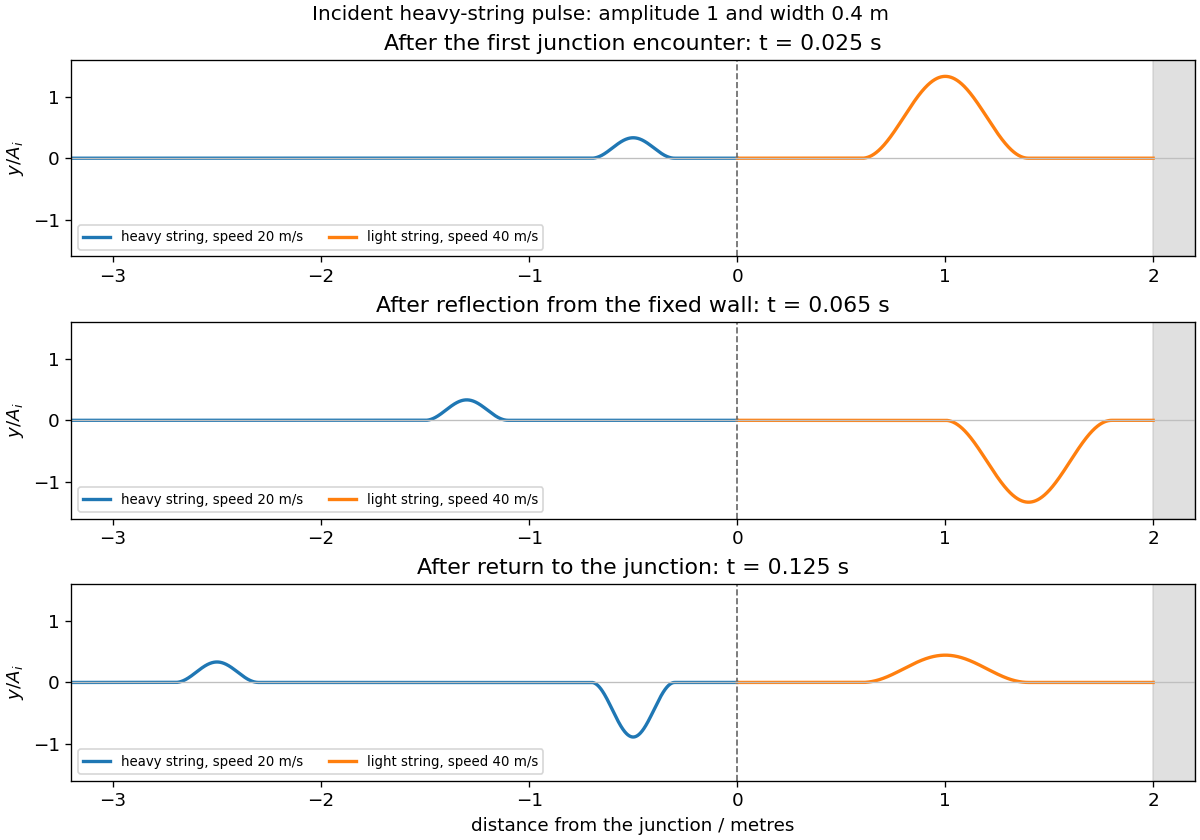

Reflection at a fixed end has displacement coefficient . The light-string pulse therefore returns from the wall with amplitude and width . It is inverted and travels left at . Taking the first junction encounter as time zero, its centre reaches the wall after and returns to the junction after ; a finite pulse takes its own duration to complete each encounter.
At the return encounter, transmission from light to heavy multiplies the amplitude by , giving a backward heavy-string pulse of amplitude . Its speed halves, so its width returns to . Reflection within the light segment multiplies the incoming amplitude by , giving a right-going pulse of amplitude and width . The earlier reflected pulse is already farther along the heavy string.
The sketches show these as separate pulses in the short-pulse regime . For longer pulses the corresponding components overlap and must be superposed rather than interpreted as isolated visible humps.
Each light-string round trip combines wall reflection with junction reflection , multiplying the remaining pulse amplitude by . The initial directly reflected heavy-string pulse has amplitude . The subsequent outgoing heavy pulses have amplitudesThey all have width in the same heavy medium. For nonoverlapping pulses their energy fractions therefore sum toThe first transmission leaves energy fraction in the light segment; each return encounter leaves only of the previous stored energy there, so this residual tends to zero.
For reflection from a finite string segment with a fixed far end, if pulses overlap, squared amplitudes cannot simply be added because of interference. The same result follows frequency by frequency: with round-trip phase , , the total amplitude coefficient isFor real frequencies , so and . Thus the ideal lossless fixed-ended segment returns all incident finite-pulse energy even when individual echoes overlap; their relative phases must be retained.
The mixed partial derivative measures how the slope changes as varies while is fixed:when this limit exists. For a small rectangle, the cross-difference is approximately if the second derivatives are continuous. It measures a change of transverse slope, rather than either first slope alone. Mere continuous differentiability does not ensure that this second derivative exists; equality with follows under the usual hypotheses of Clairaut's theorem.
An interior stationary point has . Assuming twice continuous differentiability nearby, the two-dimensional Taylor series about it iswhere , and . Let . The second-derivative test gives a strict local minimum if , a strict local maximum if , and a saddle point if .
For example, if , the quadratic form is , which proves these sign tests. If , the quadratic part is inconclusive: has a minimum while has a saddle at the origin, although both have zero Hessian matrix there. Higher-order terms or direct inequalities must then be examined.
Writing , the absolute lower bound is , attained exactly whenEvery point on these circles is a global and local minimum, but not a strict minimum: neighbouring points on the same circle have exactly the same value. At such a point the radial Hessian eigenvalue is one and the tangential eigenvalue is zero, illustrating why a degenerate second-derivative test does not exclude a minimum.
There are no other local minima: between successive multiples of , moving radially changes the value monotonically. The positive even-radius circles are maxima. At the origin the apparently singular radial expression is smooth, since , and the origin is a strict local maximum.
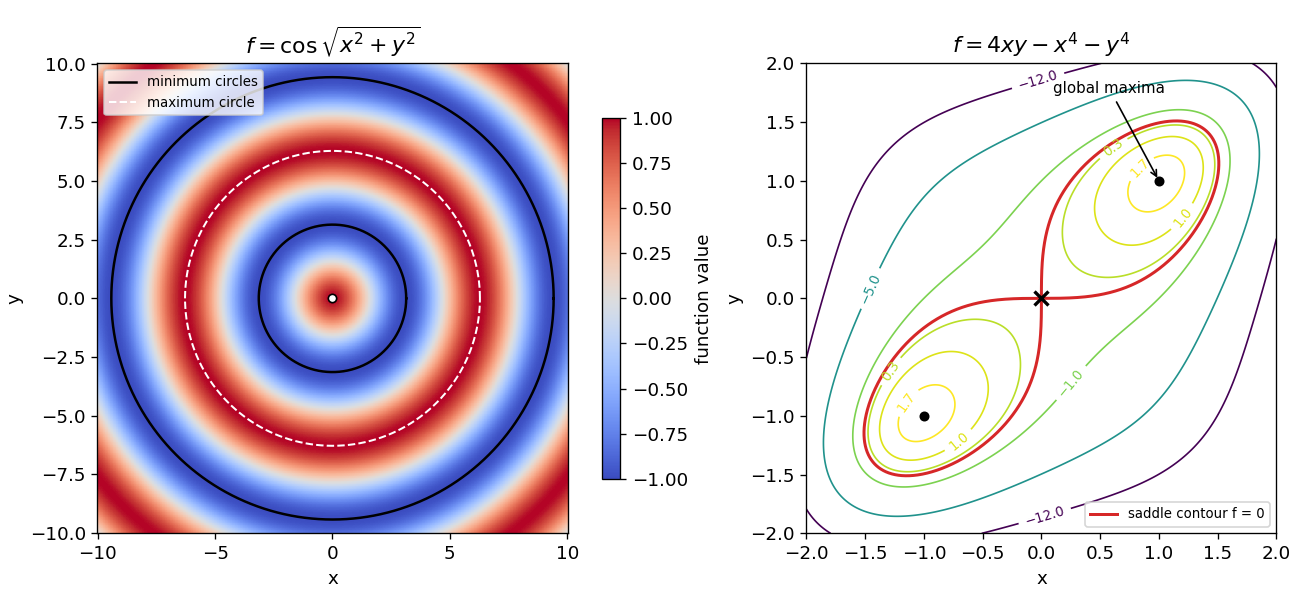
Nonisolated radial minima and a two-lobed saddle contour
. Original level plots. The left panel marks whole circles of global minima; the right marks the saddle at the origin, two global maxima and the exact zero contour. Details.
The gradient equations are and . Their real solutions are , and . The Hessian matrix is , so the origin has eigenvalues and is a saddle point, with value zero. At either other point the eigenvalues are , giving strict maxima with value two. They are global maxima becauseand equality occurs precisely at those two points.
In polar coordinates, the zero contour isBesides the saddle , its nonzero branches satisfyThe denominator is positive; real radii require . The branches form two closed lobes in the first and third quadrants, meeting at the origin. Positive contours lie inside these lobes around the maxima, and negative contours extend outside. Along the coordinate axes the function is negative away from the saddle, whereas along it is initially positive; these signs show the crossing geometry in the sketch.
Articles by others on the same topic
There are currently no matching articles.