For a bounded volume with outward-oriented piecewise smooth boundary , the divergence theorem statesHere is a continuously differentiable vector field on a neighborhood of , the outward unit normal vector, and the volume element. The left side is its outward flux.
For a twice continuously differentiable field , equality of mixed partial derivatives givesApply the divergence theorem to to obtainThe regularity hypotheses justify differentiating and integrating the curl; a field singularity cannot simply be ignored in a volume argument.
Away from the origin, the electric field is , with here denoting the position vector in the numerator and its Euclidean norm in the denominator. The spherical-coordinate formula for divergence givesAt the origin the electric field is singular, so the ordinary divergence is undefined there. The equation above must not be extended to the whole space as an ordinary smooth-field identity. Its correct distributional divergence, derived in solution, includes the point source.
On an outward-oriented sphere of radius , the electric field is normal with constant magnitude . Thus its flux isIt is independent of . There is no contradiction with solution: the classical divergence theorem cannot be applied to a full ball while pretending that is smooth at its center. On a punctured ball the outer flux and the inward-normal inner flux cancel, in agreement with zero ordinary divergence there.
The three-dimensional Dirac delta distribution is supported at the origin and satisfies the sampling identityfor smooth compactly supported test functions . It is not an ordinary function with a finite value at zero; its total integral is one, and translating it moves the point at which the test function is sampled.
The globally valid source equation isFor a direct weak verification, excise a ball of radius and integrate outside it. Since the ordinary divergence vanishes there, the result is . This is precisely the displayed distributional divergence and restores the divergence theorem with the point charge included.
Use the outward normal on the spherical patch. It is the quarter of the spherical surface lying below both the horizontal plane and the plane , with both signs of included. Close it by the two half-discs in and in .
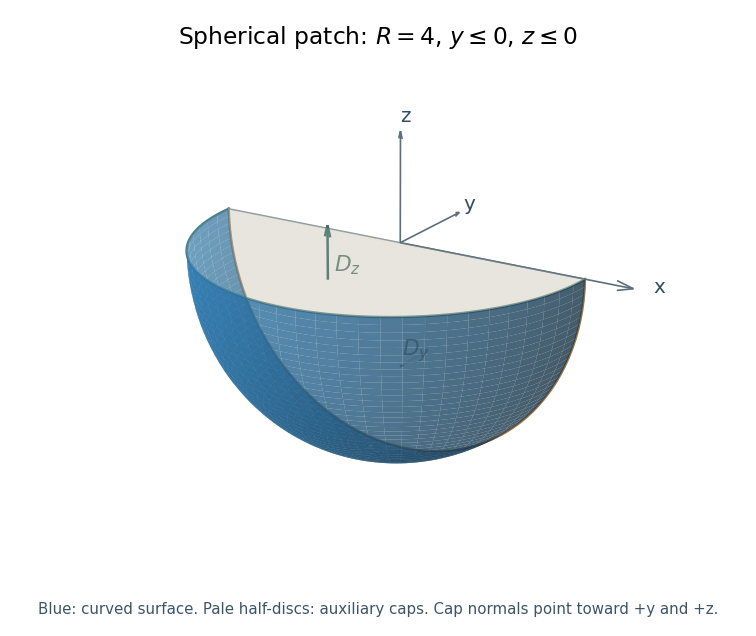
The spherical patch of radius four with y and z nonpositive, shown with the two planar caps used to close the volume.
The colored curved part is the requested surface. The planar half-discs are auxiliary surfaces for the divergence theorem; their outward normals point in positive y and positive z. Details.
The divergence of the polynomial vector field is . Its volume integral over the enclosed quarter-ball vanishes by oddness in . Thus the divergence theorem gives .
On , the outward normal is and . On , it is and ; the odd term integrates to zero. The needed half-disc moments for radius areandAt , the cap fluxes are and , respectively. Therefore the flux through a spherical quadrant by planar caps isThe source does not explicitly specify a normal for this part; the boxed answer adopts the usual outward spherical orientation. Choosing the inward normal reverses its sign.
Articles by others on the same topic
There are currently no matching articles.