The cover dates this separate resit to 5 September 2019. The held source is explicitly marked “Draft Only”; these solutions follow that version without asserting that it matches a final paper. All eleven questions and all four Section B choices are covered. The inconsistent point in Question 2 is diagnosed explicitly.
Convert the fixed position to . The element's displacement is then . Taking time derivatives at fixed position gives its transverse velocity and acceleration:Equivalently the prefactors in SI units are and . The phase is measured in radians. At ,These are the transverse motions of the material element, not the propagation speed of the wave along the string.
The printed point is not on the printed surface, so the requested tangent plane does not exist. At , the left side of the defining equation is , whereas the right side is . This is a direct counterexample to the premise that the stated point belongs to the surface.
To make the obstruction precise, set . The specified surface is the level set , but . Although , the resulting plane is tangent to the different level set through that point. It is not an answer for the printed surface. A tangent plane requires the point to lie on the surface.
If the intended correction preserves , the surface equation instead forces . At the corrected point ,The corresponding conditional tangent plane isThis conditional calculation identifies a possible repair; it does not silently replace the source's coordinate .
Assume , as required for normalization of the exponential distribution. Its cumulative distribution function is the integral of its probability density function from to :For the expected value, integration by parts givesSimilarly,The endpoint terms vanish because exponential decay dominates each fixed power of . ThereforeThe mean has the same units as , while the variance has their square; has reciprocal units.
A volume mean is the volume integral of the temperature divided by the volume. On this cube,Each one-dimensional integral is two, givingThe number is in the temperature units implicit in the given field law and coordinate units.
For a general positive side length , the cube has volume , while separability of the integral givesThus the requested general dependence of the mean temperature isFor the cube with side length three this givesEquivalently each coordinate has volume-average value , and the rectangular integration domain makes the mean of the product .
A conservative vector field can be written as for a single-valued scalar potential . Its line integral between two points depends only on the endpoints, and its integral around every closed curve is zero. A necessary local test for a smooth planar field is . On a simply connected domain such as the whole plane, this is also sufficient.
HereAn explicit scalar potential is even more decisive:Indeed and . Thus the field is conservative on .
An exact differential is a differential one-form equal to on its domain; an inexact differential is not the differential of a single-valued potential there. For example, is exact. For the supplied form , the cross derivatives areThey disagree, so is not even closed and hence cannot be exact. Equivalently, its counterclockwise line integral around the unit square is . ThereforeThe connection is : a vector field is conservative precisely when its work differential one-form is exact. Locally vanishing curl alone need not guarantee global exactness on a domain with holes.
For an oriented piecewise smooth surface , a continuously differentiable vector field on a neighborhood of it, and its compatibly oriented boundary , Stokes theorem statesHere is the chosen unit normal vector, is the unsigned surface area element, and is the tangent displacement along . The right-hand rule relates the boundary direction to .
The supplied field has curl . Parametrize the plane by over the triangle . Its upward oriented surface area element is , givingFor the boundary line integral, take the positively oriented vertices , , . Their projections run counterclockwise in the horizontal plane. With , the three edges areOn each edge, direct substitution gives . HenceThe two independent computations agree, including the orientation sign.
Assume small planar oscillations about the vertical equilibrium, with the connecting spring relaxed in that equilibrium. Let be the first-order horizontal displacements of the two simple pendulums. The gravitational restoring force on bob is ; the spring extension to first order is . Thus the linearized equations of motion areAdding and subtracting them diagonalizes the system. For and ,The normal modes and angular frequencies are thereforeThe in-phase mode does not stretch the spring, while the opposite-phase mode adds a restoring force of magnitude times each bob's displacement. These are the small-oscillation frequencies, not exact amplitude-independent frequencies for arbitrary pendulum angles.
For a bounded volume with outward-oriented piecewise smooth boundary , the divergence theorem statesHere is a continuously differentiable vector field on a neighborhood of , the outward unit normal vector, and the volume element. The left side is its outward flux.
For a twice continuously differentiable field , equality of mixed partial derivatives givesApply the divergence theorem to to obtainThe regularity hypotheses justify differentiating and integrating the curl; a field singularity cannot simply be ignored in a volume argument.
Away from the origin, the electric field is , with here denoting the position vector in the numerator and its Euclidean norm in the denominator. The spherical-coordinate formula for divergence givesAt the origin the electric field is singular, so the ordinary divergence is undefined there. The equation above must not be extended to the whole space as an ordinary smooth-field identity. Its correct distributional divergence, derived in solution, includes the point source.
On an outward-oriented sphere of radius , the electric field is normal with constant magnitude . Thus its flux isIt is independent of . There is no contradiction with solution: the classical divergence theorem cannot be applied to a full ball while pretending that is smooth at its center. On a punctured ball the outer flux and the inward-normal inner flux cancel, in agreement with zero ordinary divergence there.
The three-dimensional Dirac delta distribution is supported at the origin and satisfies the sampling identityfor smooth compactly supported test functions . It is not an ordinary function with a finite value at zero; its total integral is one, and translating it moves the point at which the test function is sampled.
The globally valid source equation isFor a direct weak verification, excise a ball of radius and integrate outside it. Since the ordinary divergence vanishes there, the result is . This is precisely the displayed distributional divergence and restores the divergence theorem with the point charge included.
Use the outward normal on the spherical patch. It is the quarter of the spherical surface lying below both the horizontal plane and the plane , with both signs of included. Close it by the two half-discs in and in .
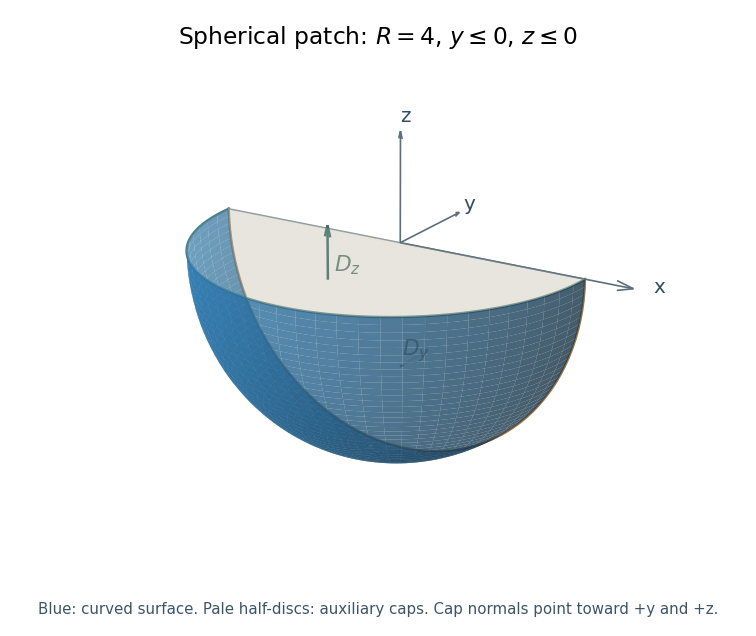
The spherical patch of radius four with y and z nonpositive, shown with the two planar caps used to close the volume.
The colored curved part is the requested surface. The planar half-discs are auxiliary surfaces for the divergence theorem; their outward normals point in positive y and positive z. Details.
The divergence of the polynomial vector field is . Its volume integral over the enclosed quarter-ball vanishes by oddness in . Thus the divergence theorem gives .
On , the outward normal is and . On , it is and ; the odd term integrates to zero. The needed half-disc moments for radius areandAt , the cap fluxes are and , respectively. Therefore the flux through a spherical quadrant by planar caps isThe source does not explicitly specify a normal for this part; the boxed answer adopts the usual outward spherical orientation. Choosing the inward normal reverses its sign.
A stationary point is a point where the function is differentiable and its first derivative vanishes. Interpret the cube root as the real cube root, and put . Then . For , the product rule and chain rule giveThe denominator is positive wherever it is defined. Consequently the two stationary abscissae areUsing the stationary equation to simplify the value of gives . Thus the complete stationary points areNumerically they are approximately and . The numerator of is positive outside and negative inside, so the first is a local maximum and the second a local minimum.
At , the real function is continuous but has a vertical tangent; the factor does not cancel either cube-root singularity. Those points are not stationary points. This is the distinction required when finding stationary points with real cube-root factors.
Differentiate to obtain . Let , with . All solutions of areSince , the first family consists of local maxima and the second of local minima. Their function values follow from :The derivative is periodic, but itself is not: increasing by lowers by , which accounts for the indexed vertical offsets.
For , the geometric series gives . Integrating from zero to yields the Maclaurin seriesOn the real axis the series also converges at to , but diverges at .
For fixed real and sufficiently large positive , the base in the requested limit is positive. Apply the series with argument :Continuity of the exponential function therefore givesThis includes , when the expression is identically one.
Set , so . The negative binomial series gives for . Hence the exact Taylor series isThe initial terms are . Equivalently the coefficient of is , obtained by differentiating repeatedly and evaluating at .
The radius of convergence is three, set by the pole at . At either endpoint , the terms fail to tend to zero, so neither endpoint is included.
For general coordinates expressed as functions of , the chain rule gives , whereThe Jacobian determinant is the oriented volume scaling of this linearized map. Thus the unsigned volume element transforms as . Where the coordinate change is invertible, the inverse Jacobian determinant is , by the Jacobian chain rule.
For cylindrical coordinates, use , , and unchanged height . Direct differentiation giveswhose determinant is . ThereforeBoth directions are displayed because “from Cartesian to cylindrical” can refer either to the derivative of the new coordinates or to the factor used in transforming a Cartesian volume integral. They are reciprocals; the cylindrical axis is a coordinate degeneracy.
Take spherical polar coordinates with polar angle measured from positive and azimuthal angle :The derivative matrix isExpanding its determinant gives . ThusThe inverse formula holds where and ; it excludes the origin and polar axis. These formulas use the general chain rule and determinant construction in solution.
Assume a positive common density scale and use the unit-radius coordinates of the source. The cylinder's density depends on distance from its axis. Its mass isThe radial factor in the cylindrical volume element cancels the apparent density singularity.
For the sphere, the spherical volume element givesThe condition is necessary for finite mass; the integral diverges for . Equating the two finite masses yields , and henceThis satisfies . A divergent pointwise density can therefore have finite total mass: the integrable power-law density at an axis or center must be tested together with its volume factor. Dimensionally, the density laws can be understood as and with unit radius in the chosen length units.
A scalar line integral is : it weights arc length by a scalar field and is unchanged by reversing orientation. A vector-work line integral is : it measures the tangent component of a vector field and changes sign under reversal. Both are invariant under a regular orientation-preserving reparametrization.
For the prescribed counterclockwise curve, traverse the upper semicircle from to , then the lower parabola from back to .
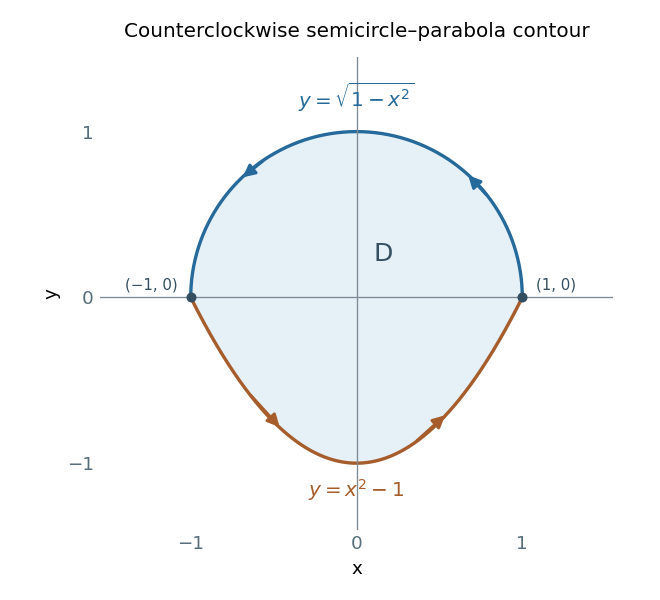
Counterclockwise contour formed by the upper unit semicircle and the lower parabolic arc.
The upper arc runs from right to left; the lower arc runs from left to right. The enclosed area is the sum of a semicircle and a parabolic segment. Details.
On the upper arc, use , , . Thenso its integral is : the last two terms integrate to zero by symmetry or direct integration. On the parabolic arc, use , for . Here andThereforeAs an independent check, Green's theorem gives the integrand . The region is symmetric in , so its odd part vanishes. Its area is , giving , exactly the same value.
For opposite propagation directions on a uniform string, write the equal-frequency transverse waves asThe cosine addition identity givesThis is a standing wave: the spatial pattern is fixed while its amplitude oscillates in time. Nodes occur at the zeros of the first cosine and are separated by , half a wavelength; antinodes have displacement amplitude . The two equal opposite travelling waves carry equal opposite average energy flux, so the net average transported power is zero.
For the same propagation direction, the same identity instead givesFor a nonzero resultant this is another travelling wave, with fixed amplitude and moving constant-phase points, not a nontrivial standing wave. If the prefactor vanishes, the waves cancel identically; the zero disturbance is a trivial exception rather than a standing oscillation. The argument assumes propagating waves with on the same uniform string.
The wave equation on a string gives and , henceThe tension is common across the join, and the frequency is unchanged by reflection and transmission at the stationary boundary.
Use the complex time convention . The physical displacement is the real part ofThe first term is incident from the left, the second reflected to the left, and the right-side term transmitted to the right. Continuity of displacement gives . At a massless join, continuity of the transverse force gives . Solving these two equations yieldsThese are displacement-amplitude coefficients for reflection at a density step on a string, not power fractions. Since the mean incident power is , the reflected and transmitted power fractions are and . They sum to one, as expected for the lossless join.
Keep the convention of solution. The point mass has the common displacement , so still holds. Its net transverse force is the right-side string force minus the left-side one:After rearranging,Eliminate to obtain the reflection at a string junction carrying a point mass:Continuity checks the identity . Setting recovers solution, while at fixed nonzero frequency gives and , the fixed-boundary limit.
The signs of the imaginary terms depend on the time convention. With and conjugate spatial conventions, both coefficients are complex conjugated; the source's displayed signs agree with the convention used here.
Articles by others on the same topic
There are currently no matching articles.