The nullclines are and . The two outer pieces of have slope ; the middle piece has positive slopeThe curve is continuous, with folds and . The unique equilibrium is . Its Jacobian matrix has trace and determinant , so it is unstable. The outer branches attract the fast voltage motion.
The jumps are almost horizontal in the phase plane, because changes negligibly on the fast time. Below , voltage increases; above it, voltage decreases; increases on the right of and decreases on the left. These signs provide a closed trapping region around the indicated route for sufficiently small positive , with the unstable equilibrium excluded, giving a periodic orbit by the planar return-map or Poincaré-Bendixson theorem argument. The continuous piecewise linear field is locally Lipschitz, so solution uniqueness is available at the corners.
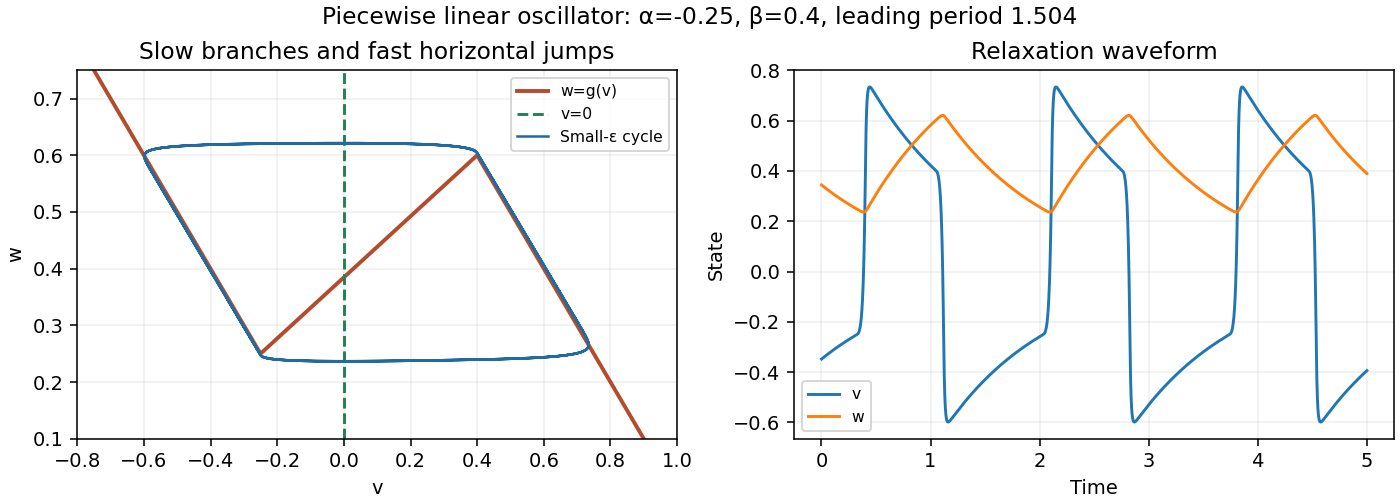

On the attracting right branch, the leading fast balance is , so . On the left branch it is , so . The slow travel times are thereforeBoth are positive because . The fast jumps contribute vanishing time as , giving the piecewise linear relaxation-oscillator periodFor the illustrated , , the leading period is in the given nondimensional time units.
Articles by others on the same topic
There are currently no matching articles.