The nullclines are the cubic and the straight line . At an equilibrium either , or . The latter quadratic has maximum , so leaves only the resting state . Its Jacobian matrix isBoth eigenvalues have negative real parts; the rest state is linearly stable and asymptotically stable.
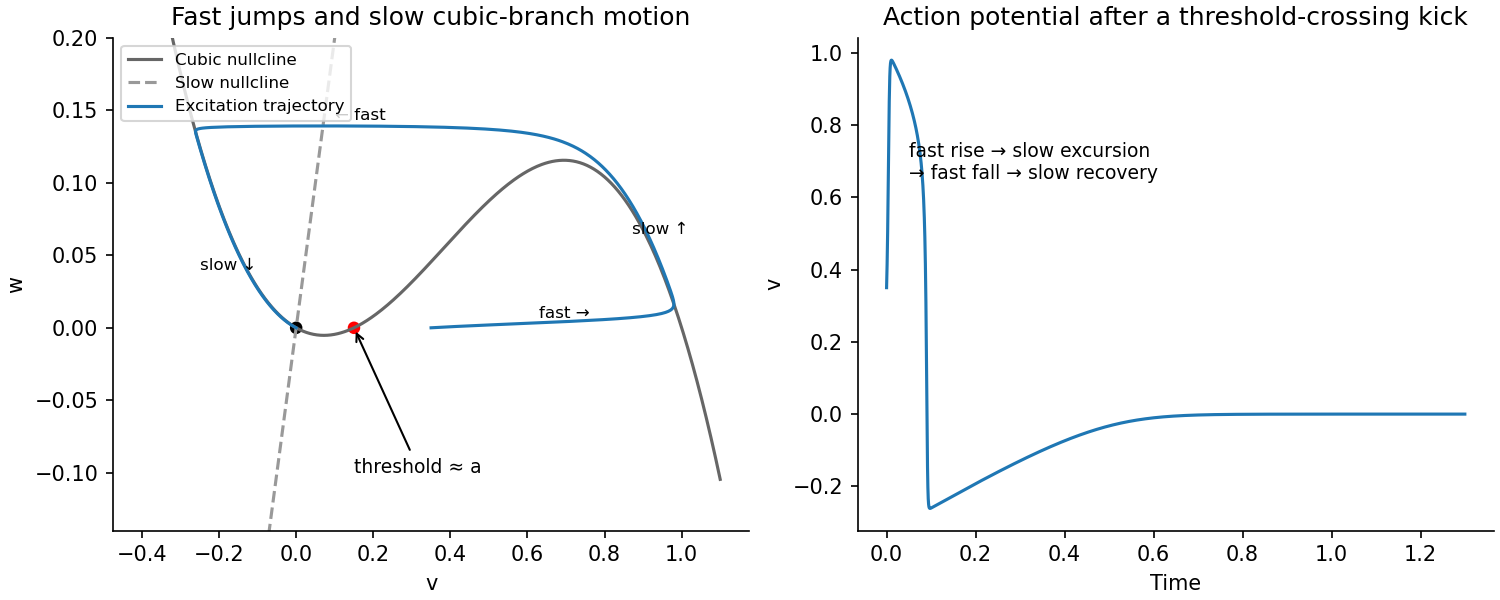
On the fast time , the recovery variable is approximately fixed. At , the scalar fast equation has stable roots and an unstable root . A small kick below decays towards rest; a kick above it moves rapidly towards the right attracting branch. For finite , the threshold is displaced from the frozen root by slow recovery, but the leading threshold mechanism is this unstable middle branch.
After the fast excitation, raises while follows the right attracting branch of the cubic. At its upper fold the branch ends and makes a fast downward jump to the left branch. Recovery then lowers slowly, with a negative undershoot in , before return towards . Thus the action potential time trace has rapid depolarization, a slower high-voltage excursion, rapid repolarization, and slow recovery. On the fast segments scarcely changes; on slow segments and . The figure shows a numerically integrated superthreshold excursion and its time trace, rather than just arrows on the nullclines.

Articles by others on the same topic
There are currently no matching articles.