The nullclines are the cubic and the straight line . At an equilibrium either , or . The latter quadratic has maximum , so leaves only the resting state . Its Jacobian matrix isBoth eigenvalues have negative real parts; the rest state is linearly stable and asymptotically stable.
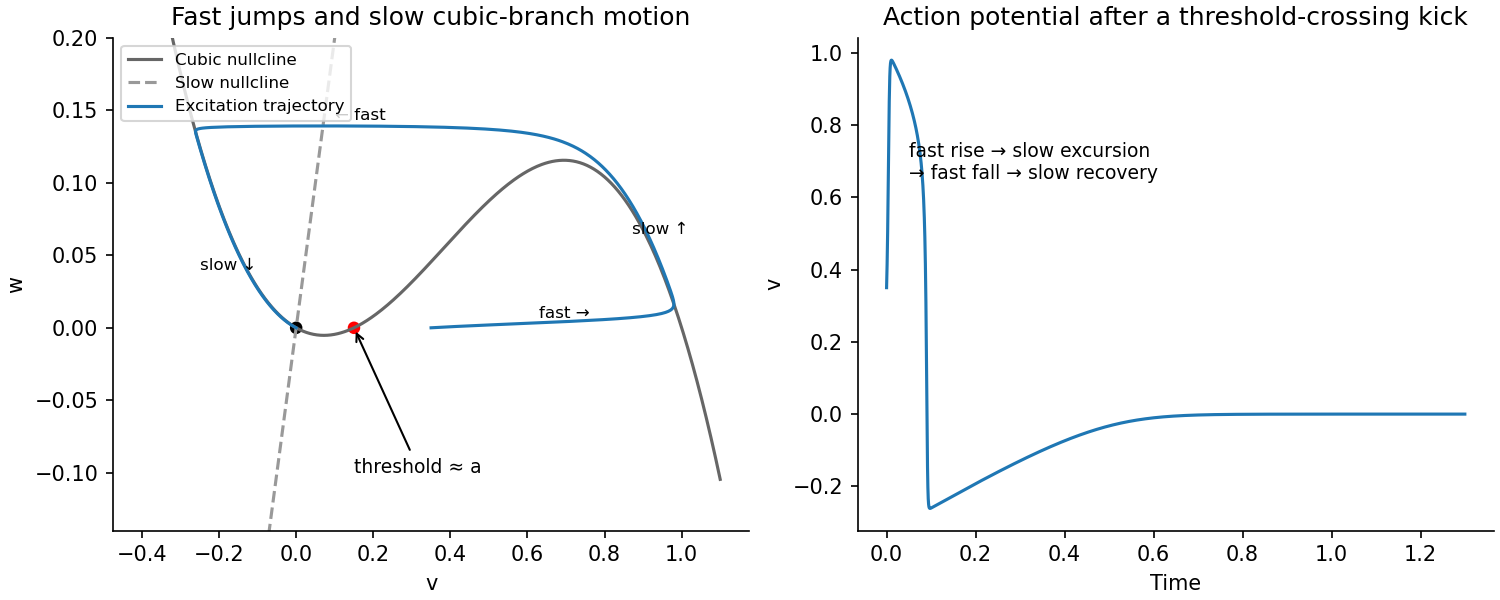
On the fast time , the recovery variable is approximately fixed. At , the scalar fast equation has stable roots and an unstable root . A small kick below decays towards rest; a kick above it moves rapidly towards the right attracting branch. For finite , the threshold is displaced from the frozen root by slow recovery, but the leading threshold mechanism is this unstable middle branch.
After the fast excitation, raises while follows the right attracting branch of the cubic. At its upper fold the branch ends and makes a fast downward jump to the left branch. Recovery then lowers slowly, with a negative undershoot in , before return towards . Thus the action potential time trace has rapid depolarization, a slower high-voltage excursion, rapid repolarization, and slow recovery. On the fast segments scarcely changes; on slow segments and . The figure shows a numerically integrated superthreshold excursion and its time trace, rather than just arrows on the nullclines.
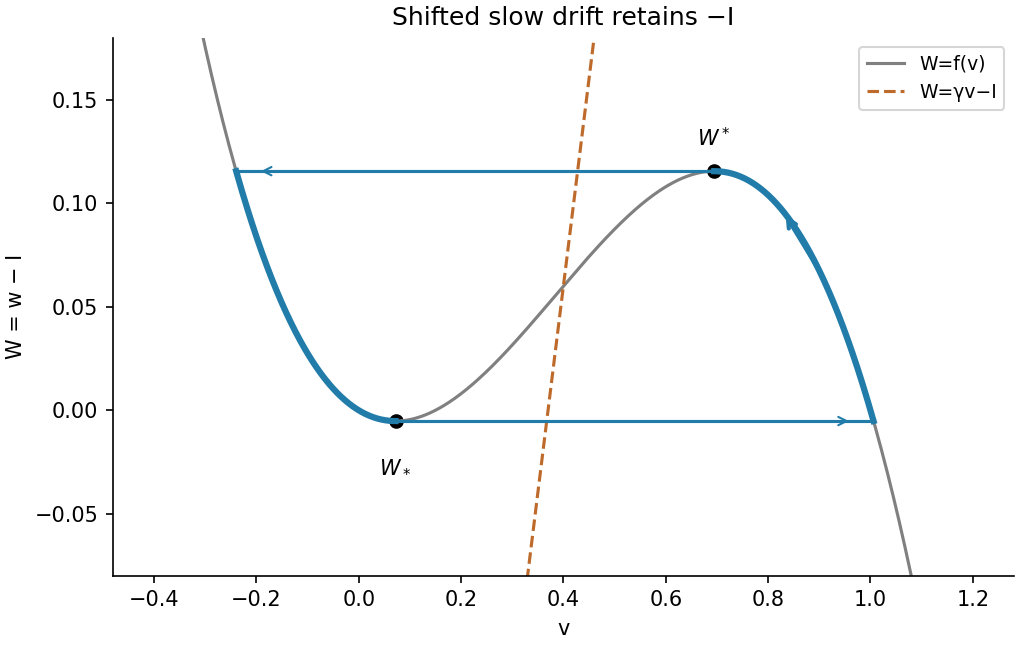
Use . The nullclines become and , while the slow equation becomes . The cubic has foldswith its local minimum and its local maximum. Let and be the left and right attracting roots of . A line whose intersection is on the repelling middle branch permits a relaxation oscillation: upward slow travel on the right branch from to , a fast jump to the left branch, downward slow travel to , and a return jump. For sufficiently large fixed this occurs for currents between the fold values and , away from the small- onset layers. The straight line then crosses each outer branch beyond the relevant slow excursion, so the slow velocities have the required signs.
Neglecting the fast-jump durations, integrate along the two slow segments. Their opposite orientations giveThe printed period omits the current shift. With the source's definition that solve , both denominators must retain in the shifted coordinate. Equivalently, in the physical recovery coordinate the bounds are and the integrand uses . The printed formula is therefore not the leading slow period for the displayed equations unless its notation is changed or an additional approximation justifying the omitted term is supplied.


For the chain rule gives , , . ThusAs increases from the material ahead of the wave towards that behind it, the singular pulse construction is . The front raises at approximately fixed from the low root to the high root. On the plateau , on the right attracting branch while rises slowly. The back decreases at approximately fixed to the left attracting branch. The recovery tail then lowers back to zero on that branch, returning to . Both sharp transitions have thickness in ; the other segments have the slower recovery scale.
The figure labels all four points and the front/back orientations. This frozen-recovery construction needs as well as if is large, so that the recovery variable remains nearly fixed in an inner transition. It also needs an admissible positive front speed for the chosen orientation, addressed below.
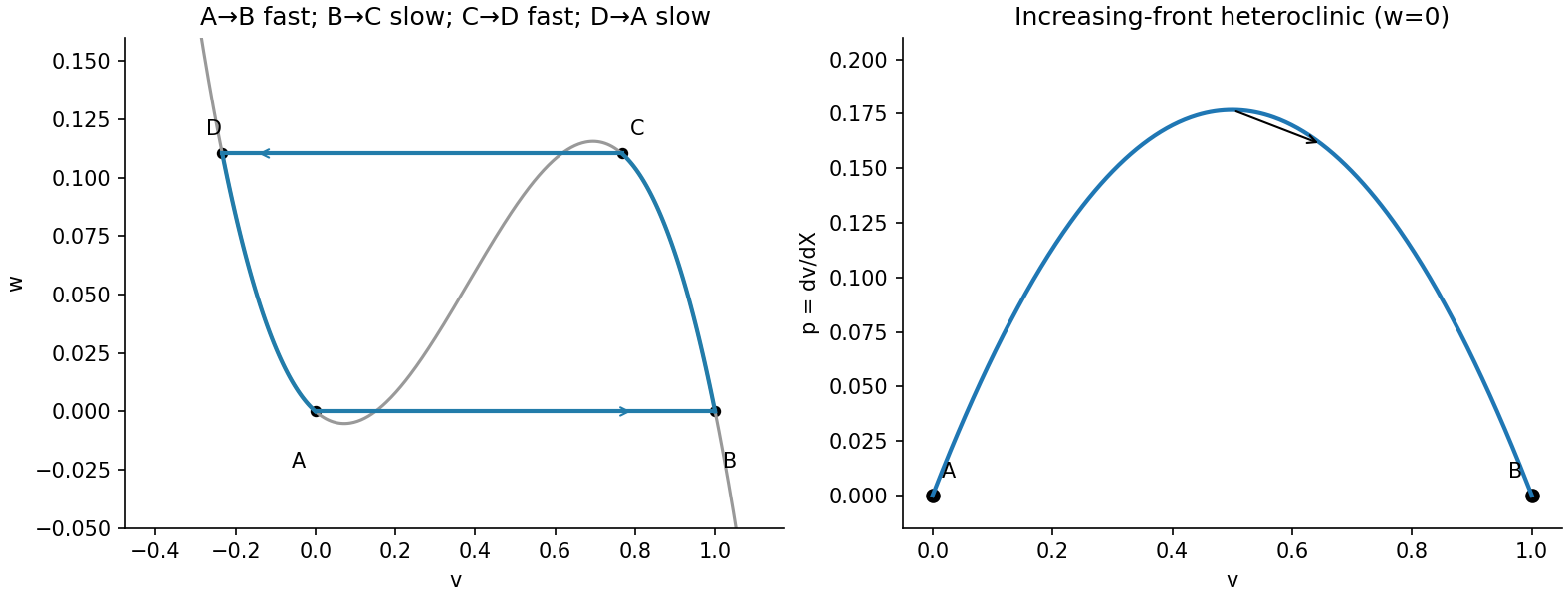
Matched front, plateau, back and recovery tail, with the inner front heteroclinic orbit
. Details. 
Put . The travelling equations become and . Hence, for nonzero speed and , is constant to leading order across the front.
Writing gives the planar system , . At the outer cubic roots and , . The Jacobian determinant is , so both are saddle points. The increasing front is a heteroclinic orbit from the unstable manifold of to the stable manifold of . Varying supplies the shooting parameter required to match these manifolds. For this cubic one can also construct it explicitly, as in the next solution.
Multiply the second-order equation by and integrate across the front. Because at both ends, the term vanishes. The remaining identity isThe denominator is positive for a nonconstant front, so its direction is determined by the signed area between the cubic and the horizontal recovery line: Maxwell balance for a scalar reaction-diffusion front gives zero speed when that area vanishes.
The derivative in the denominator must use the inner coordinate . If one instead uses the source's original and denotes , then and the identity is . Thus the printed is valid only if has silently been reused for the rescaled inner coordinate; with the original coordinate it misses a factor .
Let denote the increasing-front speed from the preceding solution. Reversing that heteroclinic reverses its speed, so a decreasing back has speed . A rigidly travelling pulse has one speed throughout, requiringThis is the correct use of the integral formula: compare the oppositely oriented transitions, including their signs, rather than equating two increasing-front speeds.
For completeness, write , . The explicit increasing frozen-recovery cubic front isSubstitution, using , verifies the equation. Since , speed matching givesFor this selects the appropriate positive back level within the cubic's three-root range. The high branch connects to slowly, and the low branch supplies recovery after .
The stated positive-speed, rising-front orientation imposes at leading order. The printed range by itself does not guarantee that pulse construction: at the leading front is stationary, while for the calculated increasing-front speed is negative. Existence and stability of a full finite- pulse also require the slow connections; speed matching is its leading necessary construction, rather than a proof for every parameter in the printed range.
Articles by others on the same topic
There are currently no matching articles.