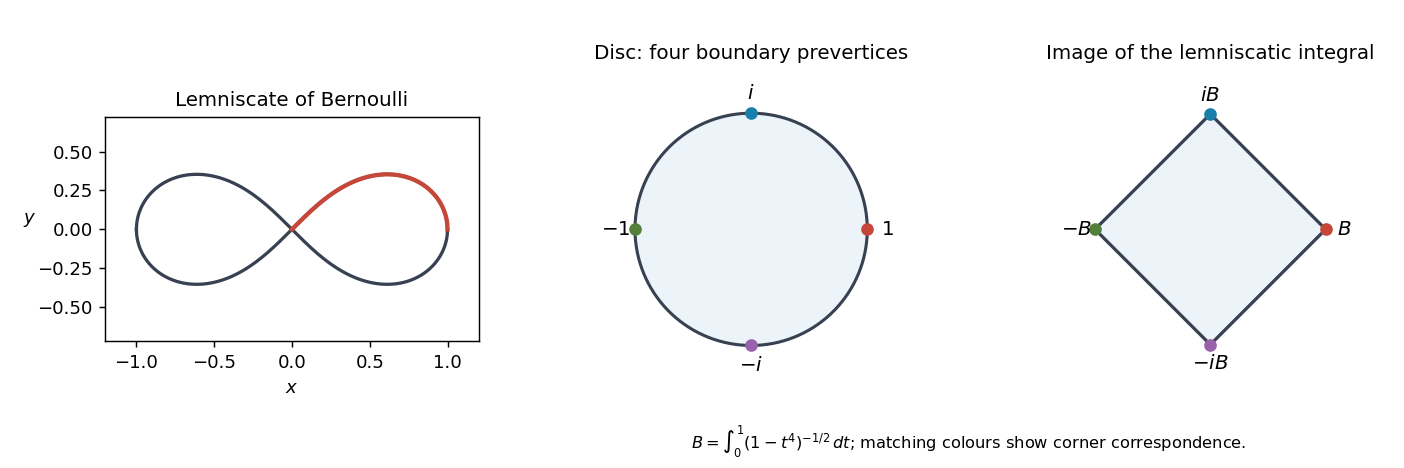
Use polar coordinates , . Away from the crossing, the lemniscate of Bernoulli has . An explicit parametrization of its four quarter-arcs iswhere the two signs are independent. Indeed and . The four arcs meet at the origin and at the two lobe endpoints, covering the entire curve.
For the upper-right quarter, take , . Differentiating gives . Thus the arc length element satisfiesSet , which decreases from one to zero. Since , it follows that . All four quarter-arcs have the same length, soThe endpoint singularity is proportional to and is integrable. This is the geometric origin of the lemniscatic integral.
Choose the holomorphic square root in the complex upper half-plane whose boundary value is positive on . Its primitive has derivative . The integral from the boundary basepoint zero is well-defined by a limiting path: the local singularity is only .
The three finite prevertices have derivative exponent , hence image angle . At infinity , so the local coordinate also gives image angle . These are the four corners of a Schwarz-Christoffel mapping to a rectangle. To establish that it is a square rather than a general rectangle, putThe length along is also by . The length along isby , and the fourth side has the same length by symmetry. With the chosen branch, the boundary derivatives on the intervals have phases , respectively. ThereforeThe extended real boundary maps continuously and once around this square. Each side is traversed monotonically, and the four corner limits are finite. The argument principle, applied after small indentations around the boundary singularities, counts one inverse image of each interior value and zero of each exterior value. Since never vanishes in the complex upper half-plane, those interior inverse images are simple. Thus
Let , the inverse Cayley transform between the half-plane and disk. Direct calculation givessoOn the unit disc, choose the holomorphic square root of equal to one at zero. Both sides define nonvanishing holomorphic derivatives, and their quotient has constant square. The branch chosen in part ii gives . ConsequentlyAn affine change of image coordinate preserves conformality, so the lemniscatic integral maps the disc bijectively onto a square.
The normalization specifies the square exactly. Put . The substitution gives . The integral satisfies and , so its four corner values are . ThusIn particular the image is a square rotated through relative to the one in part ii, and its side length is . These symmetries also give from the affine identity.

Articles by others on the same topic
There are currently no matching articles.