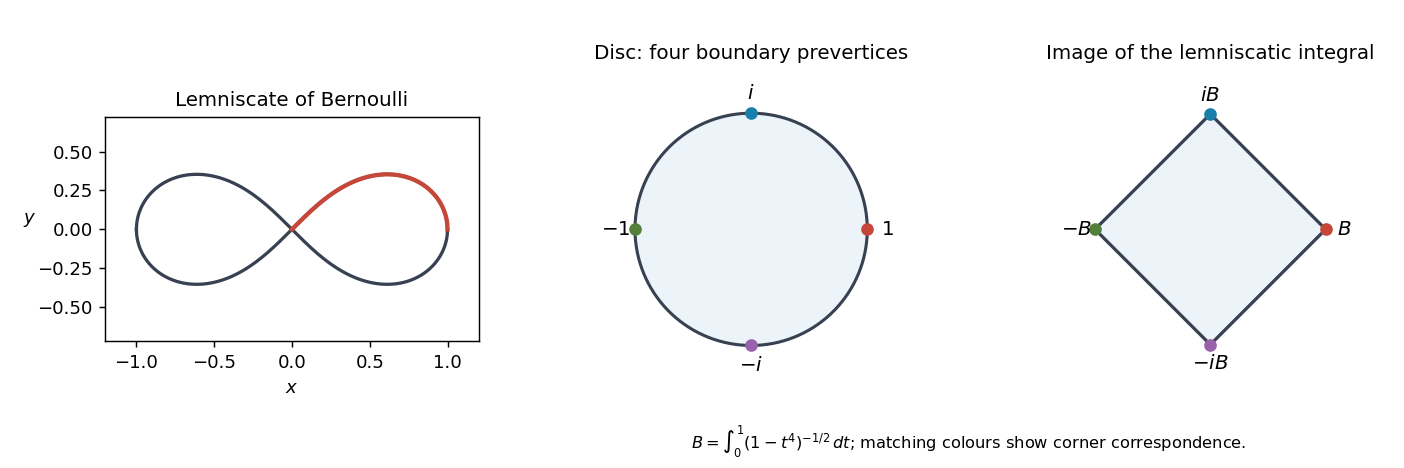
Use polar coordinates , . Away from the crossing, the lemniscate of Bernoulli has . An explicit parametrization of its four quarter-arcs iswhere the two signs are independent. Indeed and . The four arcs meet at the origin and at the two lobe endpoints, covering the entire curve.
For the upper-right quarter, take , . Differentiating gives . Thus the arc length element satisfiesSet , which decreases from one to zero. Since , it follows that . All four quarter-arcs have the same length, soThe endpoint singularity is proportional to and is integrable. This is the geometric origin of the lemniscatic integral.
Choose the holomorphic square root in the complex upper half-plane whose boundary value is positive on . Its primitive has derivative . The integral from the boundary basepoint zero is well-defined by a limiting path: the local singularity is only .
The three finite prevertices have derivative exponent , hence image angle . At infinity , so the local coordinate also gives image angle . These are the four corners of a Schwarz-Christoffel mapping to a rectangle. To establish that it is a square rather than a general rectangle, putThe length along is also by . The length along isby , and the fourth side has the same length by symmetry. With the chosen branch, the boundary derivatives on the intervals have phases , respectively. ThereforeThe extended real boundary maps continuously and once around this square. Each side is traversed monotonically, and the four corner limits are finite. The argument principle, applied after small indentations around the boundary singularities, counts one inverse image of each interior value and zero of each exterior value. Since never vanishes in the complex upper half-plane, those interior inverse images are simple. Thus
Let , the inverse Cayley transform between the half-plane and disk. Direct calculation givessoOn the unit disc, choose the holomorphic square root of equal to one at zero. Both sides define nonvanishing holomorphic derivatives, and their quotient has constant square. The branch chosen in part ii gives . ConsequentlyAn affine change of image coordinate preserves conformality, so the lemniscatic integral maps the disc bijectively onto a square.
The normalization specifies the square exactly. Put . The substitution gives . The integral satisfies and , so its four corner values are . ThusIn particular the image is a square rotated through relative to the one in part ii, and its side length is . These symmetries also give from the affine identity.

For genuine degrees three and two, the resultant is the Sylvester matrix determinantEquivalently, if are the roots of , counted with multiplicity, then . Thus means that the polynomials have no common root, or equivalently are coprime over . One can also see this from the matrix: its singularity gives a nonzero relation with , . If were coprime, would force , then , a contradiction. Conversely, a common factor supplies such a relation after dividing by that factor. When a leading coefficient is zero, use the resultant for the actual polynomial degrees rather than assuming the displayed fixed-degree criterion unchanged.
An algebraic addition theorem for a meromorphic function means a nonzero polynomial withidentically where the values are finite. A local relation extends meromorphically to the other regular arguments.
For a polynomial of positive degree , let be the roots of and the roots of . FormIts coefficients are separately symmetric polynomials in the two sets of roots. The Fundamental theorem of symmetric polynomials and the fixed nonzero leading coefficient of show they are polynomials in . The expression is monic of degree in , so it is nonzero. If , , one factor vanishes at . This proves the addition relation, including at exceptional multiple-root values by polynomial identity. A constant polynomial instead has the relation .
For the elliptic case, let . A nonconstant elliptic function defines a finite morphism , so the function field of is a finite algebraic extension of . The elliptic function-field decomposition expresses it as , withThe Weierstrass addition formula makes translation algebraic:Differentiating and using the cubic differential equation also makes rational in the four separate values. Therefore lies in a finite algebraic extension of . Its algebraic equation, after clearing denominators, is the required polynomial relation. This sketches why every elliptic function, not only , has an algebraic addition theorem. Constants are already covered.
For the final assertion, consider , an entire function. If is a period, then for every . The continuous exponent must be a constant integer multiple of ; its derivative forces . Hence its periods are exactly , making it a simply periodic function.
Suppose it had an algebraic addition theorem . There are only finitely many values for which is identically zero: a nonzero coefficient polynomial in already bounds this exceptional set. Choose a positive irrational with outside this set, and set . Specializing gives a nonzero polynomial and, with ,All exponents with nonzero coefficients are distinct, by irrationality of . Divide by the exponential with largest real exponent and let ; its nonzero coefficient would have to tend to zero. This contradiction proves that simple periodicity does not imply an algebraic addition theorem. It is the simply periodic entire function without an algebraic addition theorem example.
Take a real modulus and complementary modulus . The Jacobi elliptic sine is constructed by inverting a Schwarz-Christoffel mapping. The main reason for the Schwarz-Christoffel derivative is local angle behavior: if a prevertex corresponds to a polygon angle , straightening that corner gives . Hence has exponent . Along each straight boundary side its argument is constant. Dividing by removes those angle changes; Schwarz reflection extends the quotient across the real boundary and the corner singularities. With all vertices finite, its behavior at infinity is also regular, because the sum of the derivative exponents is . It is therefore a nonzero constant on the sphere. This yieldsThis argument explains the exponents, the branch choices and the role of boundary reflection, rather than just writing down the formula.
For a rectangle, four angles are , so choose prevertices and normalize the inverse map asUse the branch positive on . SetThe two middle corner values are . The right side length isas the substitution shows. The selected branch makes the increment along that side . Thus the other corner values are and . The two boundary intervals through infinity have combined horizontal length ; the substitution gives length from to infinity. In particular . As in the square mapping, the boundary goes once around a rectangle, and the argument principle gives a conformal bijectionIts inverse maps that rectangle onto the complex upper half-plane, and near zero has , . Differentiating the inverse relation givesThese identities continue meromorphically.
All four rectangle edges have real images, so Schwarz reflection extends across them. Reflection in the bottom edge gives . Reflection in the right edge, combined with the first reflection, gives . The even inverse-integral derivative gives , and henceReflection in the top edge and then the bottom gives . The resulting period lattice of the Jacobi elliptic sine isTo see the poles, use near the boundary point infinity. Then , so the inverse has a simple pole at with residue . The real half-period shift gives another pole at with opposite residue. Reflection tiles the plane with copies of the rectangle, so these are exactly two simple poles per displayed fundamental cell. They also show there is no additional period: a period must permute these two pole classes; exchanging them would shift by modulo the displayed lattice, which reverses the function's sign and residues rather than preserving it.
For any finite , integrate around a fundamental parallelogram avoiding its zeros and poles. The opposite edges cancel by periodicity, so the number of zeros of equals the number of poles, namely two. Therefore every value has two inverse images modulo periods, counted with multiplicity. The value infinity likewise has the two simple poles as preimages. Usually the finite-value preimages are distinct; the involution interchanges them. At , a critical point supplies one double inverse image instead. For example , , . Thus the printed “exactly two” requires the standard multiplicity convention; it would be false if interpreted as two distinct solutions at these branch values of a holomorphic map.
Now choose and put . Since , is even, elliptic for , and has degree two. The Weierstrass elliptic function for the same lattice is even and has one double pole per cell, hence also degree two. Its generic fibers are precisely . Consequently an even is constant on those fibers and descends to a meromorphic function of . At the four fixed classes of , the even local Laurent expansion makes this descent meromorphic in the squared local coordinate. A meromorphic function on the Riemann sphere is rational, so . Generic map degrees multiply:Thus has degree one and the degree-two even elliptic function conclusion isThe determinant condition follows because is nonconstant. This proves the existence requested, with the explicit allowable shift .
For fixed , Gaussian decay of gives locally uniform convergence of the theta function series and all its -derivatives. It is therefore entire. Shifting the series argument and reindexing givesSince , the corresponding second multiplier for has the opposite sign:Thus obeys and . These give candidate period lattices; to show they are exact, first locate every zero.
At ,because the terms with indices and cancel. The absolute convergence justifies that pairing. Quasi-periodicity propagates this zero to every .
For exhaustiveness and simplicity, let . It satisfies and . Take a fundamental parallelogram for , translated so its boundary has no zero. The two sloping edges cancel by the first identity; the bottom and reversed top giveThe argument principle therefore counts one zero with multiplicity in every cell. Since a known zero class already exists, all zeros are simple and exactlyThe denominator's simple zeros are instead . These two cosets are disjoint: cannot lie in because . Thus there are no cancelled zeros or poles in the quotient.
Any period of or must translate its zero set onto itself, so must belong to . A translation multiplies by ; the quotient is nonconstant, so an odd cannot be a period of . Squaring removes precisely that sign. This proves the period lattice of theta3 over theta4 and its squared counterpart:The second lattice is for the squared function; no additional translation can preserve its zero set.
The modular group is acting on the complex upper half-plane byIts central element acts trivially on points, so the effective group is . It is generated by and : the Euclidean algorithm reduces the bottom row of a matrix using these operations until it is a translation. The relations hold in the projective group.
A standard fundamental domain of the modular group isTo see that each orbit meets it, use . Choose a coprime integer pair minimizing the nonzero lattice modulus ; a modular matrix with that bottom row maximizes the imaginary part. Translate to the central strip. If the result had modulus below one, inversion would further increase its imaginary part, a contradiction. Interior representatives are unique: for a point in the interior, when . For use ; for use the strip and the strict unit-circle bound. Thus such a matrix lowers the imaginary part, which would contradict the same fact applied to its inverse if both representatives were in the interior. Matrices with are translations, and cannot move one interior strip point to another.
The vertical sides are identified by , and the circular halves by . The exceptional points with elliptic stabilizers of the modular group are represented by and , of projective stabilizer orders two and three. The rational boundary points together with infinity form one modular cusp orbit. In the hyperbolic metric the region has area .
A useful subgroup is the level-two principal congruence subgroup,Reduction modulo two is onto , which has six elements and permutes the three nonzero vectors. Hence its kernel has index six, and the quotient is . In the projective action, is torsion-free. Indeed finite-order nonidentity modular elements have trace zero or ; matrices in have even trace, and trace zero is impossible because are odd while are even: with would imply . The subgroup has three modular cusp classes, represented by , each of width two. Parity of a primitive pair distinguishes these classes, and elementary level-two row operations reduce each class to its representative. Six translates of supply a fundamental region. Its compactified level-two modular curve is obtained by adjoining these three modular cusp points.
Invariant holomorphic functions arise naturally from theta constants. In the radian convention of Question 4, put , and defineHere . The theta-constant inversion and translation laws, obtained by Gaussian Poisson summation and by reindexing, interchange under with the common factor , leave fixed up to that factor, and under interchange while multiplying by . Together with the Jacobi abstruse identity , this givesThese transformations generate the six permutations of . In particular and fix ; with , these generate . Thus the modular lambda function is invariant under this subgroup, but not under the whole modular group. Its even theta constants do not vanish on , so it is holomorphic there and avoids . Near infinity, , with , which is the width-two modular cusp coordinate. The two transformation laws give modular cusp values one at zero and infinity at one, with the same simple local orders. Thus has exactly one simple pole on the compactified level-two quotient and no pole in the half-plane. A meromorphic map with one simple pole has degree one, so it identifies that quotient with the sphere and the open quotient with . This proves the coordinate assertion and describes all three modular cusps.
Symmetrizing this subgroup invariant produces a full modular-invariant function:Substitution shows that this rational expression is unchanged by both and , hence by and . It is the Klein j-invariant. Its denominator does not vanish on , so it is holomorphic there; at the modular cusp it has , a simple pole in . It therefore remains nonconstant without being a bounded holomorphic function on the compactified quotient. In fact a holomorphic invariant extending holomorphically to the compactified modular curve would be constant by the maximum principle.
This also connects invariance to elliptic curves: changing an oriented basis of the lattice gives precisely the modular action after a rescaling. On the compact full modular quotient, has just the one simple modular cusp pole, so its map to the sphere has degree one. It therefore classifies the resulting homothety of complex lattices classes, while the modular lambda function retains a level-two labeling of the branch points in the Legendre model . Finally, a modular form of nonzero weight obeys a transformation law with a factor , not plain invariance; ratios of equal-weight forms instead give weight-zero modular functions. The distinction between forms, invariant holomorphic functions on the open half-plane, and their modular cusp behavior is essential to this construction.
Articles by others on the same topic
There are currently no matching articles.