A constant number star formation rate over produces a uniform present-age distribution. The birth-age distribution under constant star formation therefore givesOutside this age interval the cumulative distribution function is zero or one. The census here retains stellar remnants as objects, as required by the population model.
Write . The initial mass function is proportional to on . Normalizing the tail integral gives the power-law initial-mass-function tail coordinate:For lower thresholds . Because the birth mass and formation time have independence, the probability integral transform makes uniform on the unit square. is an upper-tail coordinate, so larger masses have smaller .
A red giant of current age lies in the stellar lifetime regions in a mass-age diagramThere are no red giants below in this model. For the upper boundary is the population's age limit, while for both lifetime boundaries are present. A white dwarf lies above .
In uniform probability coordinates the main-sequence boundary is and the end of the giant phase is . The giant region is therefore , clipped to the unit square: it is the triangle with vertices . Its area, and hence the individual giant fraction, isThe white dwarf region is the triangle with vertices , givingThe remaining are on the main sequence. Boundaries have zero probability and do not affect these counts. Treating every post-giant object as a white dwarf is a stipulated toy-model assumption; real high-mass stars have other stellar remnants.
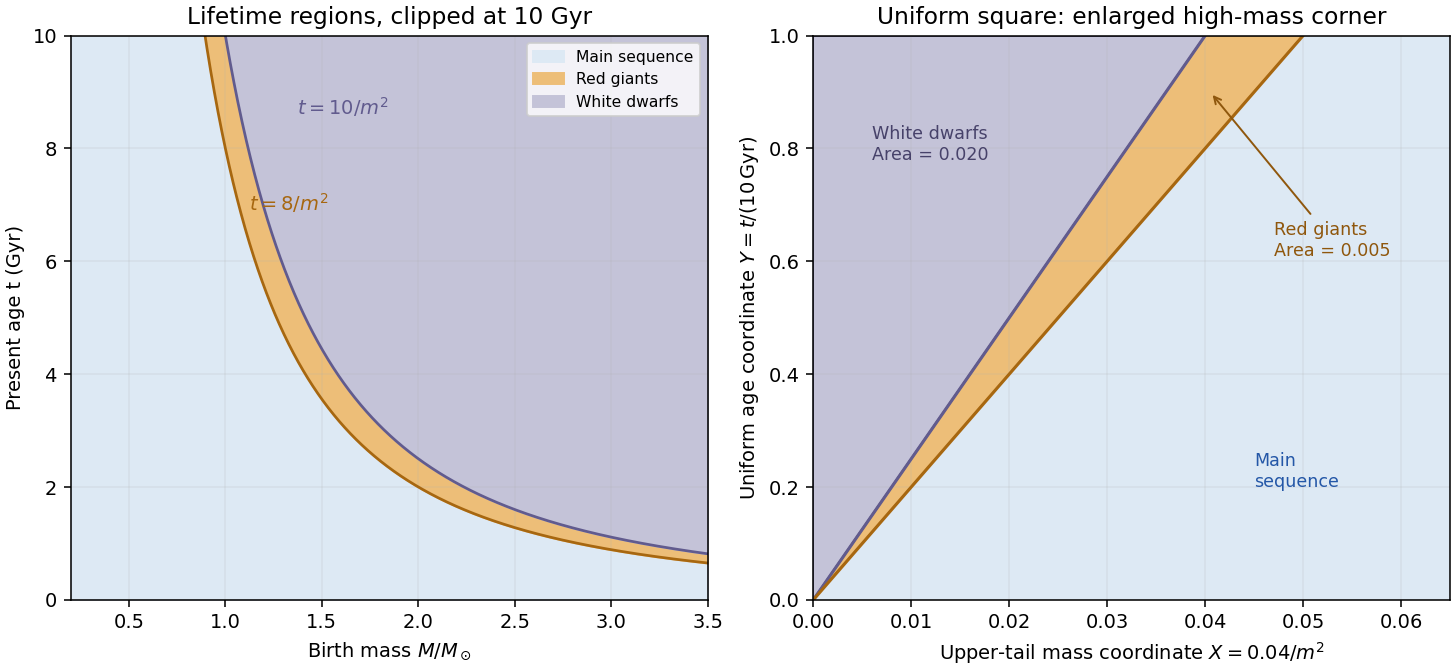
Red-giant and white-dwarf regions in mass-age coordinates and their triangular images in uniform tail-mass and age coordinates
. Details. 
For the binary calculations, use a coeval binary population: components share their birth time even though their birth masses are independently drawn and their subsequent evolution is independent. Hence is uniform in the unit cube. At a fixed age coordinate , a component is a giant when , and a white dwarf when . Define the conditional state fractionsComponents have conditional independence given ; averaging over the common age must be done after forming the conditional pair probabilities. The continuous-birth binary state fractions below are consequently volumes in this cube, not products of the marginal single-star fractions.
Condition on the common age of the coeval binary population. Each component is a red giant with conditional probability , independently of the other component at that age. The conditional probability of at least one giant is . Integrating over the uniform age distribution givesThus the fraction is , just below . The subtracted term removes the systems counted twice because both components are red giants. Using the square of the marginal giant fraction would incorrectly ignore their shared age.
A system containing a red giant and another evolved component is either a giant–giant pair or an unordered giant–white dwarf pair. At common age , these disjoint possibilities have conditional probabilities and . The conditional evolved-companion fraction in a coeval binary population therefore has numeratorDivide by the fraction of systems containing at least one giant:Thus just over of giant-containing binaries have an evolved companion. The numerator is a fraction of all binaries; it is not itself the requested conditional fraction.
For continuous-birth binary state fractions, conditional mass independence and the common age giveThe factor two in the middle expression allows either component to be the red giant. ThusGeometrically, the corresponding sections of the unit cube have areas proportional to , so their volumes equal one third of their base areas. This is exactly the pyramid-volume calculation: the equal height and common factor leave the base-area ratio unchanged.
Articles by others on the same topic
There are currently no matching articles.