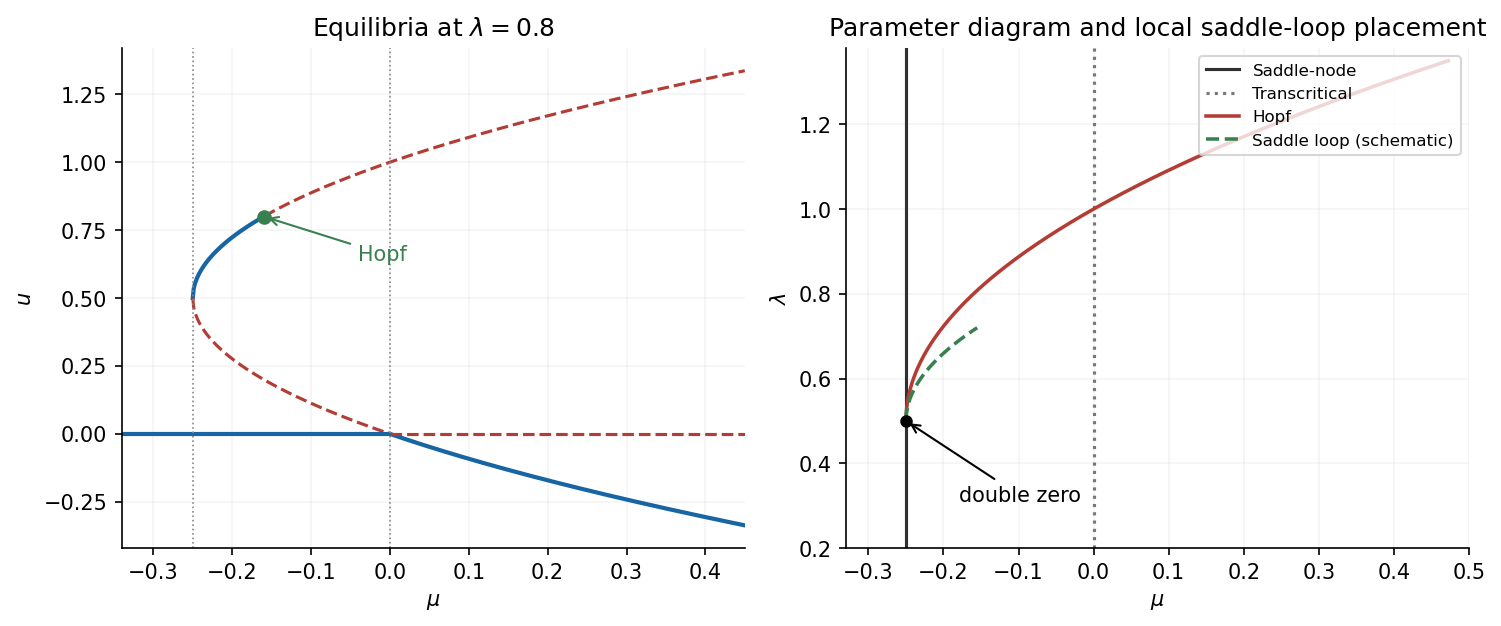
At , the two branches meet at . The eigenvalues there are and . For , the nonzero quadratic term and transverse stability identify a saddle-node bifurcation. If , it creates a sink equilibrium and a saddle equilibrium as increases; if , it creates a source equilibrium and a saddle equilibrium. At , the zero eigenvalue is double and the ordinary saddle-node description needs the two-parameter unfolding.
At , the origin and lower branch cross. Since , the branches cross transversely in the diagram. The origin changes from a sink equilibrium to a saddle equilibrium as increases through zero; the lower branch changes from a positive- saddle equilibrium to a negative- sink equilibrium. This is a transcritical bifurcation. A local centre-manifold calculation also gives , because and the transverse eigenvalue is .

Articles by others on the same topic
There are currently no matching articles.