The first equation factors as and the second gives at an equilibrium. HenceThe two nonzero branches exist for , coincide at equality, and the lower branch coincides with the origin at . For both are in ; for , has and has .
At the origin, the eigenvalues are . At any nonzero equilibrium , using givesThus is a saddle equilibrium for , and a sink equilibrium for when it lies in the negative half-plane. The upper branch has positive determinant and is stable for , unstable for . These statements include the existence and stability information needed for the subsequent diagrams.
At , the two branches meet at . The eigenvalues there are and . For , the nonzero quadratic term and transverse stability identify a saddle-node bifurcation. If , it creates a sink equilibrium and a saddle equilibrium as increases; if , it creates a source equilibrium and a saddle equilibrium. At , the zero eigenvalue is double and the ordinary saddle-node description needs the two-parameter unfolding.
At , the origin and lower branch cross. Since , the branches cross transversely in the diagram. The origin changes from a sink equilibrium to a saddle equilibrium as increases through zero; the lower branch changes from a positive- saddle equilibrium to a negative- sink equilibrium. This is a transcritical bifurcation. A local centre-manifold calculation also gives , because and the transverse eigenvalue is .
The figure uses a representative ; the upper branch's additional Hopf change is indicated. For the upper branch is unstable everywhere on its existence interval. The exact trace criterion in part (a) specifies stability for every fixed positive .
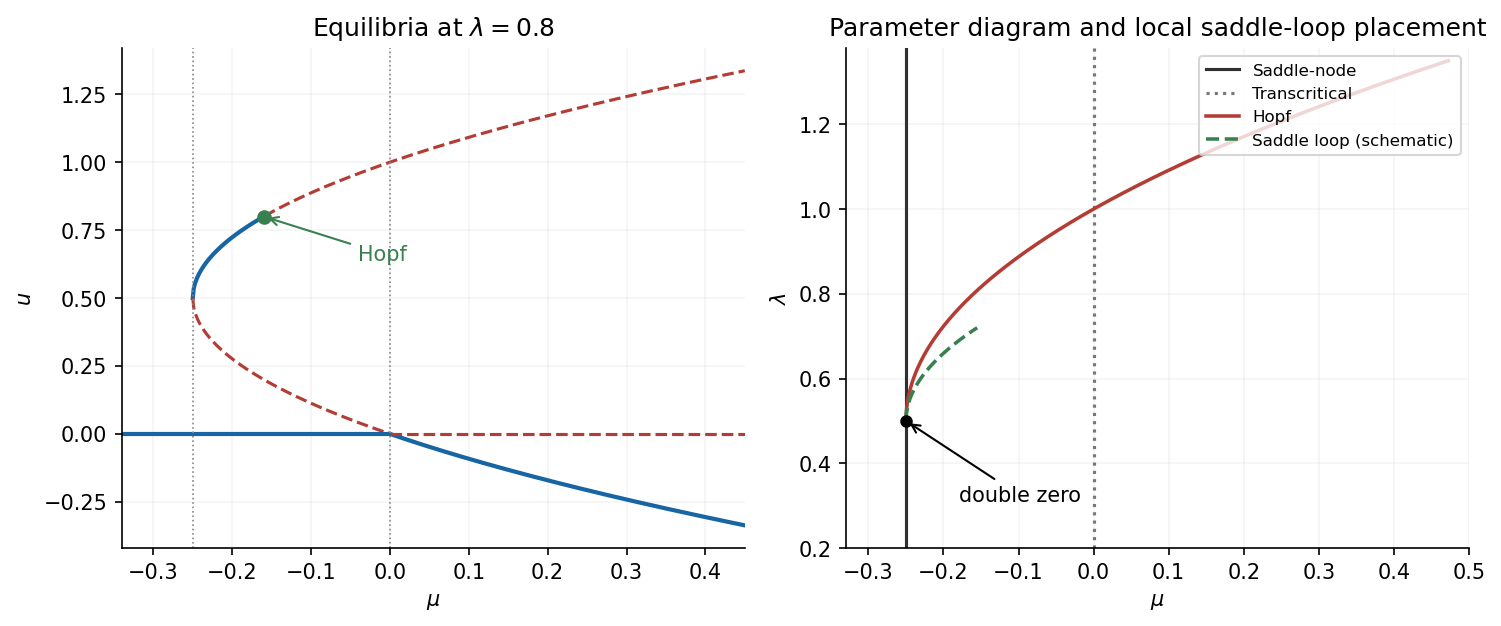
Only the upper equilibrium can have zero trace with positive determinant. Setting givesAt this point the determinant is , so the angular frequency is . Moreover , so the trace crosses zero transversely as increases. The stipulated supercritical Hopf bifurcation creates a stable periodic orbit on the side where the upper equilibrium becomes unstable.
The steady-state curves are the vertical lines and in the plane. The Hopf parabola has its endpoint atThere the Jacobian has trace and determinant zero but is not the zero matrix: it has a nilpotent Jordan block. This is the codimension-two Takens-Bogdanov point. The intersection of the Hopf curve with at concerns a different equilibrium from the transcritical crossing at the origin; it is not another double-zero equilibrium.
The global curve is a homoclinic connection to the lower positive equilibrium, which is the saddle equilibrium created at the saddle-node bifurcation. Near on the side , place it attangent to at the double-zero point. The stable periodic orbit occupies the strip and approaches the saddle equilibrium on the upper boundary. The dashed curve in the two-parameter figure indicates this local placement; its drawn numerical coefficient is schematic, not a computed global-bifurcation formula.
This placement is consistent with the supplied normal form. Its centre equilibrium has a supercritical Hopf bifurcation, and its saddle equilibrium has negative trace on the relevant loop branch, allowing a stable periodic orbit to disappear in the saddle equilibrium loop. No global-curve calculation is required here.
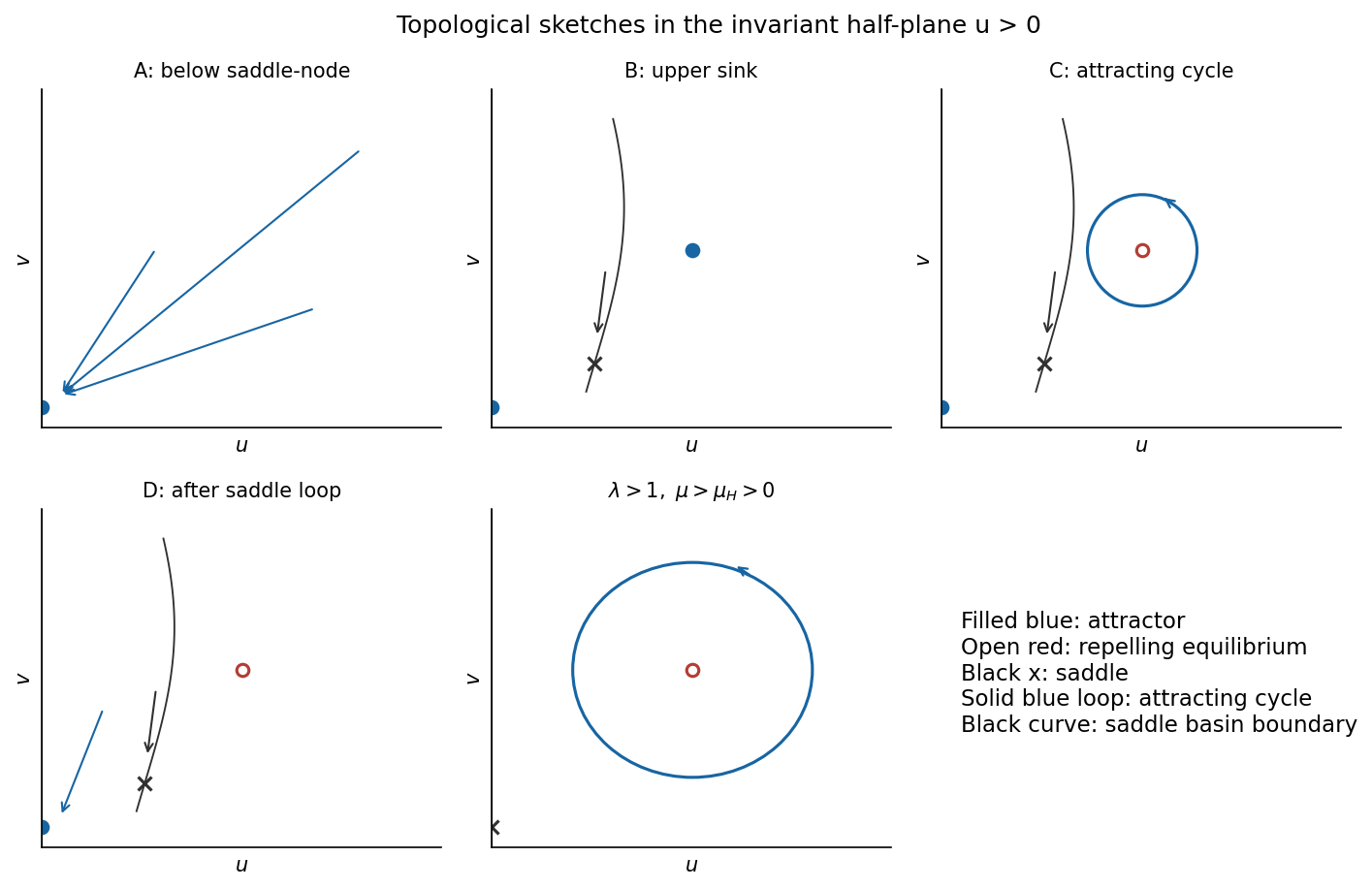
The four nearby portrait types in can be organized by increasing at fixed close to :
- A: . There is no interior equilibrium; trajectories approach the stable boundary equilibrium at the origin.
- B: . The lower interior equilibrium is a saddle equilibrium and the upper one a sink equilibrium. The saddle equilibrium's stable manifold separates trajectories approaching the sink equilibrium from those approaching the origin.
- C: . The upper equilibrium is repelling, enclosed by an attracting periodic orbit. The saddle equilibrium's stable manifold separates the periodic orbit's basin from the origin's basin.
- D: , still in the local neighborhood with . The saddle equilibrium and repelling upper equilibrium remain, but the periodic orbit has disappeared. Generic trajectories ultimately approach the origin.
The no-cycle region D continues around the double-zero point onto the side. The sketches distinguish the boundary origin from the two interior equilibria and show the periodic orbit only in region C.


Here . The origin is a saddle equilibrium, is repelling, and lies in . Thus there is no saddle equilibrium in the interior of to which this periodic orbit could become homoclinic. The origin cannot supply the missing loop: the line is invariant and is precisely its local stable manifold. An orbit in cannot lie on that stable manifold, so the positive periodic orbit cannot close into a homoclinic orbit to the origin either.
The outgoing trajectories do not escape to infinity in this regime. To see the large-amplitude turning mechanism, put once . Direct differentiation givesSince , the quadratic is uniformly positive. At large while , is bounded below by a positive multiple of , whereas . Thus rises by a fixed amount per bounded increase in : the trajectory reaches and then , where , before can diverge. The same estimate bounds repeated outgoing excursions; large positive also decreases when . Initially negative increases until it becomes nonnegative. These nullcline and ratio estimates give bounded forward excursions.
The repelling upper equilibrium is therefore surrounded by recurrent trajectories, and the Poincaré-Bendixson alternative supplies periodic motion rather than a saddle equilibrium connection. The supercritical attracting periodic orbit persists in the displayed regime, with trajectories spiralling away from the upper equilibrium and approaching it. The last panel of the portrait figure shows this behavior; the boundary stable manifold of the origin is kept separate.
The change of time is , which is positive in the half-plane under consideration. Dividing the two approximate equations by givesSet . The inhomogeneous system becomes , with eigenvalues . For , write . Integrating with the prescribed initial data givesandThese expressions also verify both initial values and their initial derivatives. For fixed and small on the outgoing branch, the sine coefficient in is positive and dominates the initial cosine term. The first return to small is near the first positive zero, . HenceThe factor is a half-turn of the growing spiral, not its full rotation period. After this excursion the approximate trajectory approaches the small-, large- region. In the full system the term , omitted during the large excursion, allows the motion to descend along that region and return.
As , the rescaled excursion time diverges and the factor produces arbitrarily large excursions. At the critical value the matrix is a nontrivial Jordan block, and the limiting formula isFor the small outgoing initial data this is positive and unbounded: the unstable manifold no longer turns back. Below the two eigenvalues are real and positive, so there is again no oscillatory return. This quadratic escape desingularization explains loss of the periodic orbit at infinity, together with the unstable-manifold escape, as decreases through . It is not a finite homoclinic bifurcation to the origin. The divergent travel time must not be identified with the physical period without integrating ; the time change becomes singular near .
Articles by others on the same topic
There are currently no matching articles.