Printed metric tensor. There is a genuine false premise. For the metric tensor actually printed, introduce . Since and ranges over all real values,This is global two-dimensional Minkowski spacetime, an example of how a time-dependent lapse can disguise flat spacetime. A future-directed timelike geodesic from the stated event, parametrized by proper time , hasFor the spatial position is unbounded, not periodic; is strictly increasing. The curve , is an explicit counterexample. Physically these are inertial particles moving at constant Minkowski velocity . The nonlinear original time coordinate does not create a confining force.
Likely intended spatial lapse. The hint instead fits the different metric tensor , the unit-radius two-dimensional anti-de Sitter spacetime in global static coordinates. This interpretation is not substituted silently for the printed one. For that metric tensor the conserved energy is , and normalization givesPutting gives , hence an outgoing geodesic from the origin hasThe supplied integral shows that increases by over each proper-time half-period. Thus the spatial oscillation repeats after proper time and coordinate time , with turning points . It describes gravitationally confined inertial motion in AdS. On the universal cover, is not identified and the worldline is not closed; identifying modulo makes the timelike geodesic closed. For the central particle stays at .
For the printed metric tensor, first use the global Minkowski time . SetThenRemoving the positive conformal factor yields the ordinary Penrose diagram of two-dimensional Minkowski spacetime: a diamond with null future/past infinity on its sloping edges, timelike infinity at the top/bottom, and spatial infinity at the left/right corners. Null geodesics have slope ; future/past causal cones are ordinary Minkowski cones. There is no physical boundary or curvature singularity at a finite original coordinate value.
For the alternative spatial-lapse metric tensor identified in part (a), set . Then and , soIts universal-cover conformal diagram is an infinitely tall strip with two timelike conformal boundaries, the conformal strip of two-dimensional anti-de Sitter spacetime. Null geodesics reach either boundary in finite coordinate time, though the boundary is not part of the physical manifold and the physical null affine parameter diverges there. The strip and diamond have different causal structures; no conformal coordinate change can identify their global causal properties.
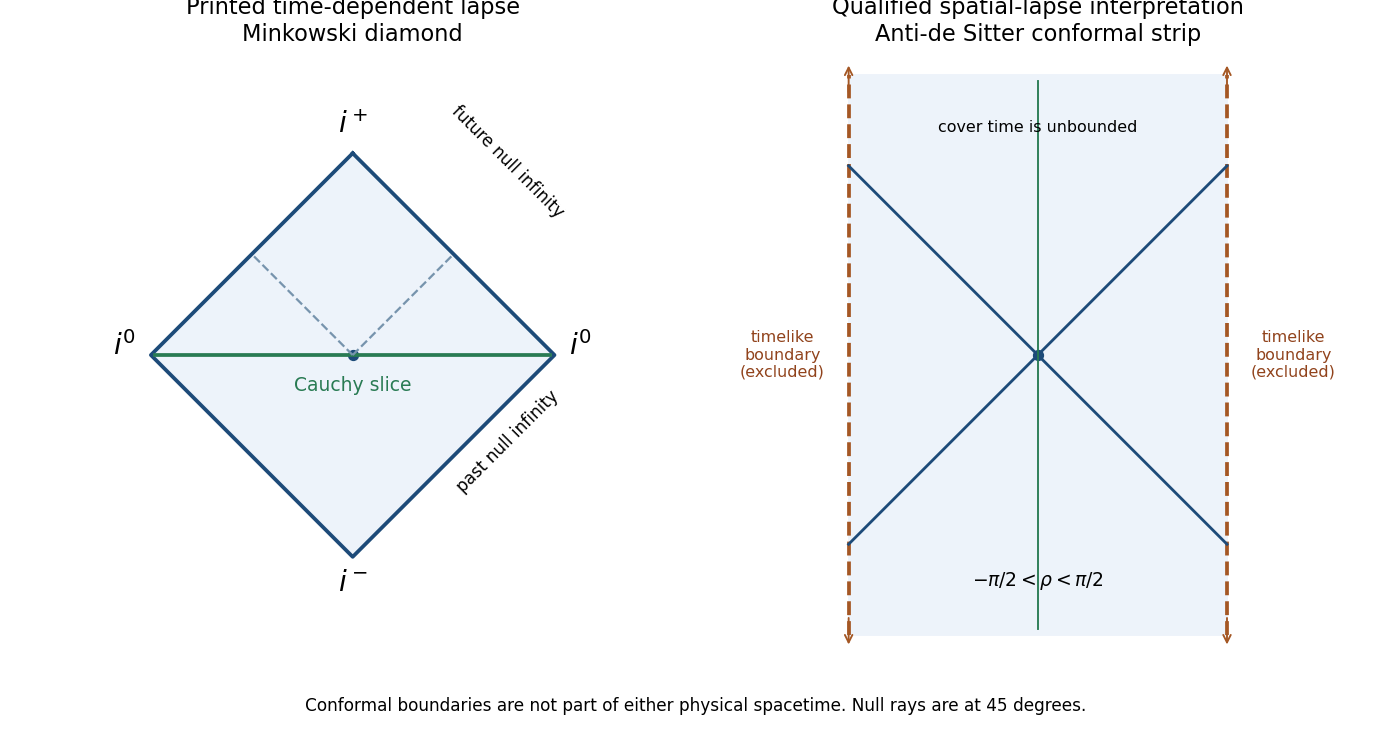
The Minkowski diamond for the printed time-dependent lapse and the AdS conformal strip for the explicitly qualified spatial-lapse interpretation
. Details. 
For the printed spacetime, yes. The surfaces , equivalently , are Cauchy surfaces in Minkowski spacetime. Every inextendible causal curve intersects each once; if its monotone time coordinate had a finite endpoint, the bound would give a finite spatial endpoint too, allowing continuation. Causal diamonds are closed and bounded in and hence compact. Therefore the printed spacetime is globally hyperbolic.
Initial data on a Cauchy slice determine unique causal evolution for the usual well-posed hyperbolic field equations, without boundary data at spatial infinity at finite time. The time reparametrization preserves that property.
For the qualified AdS interpretation, no. On the universal cover, choose two central events with enough time separation for a null ray to approach a strip edge and return. Their causal diamond contains a sequence with but no limit in the physical spacetime, so it is noncompact. A constant- surface fails to meet every inextendible causal curve arriving from timelike conformal infinity. Thus even the cover is not globally hyperbolic. Field evolution needs appropriate boundary conditions, such as a reflecting condition compatible with the field theory, as well as initial data. If AdS time itself is periodically identified, closed timelike curves give an additional and more immediate obstruction. These are consequences of the alternative spatial-lapse geometry, not of the printed flat metric tensor.
Articles by others on the same topic
There are currently no matching articles.