After one iteration , so work on that invariant sign sheet. For ,since and . This is the signed gluing-map reduction. If an arbitrary initial value of is admitted, the formula applies after that first iterate, not before it. The point represents a separatrix at which the original flow return is singular, even though the scalar map can be extended continuously there.
Let a scalar fixed point have magnitude . If , then and have the same sign; the two lifts are the fixed points and . If , their signs are opposite, and the lift is the period-two orbit . The scalar fixed-point multiplier isThe two-return fixed-point multiplier of the period-two lift is , so in either case dynamical stability requires . The negative fixed point represents one of two mirror-related single-lobe periodic orbits in the flow, whereas the positive fixed point represents a double-lobe periodic orbit.
For , the nearby fixed point is and its fixed-point multiplier tends to zero. Thus two stable single-lobe limit cycles for glue into one stable double-lobe limit cycle for . Their periods diverge as the separatrix is approached; is not a finite-period limit cycle.
For , the small branch instead satisfies and its fixed-point multiplier tends to infinity. Hence one unstable double-lobe limit cycle on splits into two unstable single-lobe limit cycles on . Additional finite-size stable branches depend on the surrounding map; near the resonance with they are resolved by the saddle-node bifurcations in part (c).
For a fixed point write . A saddle-node bifurcation requires both and . For these conditions giveThe second derivative is nonzero at either nonzero saddle-node bifurcation, making it an ordinary saddle-node bifurcation. For , defineThe saddle-node bifurcations occur at and , and three scalar fixed points coexist for . The two outer branches have fixed-point multiplier below one and are stable, while the middle branch is unstable. Negative points lift to two symmetry-related limit cycles, so these scalar branch counts need not equal the number of flow limit cycles. The cusp records coexistence of distinct return-map branches; even outside it a negative branch represents a symmetry-related pair of flow cycles.
If , , thenThis exponentially narrow region ends in a gluing-map cusp at . At its boundaries the graph of is tangent to the diagonal at or , as shown below. At exactly , and gives one stable fixed point for nonzero .
For , the formal saddle-node bifurcation radius is , and the corresponding saddle-node bifurcation parameters also diverge. Thus the near-origin gluing-map cusp lies on the side; the formal large saddle-node bifurcations of the power-law formula on the other side are outside the local gluing-map approximation. They must not be drawn as a second small gluing-map cusp near the origin.
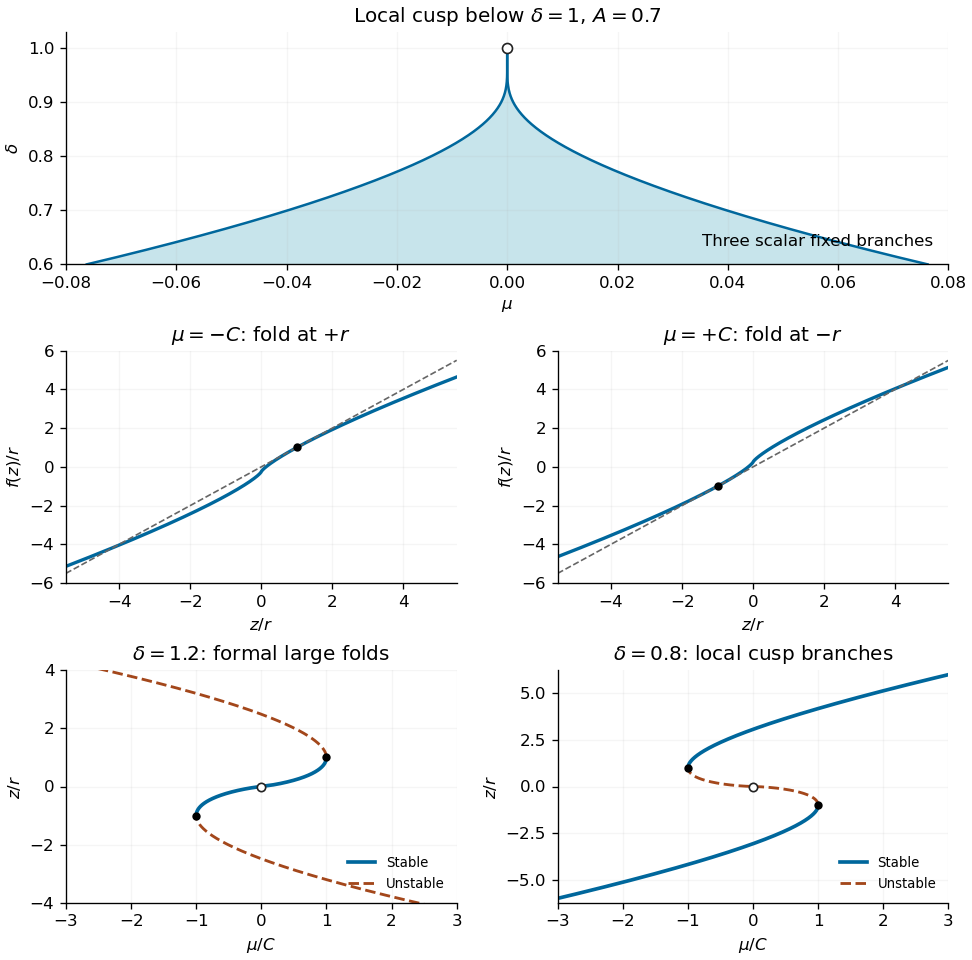
Exponentially narrow gluing-map cusp, tangencies at its two fold boundaries, and stable and unstable fixed-point diagrams on either side of delta one
. Details. 
For , the graph of has a positive maximum at and a negative minimum at . The central branch is stable, while the formal outer branches are unstable. Near the gluing point only the stable central branch is relevant: it crosses from negative to positive , representing the stable two-to-one gluing described in part (b). The formal full power-law diagram has three fixed points between its two large saddle-node bifurcations.
For , the positive branch has its minimum at , while the negative branch has its maximum at . The inner pieces are unstable and outer pieces stable. In the gluing-map cusp interval there is a stable negative branch, a stable positive branch, and an unstable central branch; the unstable branch passes through the singular gluing point with opposite sign to . Outside the gluing-map cusp just one stable outer branch remains. The lower panels of the figure plot these diagrams in fold-scaled variables; dashed lines denote instability and solid lines dynamical stability. Neither diagram has a flip bifurcation, since the scalar derivative is positive wherever defined.
Articles by others on the same topic
There are currently no matching articles.