Realize the defining sl2 Lie algebra Lie algebra representation as , with , , . A basis of the symmetric power is for , with . Hence the exterior square basis , , has weight .
Collecting equal weights gives the complete weight-space decomposition:Every one of the ten exterior basis vectors appears exactly once. Thus , with the displayed bases and dimensions.
The weight diagram has weights with multiplicities . An Irreducible Lie algebra representation of the sl2 Lie algebra with highest weight has weights , all of multiplicity one. The top weight therefore forces one summand. Subtracting its formal character leaves weights , each once, which is . By Weyl complete reducibility theorem,Their dimensions account for the entire module.
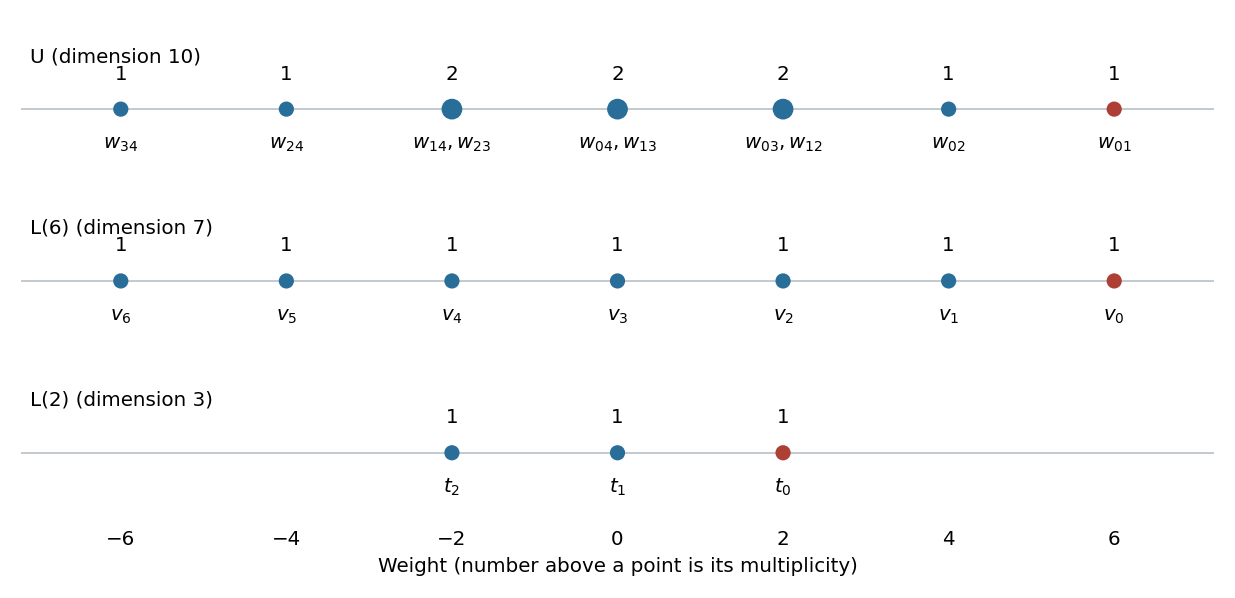
The exterior-square weight diagram and its two irreducible summands; basis labels are defined in part iii
. Details. Use the exterior-power Lie algebra representation:Reorder wedge factors when necessary and interpret repeated factors as zero. The explicit weight basis of the exterior square of Sym4 for sl2 isfor , andfor . Their weights are and , respectively.
Direct application of the displayed operators gives and the lowering chainsThe raising coefficients along the first chain are ; along the second, and . Thus each span is stable and is the required irreducible module. At the common weights , the and vectors are independent; the other weight spaces occur only in the first span. This proves that the ten vectors are a basis of and that the two spans are complementary. The highest-weight vectors are
Let be the basis of the defining representation and its dual. On a diagonal element of the Cartan subalgebra their weights are and , with . Use the tensor product and symmetric square basisIts weight is . For the three repeated weights putIf , the complete weight-space decomposition isThere are six spaces of the first type, three of the second, and three of the third. Their dimensions sum to . The weight diagram below labels every space with all of its basis vectors.
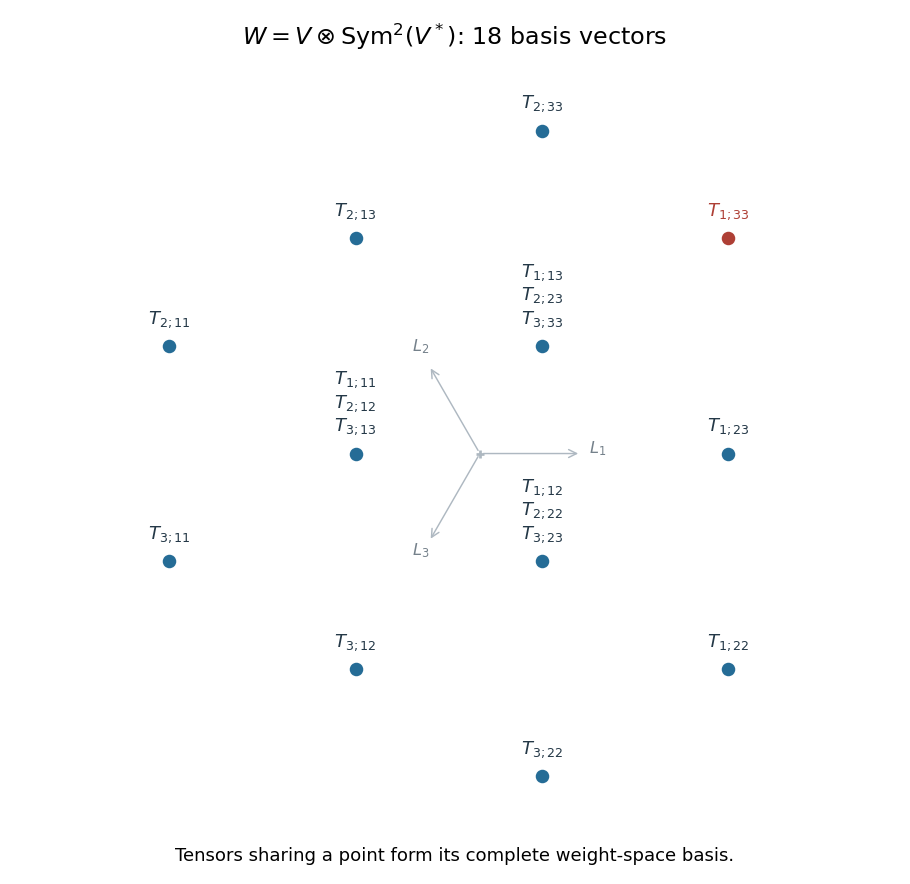


Use the contraction splitting of a defining module tensor a dual symmetric square. For a quadratic polynomial in the dual variables, defineBoth maps are intertwiners. The first is the natural tensor contraction; the second uses the invariant tensor . Directly, , so andThe vector lies in and is killed by both positive simple-root operators . It is a highest-weight vector of weight . By Weyl complete reducibility theorem, it generates the corresponding irreducible summand. The Weyl dimension formula for gives , hence , exhausting the kernel. ThereforeThe kernel has the nine outer weights of multiplicity one and each inner weight of multiplicity two; the dual summand has just the three weights , each once.
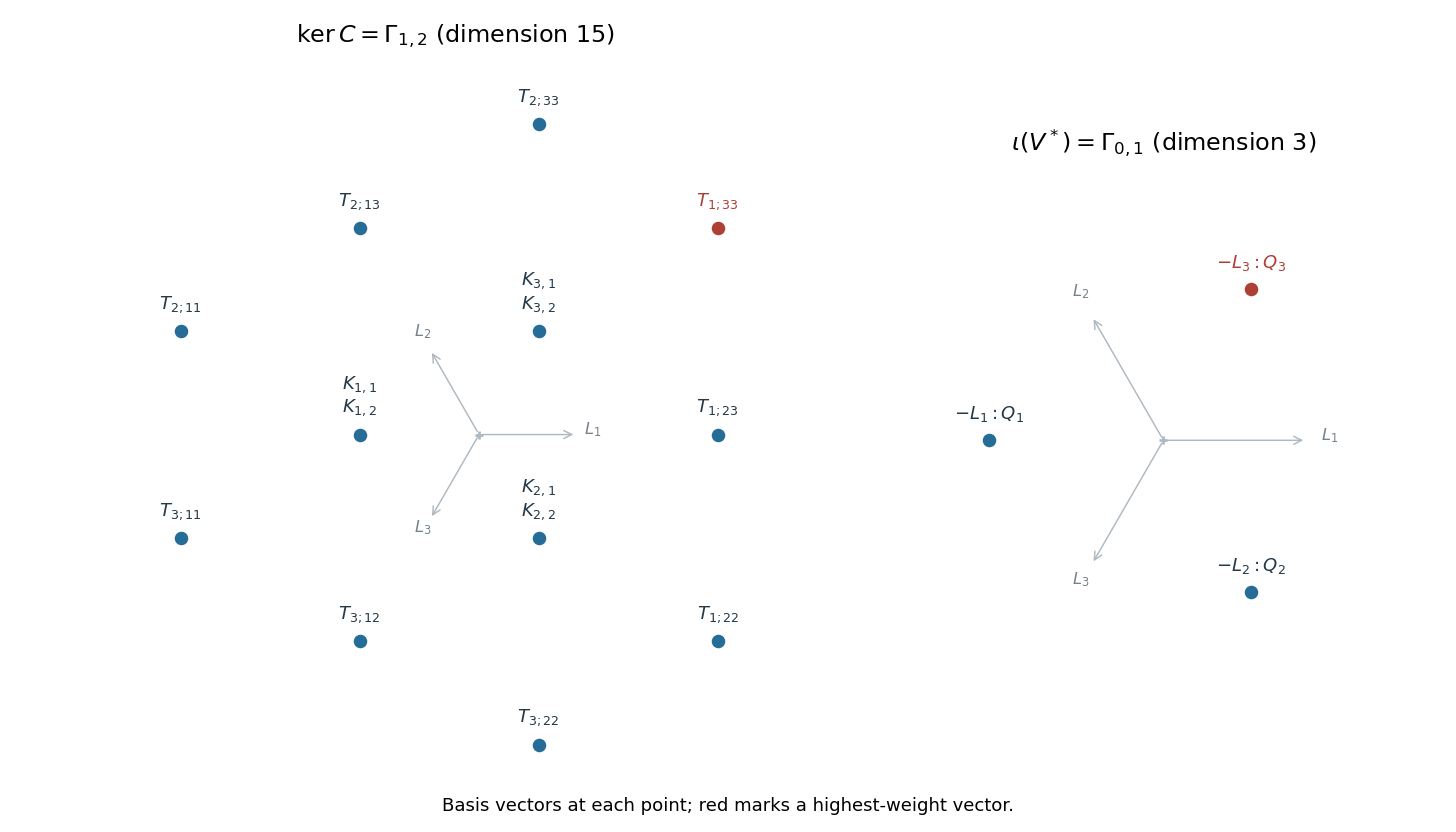
Weight diagrams and basis labels of the fifteen-dimensional kernel and the dual summand
. Details. 
Use the basis labels in the preceding diagrams. For each , write with , and defineThe contraction satisfies and , so both vectors lie in . They are independent and form a basis of its weight space at .
Thus the bases marked on the weight diagram of areand the diagram of uses the basis at . Each is complementary to the two kernel vectors because its contraction is . All vectors shown are therefore genuine bases, not merely weight counts. The highest-weight vectors areThe latter is highest because intertwines the dual Lie algebra representation and is its highest-weight vector.
Articles by others on the same topic
There are currently no matching articles.