Use the course convention that a root system is finite and is a reduced root system satisfying the crystallographic root system condition. These hypotheses are essential for the angle restriction. For roots , the two Cartan integerssatisfy . If are not parallel, the strict Cauchy-Schwarz inequality and integrality give . These values give angles , or , or , and or , respectively. If the roots are parallel, reducedness implies , giving or . ThereforeHere are examples accounting for every angle. In the A1 root system, the pairs and give . Two roots from different summands of give . The six unit vectors at angles form an A2 root system: taking one root at angle zero and another at or gives those two angles. In the B2 root system , pair with or to obtain . In a G2 root system, take short unit roots at angles and long roots of length at angles . A short root at zero paired with long roots at gives the remaining angles.
If the roots are parallel, their Euclidean norms are equal by reducedness. For nonparallel, nonorthogonal roots, the Cartan integers above are nonzero integers of the same sign and have product or . AlsoThe absolute pairs are , , or . HenceMore precisely, angles require equal lengths; angles require a long-to-short ratio ; and angles require a ratio . The exclusion of orthogonality matters: orthogonal irreducible components can be scaled independently.
Choose a fundamental system of a root system . Distinct simple roots have nonpositive inner product. Their Cartan matrix has diagonal entries two and off-diagonal entries , where either , or are positive integers. The root-system finiteness lemma gives . After exchanging the simple roots, the possibilities areTheir angles and relative lengths determine the two simple roots up to an orthogonal transformation and common scaling, except that the two orthogonal components can be scaled separately.
To see that no extra roots remain unspecified, write a positive root with nonnegative integer coefficients. If it is not simple, some simple root has : otherwise . The root reflection in subtracts a positive integer multiple of . The other coordinate stays nonnegative; since is not proportional to , it is positive, so the reflected root must still be positive by the defining sign property of a fundamental system of a root system. Its height decreases. Repeating reduces to a simple root. Thus every root is in a Weyl group orbit of a simple root.
For the four matrices, applying their simple reflections gives, respectively, the following positive roots:where in the last two rows is long, short. For example, and for the displayed matrices when the convention is . The sets comprising these positive roots and their negatives are invariant under both reflections, as direct substitution verifies. The height argument therefore shows they are the whole root system. This proves the classification of rank-two root systems:
A Dynkin diagram has one vertex for each simple root. Vertices are joined by bonds, where are the off-diagonal Cartan integers. No bond means orthogonality; one, two and three bonds mean angles . A multiple-bond arrow points to the shorter root. Thus the Dynkin diagram determines the Cartan matrix, including the relative lengths inside each connected component.
An irreducible root system corresponds to a connected Dynkin diagram. The classification of finite crystallographic Dynkin diagrams givesHere is already represented by , and by . General systems are orthogonal direct sums of these, with separate component scales. The following diagrams specify all the types; dots denote a continued chain, not additional vertices.
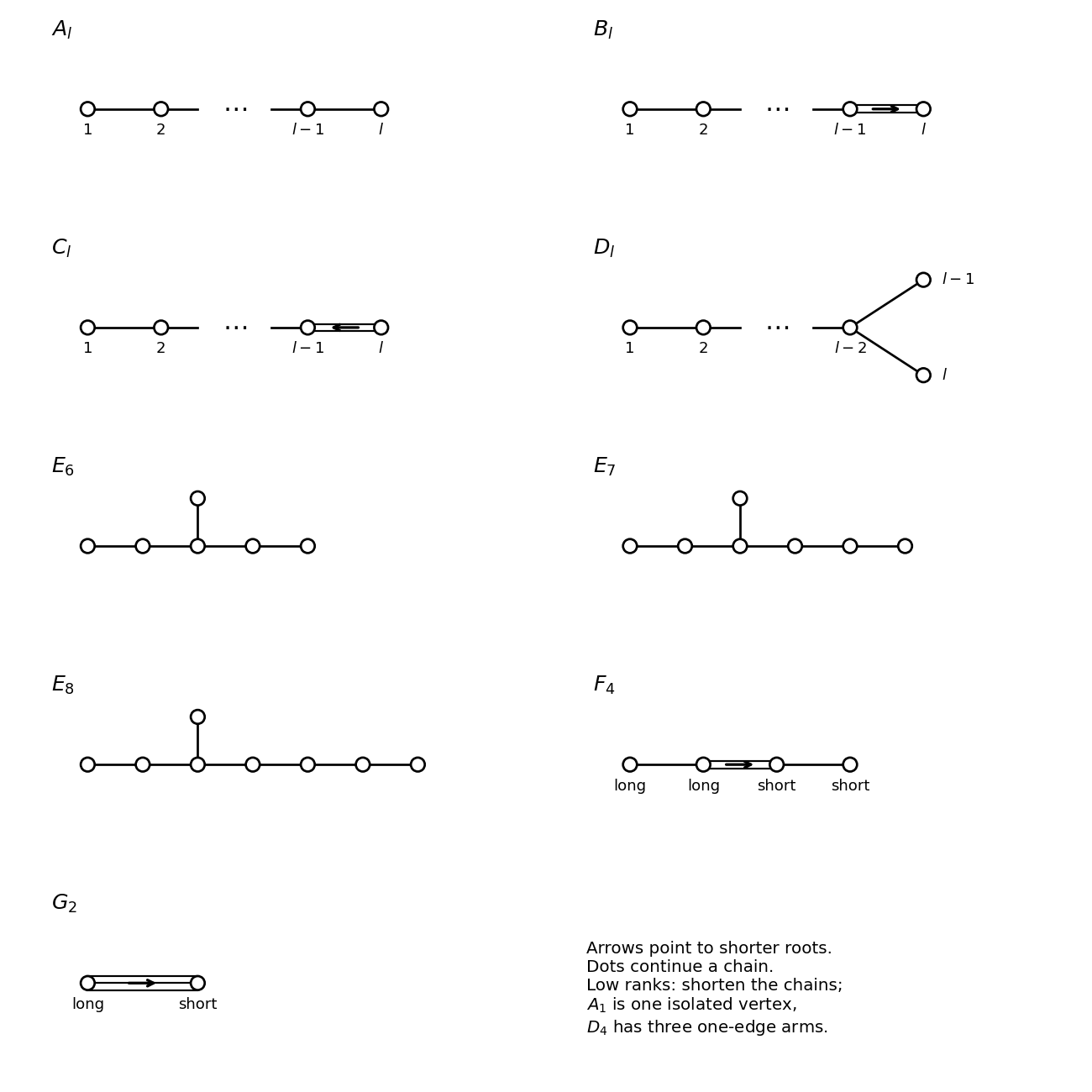
Finite irreducible crystallographic Dynkin diagrams, with every arrow pointing toward the shorter root
. Details. 
For orientation, the An Dynkin diagram is a single chain, the Bn Dynkin diagram has a terminal double bond pointing to its terminal short root, and the Cn Dynkin diagram reverses that arrow. The Dn Dynkin diagram has arm lengths . The En Dynkin diagram has arm lengths ; ; or . The F4 Dynkin diagram has a central double bond and the G2 Dynkin diagram a triple bond.
The positivity behind this finite list is the positive-definite Gram matrix of the simple roots. In particular the underlying graph is a tree: if it contained a cycle, the sum of its normalized roots would have squared norm at most zero, since each bonded inner product is at most . This contradicts linear independence. Restricting the possible bonds and branches by positive definiteness gives precisely the listed chains and trees. Conversely their Cartan matrices are positive definite after symmetrization and their reflection-generated root sets give the indicated finite root systems.
Articles by others on the same topic
There are currently no matching articles.