A phase diagram partitions a space of thermodynamic controls into regions with distinct equilibrium phases. Its boundaries indicate phase coexistence or continuous phase transitions; a critical point is a termination of coexistence where the distinction between phases disappears. A concrete three-dimensional control space is for the Blume–Capel model: a spin can be or , the exchange favors aligned nonzero spins, and controls the energetic cost of nonzero spins. Varying changes the balance between a continuous ordering transition and a first-order phase transition. Their meeting is a tricritical point.
Locally, the same structure is displayed by the Landau free energywith three controls . For , the line consists of ordinary critical points. For , equal free energies of and a nonzero stationary point requireEliminating gives the tricritical three-phase lineHere and both signs of coexist, with a discontinuous order parameter. Below this line, or below when , the plane is an ordered phase coexistence sheet: crossing it reverses the sign of . Two tricritical wings also extend to nonzero , separating weakly and strongly magnetized states of the same sign. Their ordinary critical points satisfy . Since , their tricritical wing critical edges areAt these edges , giving an ordinary quartic critical expansion around . All these structures end at the tricritical point . The diagrams show both the zero-field section and the genuinely three-dimensional coexistence structure.
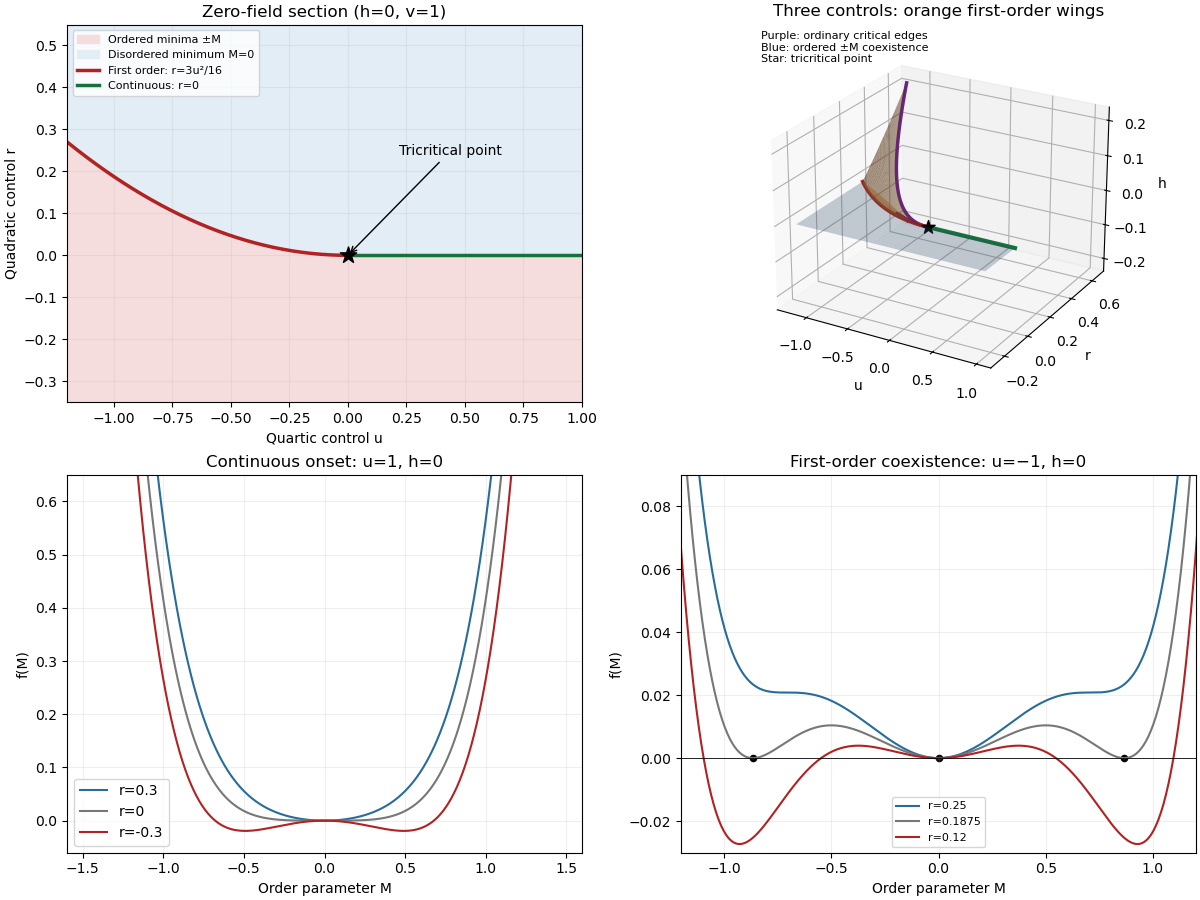

For the final critical exponent calculation, take with , , and hold the other controls fixed. At an ordinary critical point, the quartic term dominates the sextic term. For and ,whereas on the disordered side the singular contribution is zero. Two temperature derivatives give a finite jump in heat capacity, so . At , the equation of state is , so .
Along the tricritical trajectory , the nonzero minimum obeys andThus two temperature derivatives produce . At , . Therefore the mean-field critical exponents areWith the thermodynamic free energy, the physical sign is , rather than the positive sign printed in the paper. This correction affects the sign of the heat capacity, not its critical exponent. The tricritical result assumes that the independent quartic control is tuned to zero; a generic trajectory through nearby ordinary critical points need not have these exponents.
Articles by others on the same topic
There are currently no matching articles.