A constant of motion is a quantity preserved along the evolution, possibly with explicit time dependence. For in a gravitational potential , the preservation condition isFor free motion, is a useful explicitly time-dependent example. Such initial-position labels should not be counted as stationary isolating integrals of a galactic orbit.
In the distinction relevant here, an integral of motion is a single-valued function of instantaneous phase space, with no explicit time dependence, constant along the orbit. In an autonomous Hamiltonian system this is , where the bracket is the Poisson bracket. An integral must be defined consistently on the phase space region under discussion; an arbitrary multivalued formula obtained by solving one trajectory does not supply a global integral. Some conventions call explicitly time-dependent conserved functions integrals too; the stationary interpretation is needed for the following counts.
An isolating integral restricts the accessible phase space to a lower-dimensional regular level set. For functionally independent integrals of motion , the differentials must be independent, and impose independent restrictions. In six-dimensional phase space the common regular level set has dimension . Nonisolating orbit labels or multivalued constants do not further reduce the closure explored by the motion. This is the isolating integrals and orbital closure dimension distinction.
Zero stationary isolating integrals are possible when time dependence removes conservation of energy and no other symmetry or invariant survives. For instance, a generic time-dependent nonsymmetric gravitational potential need not have a stationary integral. This is not possible in an ordinary time-independent galactic gravitational potential: is already an isolating integral on a regular specific orbital energy surface. An explicitly time-dependent constant that encodes an initial condition does not contradict the stationary count.
One isolating integral occurs when specific orbital energy is the only independent stationary invariant. An autonomous chaotic orbit that densely explores a connected five-dimensional specific orbital energy surface is the standard case. Every continuous integral of motion must then be constant on that surface, so it is locally a function of specific orbital energy rather than an additional independent integral. Irregular motion need not mean zero integrals; specific orbital energy still isolates the orbit from other specific orbital energy surfaces.
More than three occur when symmetries or frequency degeneracies reduce the orbit's invariant closure below a generic three-dimensional invariant torus. For a nonradial orbit in a spherical gravitational potential, specific orbital energy and the three components of specific angular momentum are generically four independent isolating integrals. Their values fix the orbital plane, angular momentum magnitude and radial specific orbital energy, but a nonclosed rosette still fills a two-dimensional invariant torus. Thus more than three does not by itself imply closure. Orbital resonances can further reduce the number of independent orbital phases. The count concerns independent integrals, not arbitrarily many functions of the same invariants.
Five independent isolating orbit labels describe a regular closed, nonstationary orbit in three-dimensional space: its phase space closure is one-dimensional. Five is the maximum at a nonzero flow vector, since every conserved differential annihilates that vector in the six-dimensional tangent space. A global superintegrable Hamiltonian system example is the Kepler orbit, where specific orbital energy, angular momentum and the Laplace-Runge-Lenz vector have two vector/scalar relations leaving five independent invariants. A circular or radial orbit requires a separate treatment of any rank-degenerate formula for these invariants. Five integrals do not force an escaping trajectory to be periodic: unbound Kepler orbits also have the conserved apsidal vector. The closure criterion concerns recurrent bound motion.
Closure of one resonant orbit need not imply five smooth independent integrals on an open neighborhood of all nearby orbits. The orbit-wise count and global superintegrability must be distinguished; the distinction matters in part (b).
Set and interpret in the displayed equation as specific angular momentum, , rather than total angular momentum. The gravitational potential is per unit mass and has dimensions of length. Spherical symmetry fixes the orbital plane and conserves the vector angular momentum, while the autonomous specific orbital energy is also conserved.
For the orbit equation for combined inverse-square and inverse-cube attraction, defineA regular nonradial bounded oscillation requires and . Solving the linear Binet equation then givesFor a noncircular bound orbit ; its specific orbital energy is . The effective potential has a centrifugal barrier and a minimum in this case. If , the oscillator frequency is zero or imaginary and there is no regular finite-radius bound oscillation: the attractive centre lacks a centrifugal barrier. Unbound branches with are not closed ellipselike trajectories.
Successive pericentres differ in angle by . The full phase space state returns after radial oscillations and revolutions precisely whenwhere are coprime positive integers; the second formula applies when . Thus requires and , whereas requires . An irrational advances the apsidal direction through a dense set of angles and gives a nonclosed rosette, with only the four regular spherical invariants needed to label its two-dimensional closure.
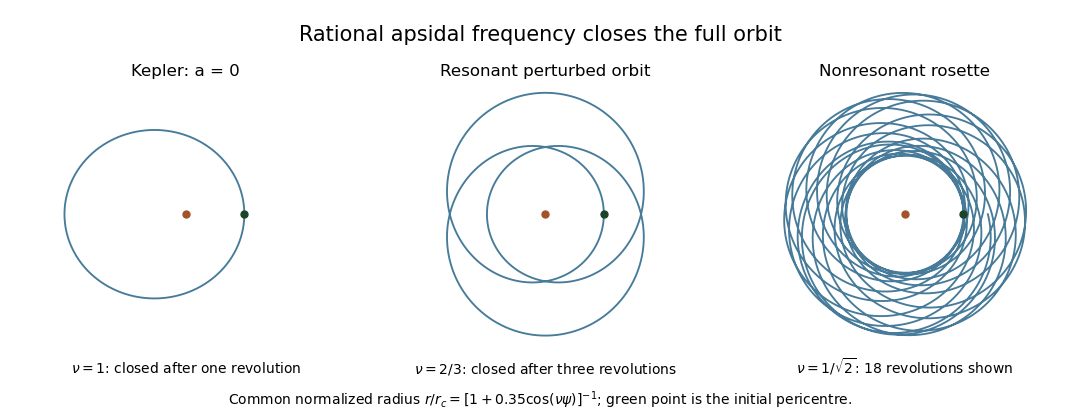
Closed rational-frequency orbits and a nonclosed irrational-frequency rosette in an inverse-cube-perturbed central force
. Details. 
To see the additional resonant label explicitly, let and . Then , so on a family with fixed resonant ,Its argument fixes the remaining apsidal phase modulo the symmetry of the closed curve; its magnitude is already determined by specific orbital energy and . Choosing reference axes in the fixed orbital plane makes this single-valued under . This is the fifth independent orbit label on the resonant family described by closed orbits with an inverse-cube perturbation.
For , varies with . The orbital resonance condition holds only on selected angular momentum surfaces, so this construction is not a fifth global smooth integral on an open set of arbitrary nearby . If the question asks for a maximally superintegrable Hamiltonian system on an open region of noncircular bound orbits, the required case is : then for every , and the conserved Laplace-Runge-Lenz vector fixes the apsidal direction globally. The relations and leave five independent constants. For the usual orbit-wise interpretation, noncircular bound orbits with rational have five isolating labels; irrational has four. Circular orbits are closed for any allowed but have no independent apsidal phase, so the generic noncircular count cannot simply be applied to them.
For completeness, regular unbound branches are different. When and , positive radius restricts the radial phase to . The apsidal invariant on an unbound central-force branch isThe principal argument is continuous on this scattering branch because it never reaches an apocentre across the negative-real-axis cut. Thus the periapsis direction can be a fifth single-valued scattering label for any positive , including irrational ; the rationality condition applies to the noncircular bound case. For plunging or collision branches with , local trajectory labels can still be defined away from the singular centre, but the preceding periodic-orbit criterion is inapplicable and no smooth continuation through is asserted.
Articles by others on the same topic
There are currently no matching articles.